Introduction
The Volcano Swiftlet, Aerodramus vulcanorum, is a small swiftlet endemic to the Indonesian island of Java. It is associated mainly with high volcanic peaks, crater rims and surrounding montane habitats. Its restricted range, specialised habitat and fast, high-altitude flight make it one of Java’s more distinctive mountain birds.
Physical Description
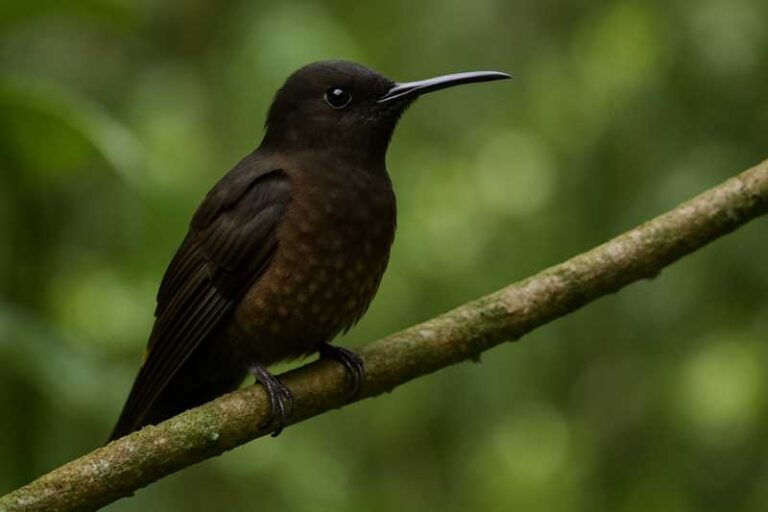
The Volcano Swiftlet is approximately 13–14 centimetres long. It has a slender body, narrow swept-back wings and a forked tail. The upperparts are dark brown to sooty grey, while the underparts are slightly paler. A pale greyish or buff rump band is an important field mark, although it may be less clearly defined in younger birds.
There is no well-established evidence of obvious sexual dimorphism in the field. As with other swiftlets, the feet are small and adapted mainly for clinging to vertical surfaces rather than perching on branches.
The species is often identified by its combination of dark plumage, pale rump, noticeably forked tail and occurrence at high elevations around volcanic summits. Its high-pitched calls and clicking notes can also help draw attention to birds that are difficult to follow in flight.
Range and Habitat
The Volcano Swiftlet is endemic to Java, Indonesia. It is known from a small number of mountainous localities, including Mount Gede, Mount Pangrango, Mount Tangkuban Perahu, Mount Ciremai, Mount Slamet and the Yang Highlands. Some additional reports remain unconfirmed.
It is most closely associated with high volcanic terrain, particularly crater rims, rocky slopes and crevices at approximately 2,200–3,000 metres. Birds also forage over mountain ridges, open areas near summits and adjoining hilly primary or montane forest. The species is not known to be migratory, although local movements may occur in response to weather and food availability.
The original description of a distribution extending across Java and Bali is not supported by current taxonomic and distributional sources. The accepted species is regarded as a Javan endemic.
Where to See This Species
Gunung Gede-Pangrango National Park, West Java, Indonesia
The summit and crater-rim areas of Mount Gede are among the most reliable documented places to look for the Volcano Swiftlet. Birds have been recorded around the crater and higher trails, where open volcanic terrain, rocky surfaces and adjacent montane forest provide suitable conditions. Clearer weather and early morning may offer better viewing before cloud develops, although summit access can be restricted by park regulations or volcanic conditions.
Nearby accommodation: Cibodas and Cipanas are practical gateway areas with lodges, guest houses and other small accommodation options.
Taman Nasional Gunung Merapi, Central Java, Indonesia
The Volcano Swiftlet is listed among the notable fauna of Mount Merapi National Park. The upper volcanic slopes and surrounding montane habitats are the most relevant areas to search, subject to access restrictions, weather and volcanic-safety closures.
Nearby accommodation: Kaliurang is the main practical accommodation area, with guest houses, hotels and homestays.
Mount Tangkuban Perahu, West Java, Indonesia
Volcano Swiftlets have been documented around Mount Tangkuban Perahu, where accessible high-elevation volcanic terrain and remaining forest patches provide suitable viewing habitat. Birds are most likely to be encountered around the upper slopes and summit area rather than in the lower cultivated landscape. Local access and visitor regulations may change with volcanic activity.
Nearby accommodation: Lembang is the principal nearby base, offering hotels, guest houses, villas and homestays.
Behaviour and Diet
Volcano Swiftlets spend much of the day in the air, often foraging in small groups around volcanic peaks, ridges and forest edges. They feed on flying insects captured during aerial pursuit. Their narrow wings and streamlined bodies allow rapid, manoeuvrable flight in difficult mountain conditions.
Like other Aerodramus swiftlets, the species produces calls that include high-pitched notes and clicking sounds. Echolocation is known in several swiftlet species and may assist movement in dark roosting or nesting sites, but detailed species-specific information for the Volcano Swiftlet remains limited.
The breeding season, clutch size, incubation period and fledging period are not sufficiently documented to support the precise figures given in the original article. Available information indicates that the species nests in rocky crevices associated with volcanic crater rims. Its nesting biology should therefore be treated as poorly known rather than assumed to follow a fully documented pattern.
Identification Tips
- Look for a small, dark swiftlet flying rapidly around high volcanic summits and crater rims.
- Note the pale rump band, which contrasts with the otherwise dark brown or sooty plumage.
- The tail is distinctly forked, although its shape can be difficult to judge during fast flight.
- The underparts are only slightly paler than the upperparts, helping to distinguish the species from some paler swiftlets.
- High elevation is a valuable clue. Other dark swiftlets are less likely to occur around Java’s highest volcanic peaks.
- Listen for high-pitched calls and clicking notes when birds are difficult to see through cloud or mist.
Conservation Status
The Volcano Swiftlet is currently assessed as Least Concern on the IUCN Red List. Older sources may still give the species as Near Threatened because its assessment has changed in recent Red List updates.
The species nevertheless has a restricted distribution and depends on specialised high-elevation volcanic habitats. Potential pressures include disturbance or degradation of montane habitat, human activity around nesting areas and natural losses associated with volcanic eruptions. The overall population trend is not sufficiently documented for a reliable estimate.
Protection of Java’s mountain forests and volcanic summit habitats is important. Maintaining protected areas, controlling disturbance around crater rims and improving surveys of breeding sites would help clarify the species’ distribution, population trend and conservation needs.
Frequently Asked Questions
Where does the Volcano Swiftlet live?
The species is endemic to Java, Indonesia. It occurs mainly on high volcanic mountains, especially around crater rims, rocky slopes and nearby montane forest.
Is the Volcano Swiftlet found in Bali?
Current recognised distribution sources treat the Volcano Swiftlet as a Javan endemic. The original claim that it occurs in Bali is not supported by the sources used for this revision.
How large is a Volcano Swiftlet?
It is approximately 13–14 centimetres long. Its wings are narrow and swept back, and its tail is forked.
What does the Volcano Swiftlet eat?
It feeds mainly on flying insects caught in the air while foraging around mountain peaks, ridges and forest edges.
Can Volcano Swiftlets echolocate?
Clicking sounds and echolocation are associated with several Aerodramus swiftlets, but the extent and precise function of echolocation in the Volcano Swiftlet are not well documented.
Where is the best place to look for this species?
Gunung Gede-Pangrango National Park is one of the best-documented places to search, particularly around the higher trails and crater rim of Mount Gede. Mount Merapi National Park and Mount Tangkuban Perahu are also documented localities.
References
- IUCN Red List of Threatened Species
- IOC World Bird List
- Cornell Lab of Ornithology, eBird
Related posts