Introduction
The Rusty Tinamou (Crypturellus brevirostris), also known as the Short-billed Tinamou, is a shy, ground-dwelling bird of northern South America. It belongs to the tinamou family, Tinamidae, and is usually detected by its distinctive whistle rather than seen. Its cryptic plumage and preference for dense forest make it one of the less conspicuous birds of the Amazonian forest floor.
Physical Description
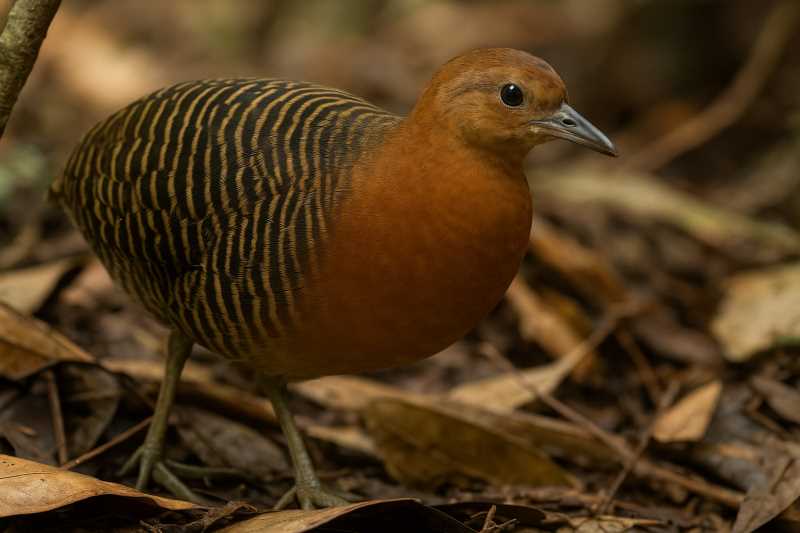
The Rusty Tinamou is a compact tinamou measuring approximately 25–28 centimetres in length. Its upperparts are brown to rufous, with dark barring or scalloped markings across the back and wings. The throat is pale or white, the breast is strongly rufous, and the belly is paler, often white. The flanks show fine dark barring, while the crown is chestnut or rusty brown. The bill is dark above and paler below, and the legs are generally greyish-yellow to olive-grey.
The sexes are not known to show consistently obvious differences in the field, although tinamous can show variation in plumage between males and females. Juveniles are less well documented and may appear duller or less crisply marked than adults.
Range and Habitat
The Rusty Tinamou has a discontinuous distribution across northern Amazonia and the Guiana Shield. It occurs in parts of Brazil, French Guiana, Guyana, Suriname, Venezuela, Colombia and eastern Peru. Recent acoustic records have helped extend the documented range in the Colombian Amazon.
It is associated with humid lowland forest, including terra firme forest, seasonally flooded forest and other dense forest habitats. Some records also come from white-sand or other nutrient-poor Amazonian soils. The species has generally been reported from low elevations, usually below about 500 metres, although its habitat preferences are not yet fully understood.
The Rusty Tinamou is considered resident rather than migratory. Its distribution depends on the continued availability of suitable forest and dense ground cover.
Behaviour and Diet
Rusty Tinamous are terrestrial, secretive and usually encountered alone or in pairs. They spend much of their time moving quietly through leaf litter and undergrowth, where their brown and rufous plumage provides effective camouflage. They can fly, but their normal lifestyle is on the forest floor.
The species is often heard before it is seen. Its vocalisation consists of repeated, clear or slightly tremulous whistles. Acoustic surveys have shown that calling may occur at different times of day, including around dawn and dusk, and that passive sound recording can be an effective way to detect the species.
Its diet is based mainly on fallen fruit and fruit collected from low vegetation. It also takes seeds, tender plant material, flower buds and small invertebrates. By eating fruit and moving through the forest, it may contribute to local seed dispersal, although the extent of this ecological role has not been quantified.
Detailed information about breeding remains limited. As in many tinamous, the male is understood to incubate the eggs and care for the chicks after hatching. Available accounts describe a simple ground nest or shallow depression in dense vegetation or among exposed tree roots. The young leave the nest soon after hatching and follow the male. Precise information on incubation length, clutch size and breeding success is still incomplete for this species.
Identification Tips
- Look for a medium-sized, short-tailed forest bird with a rusty-brown head and breast, a pale throat and a paler belly.
- The back and wings are brown or rufous with dark barring or scalloped markings, while the flanks are finely barred.
- The bird is more likely to be heard than seen. Listen for a series of repeated whistles from dense lowland forest.
- Distinguish it from the Variegated Tinamou (Crypturellus variegatus) by its generally smaller size and less heavily marked appearance on the flanks.
- Take care when identifying the species by voice, because several Crypturellus tinamous have similar-sounding calls. A recording, photograph or repeated observation is preferable to a single uncertain call.
Conservation Status
The Rusty Tinamou is currently assessed as Least Concern on the IUCN Red List. This assessment reflects its broad distribution and the absence of evidence that it is approaching the thresholds for a threatened category. However, the species is poorly studied, and there is no reliable global population estimate.
Deforestation, forest degradation, agricultural expansion, logging, infrastructure development and hunting may affect local populations. The species has also been described as uncommon or poorly known in parts of its range. Maintaining large areas of connected forest, protecting seasonally flooded and white-sand habitats, and monitoring populations through field surveys and acoustic recording are important conservation measures.
Frequently Asked Questions
Where does the Rusty Tinamou live?
The Rusty Tinamou lives in humid lowland forests across northern Amazonia and the Guiana Shield. Its range includes parts of Brazil, French Guiana, Guyana, Suriname, Venezuela, Colombia and eastern Peru.
Is the Rusty Tinamou migratory?
No. It is generally regarded as a resident species rather than a long-distance migrant, although individuals may make local movements within suitable forest habitat.
What does the Rusty Tinamou eat?
It feeds mainly on fallen fruit and fruit from low vegetation. Its diet also includes seeds, tender leaves, flower buds and small invertebrates.
Why is the Rusty Tinamou difficult to see?
It is a quiet, ground-dwelling bird that uses dense undergrowth and leaf litter for cover. Its brown and rufous plumage blends with the forest floor, and observers usually hear its whistle before locating the bird.
Does the male Rusty Tinamou incubate the eggs?
Available accounts indicate that the male incubates the eggs and cares for the chicks after hatching, as occurs in many tinamous. Species-specific breeding information remains limited.
Is the Rusty Tinamou endangered?
The Rusty Tinamou is currently classified as Least Concern. Nevertheless, habitat loss and hunting can threaten local populations, and much more information is needed about its population size and long-term trend.
References
- BirdLife International. 2024. Rusty Tinamou (Crypturellus brevirostris) species factsheet. BirdLife DataZone. https://datazone.birdlife.org/species/factsheet/rusty-tinamou-crypturellus-brevirostris. Accessed 8 September 2026.
- BirdLife International. 2024. HBW/BirdLife Taxonomic Checklist, version 9.0. BirdLife International. https://datazone.birdlife.org/about-our-science/taxonomy. Accessed 8 September 2026.
- Acevedo-Charry, O. and Gardner, N. 2024. Four more records of Rusty Tinamou Crypturellus brevirostris in Colombia and a revision of its known range. Cotinga 46: 29–33. https://www.neotropicalbirdclub.org/cotinga/C46_online/Release1/Cotinga%2046OL_Acevedo-Charry%20%26%20Gardner%202024.pdf.
- Boesman, P., Claessens, O., Costa, T. V. V., Pelletier, V., Ingels, J. and Renaudier, A. 2018. Songs of Rusty Tinamou Crypturellus brevirostris and duetting in Crypturellus species. Bulletin of the British Ornithologists’ Club 138(2): 69–78. https://doi.org/10.25226/bboc.v138i2.2018.a2.
- Cabot, J., Christie, D. A., Jutglar, F., Sharpe, C. J. and Boesman, P. F. D. 2020. Rusty Tinamou (Crypturellus brevirostris), version 1.0. In J. del Hoyo, A. Elliott, J. Sargatal, D. A. Christie and E. de Juana, eds, Birds of the World. Cornell Lab of Ornithology. https://doi.org/10.2173/bow.rustin1.01. Accessed 8 September 2026.
- International Union for Conservation of Nature. 2024. Crypturellus brevirostris, The IUCN Red List of Threatened Species. IUCN Red List. https://www.iucnredlist.org. Accessed 8 September 2026.
- Gill, F., Donsker, D. and Rasmussen, P., eds. 2026. IOC World Bird List, version 15.2. International Ornithologists’ Union. https://www.worldbirdnames.org/. Accessed 8 September 2026.
- Rufray, V., Pelletier, V. and Ingels, J. 2014. First photographs and new records of the Rusty Tinamou Crypturellus brevirostris from French Guiana. Neotropical Birding 15: 15–19.
Related posts