Introduction
The Golden-tailed Starfrontlet (Coeligena eos) is a small hummingbird endemic to the Venezuelan Andes. It is also known in some taxonomic treatments as the Mérida Starfrontlet or Golden Starfrontlet. The species was formerly treated as a subspecies of the Golden-bellied Starfrontlet, but major modern checklists recognise it as a separate species, although some taxonomic authorities continue to treat the group differently.
Physical Description
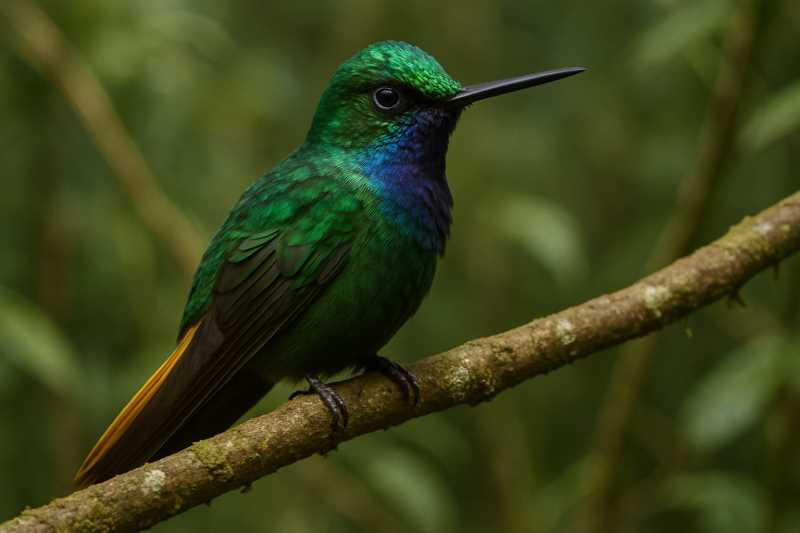
The Golden-tailed Starfrontlet is a compact, brightly coloured hummingbird with a slightly forked tail. The male has a brilliant green forehead and throat, a darker crown, a small pale mark behind the eye, and shining golden-green upperparts that become golden or coppery towards the rump. The underparts are mainly rich cinnamon, coppery or fiery golden, while the wings are dark with conspicuous rufous markings on the secondary feathers. The tail is rufous to cinnamon, with golden-bronze tones towards the tips.
Females are duller overall. They have a greener upper body, a paler throat and breast mottled with green, and more extensive cinnamon or buff underparts. Their plumage provides better camouflage in dense montane vegetation.
The species is most likely to be confused with the Golden-bellied Starfrontlet (Coeligena bonapartei), but the Golden-tailed Starfrontlet is associated with the western Venezuelan Andes and has distinctive rufous wings and tail, together with strongly golden or coppery lower plumage.
Range and Habitat
The Golden-tailed Starfrontlet is endemic to western Venezuela. Its range extends through the Venezuelan Andes from southern Lara and Trujillo southwards through Mérida and Barinas to Táchira, although its distribution is local and uneven.
It inhabits humid montane forest, forest edges, dwarf forest and open highland vegetation with scattered shrubs. Records generally come from elevations of approximately 1,400 to 3,200 metres. The species is not regarded as a long-distance migrant, but it may move to different elevations or parts of its range in response to seasonal rainfall and flowering conditions.
Where to See This Species
Sierra Nevada National Park, Mérida State, Venezuela
The species is documented in the park’s bird checklist, and suitable habitat includes humid montane forest, forest edges and higher-elevation vegetation. The La Mucuy sector near Tabay is a practical starting point for birdwatchers exploring the lower forested slopes and trails, although sightings are not guaranteed.
Nearby accommodation: Tabay and Mérida provide hotels, guest houses, mountain posadas and self-catering accommodation. Basic lodging and camping options may also be available near park access areas, subject to current local regulations.
Dinira National Park, Trujillo, Lara and Portuguesa States, Venezuela
An avifaunal survey of Dinira National Park recorded Coeligena eos in montane evergreen forest, including the Las Antenas area at approximately 2,550 metres. The park’s forested highlands and relatively low-disturbance habitats make it a credible location for searching for the species.
Nearby accommodation: Visitors generally use guest houses, small hotels or rural accommodation in nearby settlements such as Carache, Boconó or Trujillo, depending on the route and access point.
Sierra La Culata National Park, Mérida State, Venezuela
The Golden-tailed Starfrontlet is included in regional biodiversity records for Sierra La Culata. Montane forest, elfin woodland and páramo-edge habitats within the park provide appropriate conditions, particularly where flowering shrubs occur between the forest and open highlands.
Nearby accommodation: Mérida, Tabay and Mucuchíes offer hotels, guest houses, mountain lodges, cabins and other rural accommodation suitable for exploring different sections of the park.
Behaviour and Diet
Like other hummingbirds, the Golden-tailed Starfrontlet feeds mainly on nectar obtained from tubular flowers. It has been recorded visiting plants in the heath family, as well as flowers of Centropogon and Fuchsia. Its long bill allows it to exploit flowers that are less accessible to shorter-billed hummingbirds.
It supplements nectar with small insects and other arthropods, which provide protein and other nutrients. Individuals may glean prey from foliage, hover while taking small flying insects, or forage among mixed insectivorous bird flocks.
The species is active throughout the day and may follow regular routes between flowering plants. Males can defend productive feeding areas from other hummingbirds by making short chases and aerial displays. Detailed information about courtship and nesting remains limited. Available observations indicate that the breeding period may occur from January to March, and that the nest is a small cup made from moss, lichens and rootlets, attached within dense vegetation.
Identification Tips
- Look for a medium-sized Andean hummingbird with a green head and throat, golden-green back, and strongly rufous or coppery lowerparts.
- The rufous wing feathers and warm-coloured, slightly forked tail are useful field marks.
- Males show brighter and more sharply contrasting plumage than females.
- Search humid montane forest edges, flowering shrubs, dwarf forest and páramo margins between about 1,400 and 3,200 metres.
- Separate it from the Golden-bellied Starfrontlet by its predominantly Venezuelan distribution, more obvious rufous wing and tail markings, and the strong coppery or golden tones of the underparts.
Conservation Status
The Golden-tailed Starfrontlet is currently assessed as Least Concern on the IUCN Red List. Its population size has not been reliably quantified, and the population trend is not well established.
The species has a relatively restricted Andean distribution, so continued loss and degradation of montane forest remain potential concerns. Agricultural expansion, settlement, road construction and other development pressures can reduce or fragment suitable habitat. Protection of Andean forests and páramo-edge vegetation, together with responsible land management and further field surveys, are important for maintaining the species and improving knowledge of its population.
Frequently Asked Questions
Where is the Golden-tailed Starfrontlet found?
It is endemic to the Andes of western Venezuela, where it occurs from southern Lara and Trujillo through Mérida and Barinas to Táchira.
What habitat does the Golden-tailed Starfrontlet use?
It uses humid montane forest, forest edges, dwarf forest and open highland vegetation, generally between about 1,400 and 3,200 metres.
What does the Golden-tailed Starfrontlet eat?
Its diet consists mainly of nectar from tubular flowers, supplemented by small insects and other arthropods.
Is the Golden-tailed Starfrontlet a separate species?
The IOC World Bird List and several other modern taxonomic authorities recognise Coeligena eos as a separate species. Some authorities have historically treated it as the subspecies Coeligena bonapartei eos, so taxonomic treatment should be checked against the checklist being followed.
What is the conservation status of the Golden-tailed Starfrontlet?
The species is currently listed as Least Concern by the IUCN. Its population size and trend are not well known, and protection of montane forest remains important.
Where can birdwatchers look for this species?
Documented protected areas include Sierra Nevada National Park, Dinira National Park and Sierra La Culata National Park in Venezuela. Sightings are local and conditions can vary with season, flowering and access.
References
- IOC World Bird List
- IUCN Red List of Threatened Species
- Avibase
Related posts