Introduction
The Northern Screamer (Chauna chavaria), also known as the Black-necked Screamer, is a large wetland bird in the small South American family Anhimidae. It occurs mainly in northern Colombia and north-western Venezuela, where it inhabits marshes, lagoons, seasonally flooded plains and slow-moving river margins. Like other screamers, it is related to the waterfowl but has a distinctive appearance, unusual wing spurs and exceptionally loud calls.
Physical Description
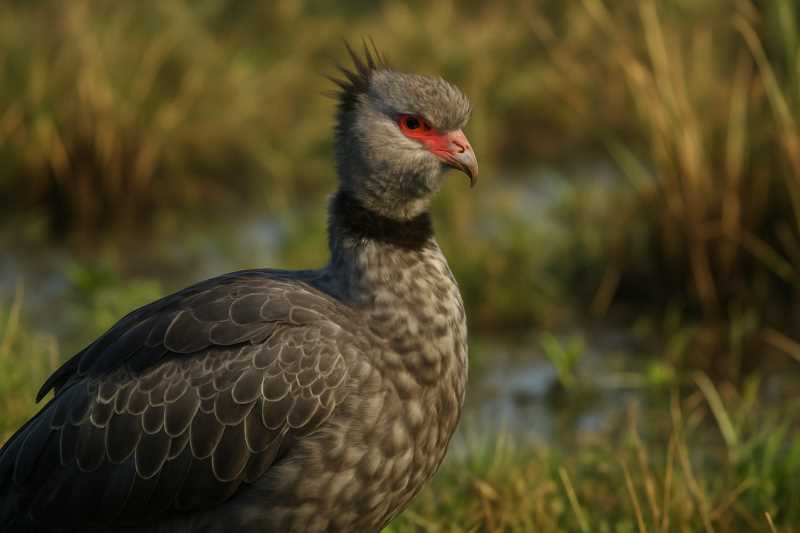
The Northern Screamer is a heavy-bodied bird measuring approximately 84–94 cm in length. The sexes are similar in plumage. Adults have a dark grey to blackish-grey body, wings and tail, contrasting with a pale or white face, cheeks and throat. A broad black band surrounds the lower neck, while the crown carries a somewhat untidy crest of elongated feathers.
The facial skin around the eye is reddish, the bill is dark grey to blackish, and the long legs and feet are generally greenish-grey. Two sharp bony spurs occur on the wing at the carpal joint. These spurs are associated with defence and aggressive encounters, although the species is not normally dangerous to people.
Screamers also have extensive air sacs beneath the skin, a characteristic of the family that contributes to their unusual anatomy and produces a crackling sensation when the skin is touched. Reliable species-specific measurements for wingspan and body mass are not consistently available, so they are not given here.
Range and Habitat
The Northern Screamer is restricted to northern South America. Its range extends across northern Colombia, including wetland systems associated with the Atrato, Sinú and Magdalena regions, and eastwards into north-western Venezuela, particularly the Lake Maracaibo area. It is considered essentially sedentary, although local movements by juveniles and non-breeding birds may occur.
The species is found mainly in lowland tropical wetlands, generally below about 200 m elevation. Preferred habitats include vegetation-choked lagoons, freshwater marshes, swamps, grassy ponds, seasonally flooded plains and the banks of slow-flowing rivers. It may also use wetlands surrounded by forest, open country or red mangrove, provided that dense aquatic or emergent vegetation is available.
The Northern Screamer is monotypic, meaning that no currently recognised subspecies are generally accepted.
Behaviour and Diet
Northern Screamers are usually seen singly or in pairs, although loose groups may form outside the breeding period. They are relatively sedate and may remain inconspicuous among tall marsh vegetation. When disturbed, they can fly strongly to nearby trees or other elevated perches, where they may call.
Their calls are loud and far-carrying. Pairs may duet, with one bird answering the other in a rising, high-pitched, somewhat yelping or trumpet-like exchange. Vocalisations probably help maintain contact between partners and advertise occupancy of an area, but detailed studies of territorial behaviour remain limited.
The species is herbivorous. Its diet consists mainly of aquatic and wetland plants, including leaves, stems, roots and other soft vegetation. Birds forage from shallow water, wet ground and the margins of marshes, using their bills to gather plant material.
Breeding information is comparatively limited. Northern Screamers construct nests from plant material in or close to wetland vegetation, and both members of a pair may participate in parental care. Recent field observations from the Ciénaga Grande de Santa Marta wetland complex in Colombia have documented nesting and parental-care behaviour in areas outside formal protected areas.
Identification Tips
Look for a large, goose-like bird with a heavy body, long legs, a small head and a long neck. The most useful field marks are:
- Dark grey to blackish-grey body and wings.
- Pale face, cheeks and throat.
- Broad black band around the neck.
- Red facial skin around the eye.
- Untidy crest on the crown.
- Long greenish-grey legs and a dark bill.
- Very loud, rising calls, often given by a pair.
The most relevant comparison is the Horned Screamer (Anhima cornuta), which may occur in similar wetland habitats. The Northern Screamer lacks the Horned Screamer’s prominent forward-projecting horn and is recognised by its black neck band, pale face and generally dark, fairly uniform body. Its red facial skin and relatively untidy crest are also useful identification features.
Conservation Status
The Northern Screamer is currently assessed as Near Threatened. It has a relatively restricted distribution and is uncommon and local in parts of its range. The principal concern is the continuing loss and degradation of wetlands through agricultural expansion, drainage, altered water management, pollution, urban development and other forms of disturbance. Hunting and disturbance at nesting sites may also affect local populations in some areas.
Important conservation measures include protecting wetland complexes, maintaining natural flooding regimes, preventing further drainage and pollution, and managing surrounding land uses in ways that retain aquatic vegetation and riverine habitat. Surveys and long-term monitoring are also needed because the species is localised and its population size and trend are not well quantified.
Frequently Asked Questions
Where does the Northern Screamer live?
It occurs in northern Colombia and north-western Venezuela. It lives mainly in lowland marshes, swamps, lagoons, seasonally flooded plains and vegetated river margins.
What does the Northern Screamer eat?
The species is herbivorous and feeds mainly on aquatic and wetland plants, including leaves, stems, roots and other soft vegetation.
Why is it called a screamer?
It is named for its loud, far-carrying calls. Pairs may call in duet, with one bird answering the other across the wetland.
Can the Northern Screamer fly?
Yes. Although it is heavy-bodied and often walks or stands in marshes, it is capable of strong flight and may fly to trees or other elevated perches when disturbed.
Is the Northern Screamer related to ducks?
Yes. Screamers belong to the order Anseriformes, the group that includes ducks, geese and swans. They form a separate family, Anhimidae, and differ from typical waterfowl in several anatomical features.
Why is the Northern Screamer threatened?
Its wetland habitats are being lost or degraded through drainage, agricultural expansion, pollution, altered water regimes and urban development. Its restricted and localised distribution increases its vulnerability to these changes.
References
- BirdLife International. 2026. Northern Screamer Chauna chavaria species factsheet. BirdLife DataZone. Accessed 8 September 2026. https://datazone.birdlife.org/species/factsheet/northern-screamer-chauna-chavaria
- Carboneras, C., Boesman, P. F. D., Kirwan, G. M. & Sharpe, C. J. 2020. Northern Screamer (Chauna chavaria), version 1.0. In Birds of the World, edited by J. del Hoyo, A. Elliott, J. Sargatal, D. A. Christie & J. de Juana. Cornell Lab of Ornithology, Ithaca, New York. https://doi.org/10.2173/bow.norscr1.01
- IOC World Bird List. 2026. IOC World Bird List, version 15.2. International Ornithologists’ Union. Accessed 8 September 2026. https://www.worldbirdnames.org/
- Mendoza-Roldán, J. S. 2026. Aspectos de la anidación de la Chavarría (Chauna chavaria), Anhimidae, en áreas no protegidas del Complejo Lagunar Ciénaga Grande de Santa Marta, Magdalena, Colombia. Ornitología Colombiana 28: 36–44. https://doi.org/10.59517/oc.e627
- Restall, R., Rodner, C. & Lentino, M. 2007. Birds of Northern South America: An Identification Guide, Volume 1: Species Accounts. Yale University Press, New Haven. https://yalebooks.yale.edu/book/9780300108620/birds-of-northern-south-america/
- Stott, K. 1986. Aspects of the biology of the screamers (Anhimidae). The Wilson Bulletin 98(2): 243–256. https://sora.unm.edu/sites/default/files/journals/wilson/v098n02/p0243-p0256.pdf
- Zuluaga-Bonilla, J. E. & Umaña, A. M. 2016. Chauna chavaria. In L. M. Renjifo, A. M. Amaya-Villarreal, J. Burbano-Girón & J. Velásquez-Tibatá (eds), Libro rojo de aves de Colombia, Volumen II. Editorial Pontificia Universidad Javeriana and Instituto Alexander von Humboldt, Bogotá.
Related posts