Yellow-bellied Siskin: A Vibrant Jewel of the Americas
The Yellow-bellied Siskin (Spinus xanthogastrus), a small passerine bird belonging to the family Fringillidae, is a vibrant emblem of avian diversity found primarily in the highlands of Central and South America. Known for its striking plumage and melodious song, this species draws the attention of bird enthusiasts and ornithologists alike.
Taxonomy and Distribution
Classified under the genus Spinus, the Yellow-bellied Siskin shares a lineage with other siskins and goldfinches. The scientific name, Spinus xanthogastrus, is derived from Greek, where ‘xantho’ means yellow and ‘gastrus’ refers to the belly, highlighting one of the bird’s most distinguishing features.
The geographic range of the Yellow-bellied Siskin extends from southern Mexico to western Panama, with isolated populations in the Andes from western Venezuela to northwestern Argentina. This range suggests a preference for montane environments, where they inhabit altitudes ranging from 1,200 to 3,500 meters. Their habitats include subtropical or tropical moist montane forests, as well as heavily degraded former forests, where they show a remarkable adaptability to human-altered landscapes.
Physical Description
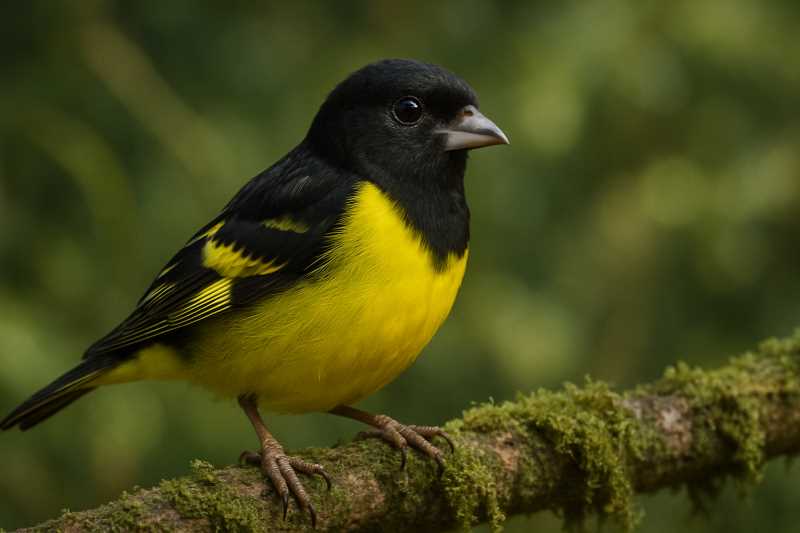
The Yellow-bellied Siskin exhibits sexual dimorphism, where males and females display different plumage characteristics. Males are particularly eye-catching, with a bright yellow underside, contrasting sharply with their black head, wings, and tail. The bright yellow belly, for which they are named, extends to the under-tail coverts. Females, on the other hand, are more subdued, with olive-green upperparts and a duller yellow below, aiding in camouflage while nesting.
Both sexes have a stout, conical bill adapted for seed eating, and their compact, agile bodies are well-suited for acrobatic flight among trees and shrubs.
Behavior and Diet
Yellow-bellied Siskins are gregarious birds, often seen foraging in flocks. Their diet primarily consists of seeds, which they expertly extract from a variety of plants using their specialized bills. They also consume buds and small insects, particularly during the breeding season when protein-rich food is essential for chick development.
The social nature of these birds extends to their vocalizations. They are known for their sweet, twittering songs and calls, which are used in communication within flocks and during courtship displays. Their musical repertoire is a delightful addition to the soundscape of montane forests.
Breeding and Nesting
The breeding season of the Yellow-bellied Siskin varies geographically but typically occurs during the rainy season when food resources are abundant. The species is monogamous, with pairs forming strong bonds that last throughout the breeding period.
Nest construction is a cooperative effort between the male and female. The nest is a small cup made from grasses, moss, and plant fibers, often lined with softer materials like feathers. It is usually placed in a tree or shrub, well-hidden among foliage to protect from predators.
The female typically lays between two to four eggs, which are incubated for about two weeks. Both parents participate in feeding the chicks, which fledge approximately three weeks after hatching.
Conservation Status and Threats
Currently, the Yellow-bellied Siskin is listed as a species of Least Concern by the International Union for Conservation of Nature (IUCN). However, like many forest-dependent species, it faces threats from habitat loss and degradation. Deforestation for agriculture and urban development is a significant concern, particularly in areas where human encroachment into montane forests is pronounced.
Conservation efforts for the Yellow-bellied Siskin are largely focused on habitat preservation and restoration. Protecting montane forest ecosystems is crucial not only for this species but also for the myriad of other flora and fauna that inhabit these regions.
Conclusion
The Yellow-bellied Siskin stands as a vibrant testament to the rich avian diversity of the Americas. Its striking appearance, melodious song, and adaptability make it a fascinating subject for study and admiration. Ensuring the preservation of its natural habitat is essential to maintaining the ecological balance and biodiversity of montane forests.
As we continue to explore and understand the complexities of avian life, the Yellow-bellied Siskin reminds us of the beauty and importance of conserving the natural world, inviting us to appreciate the intricate connections that sustain life on our planet.
Related posts