Introduction
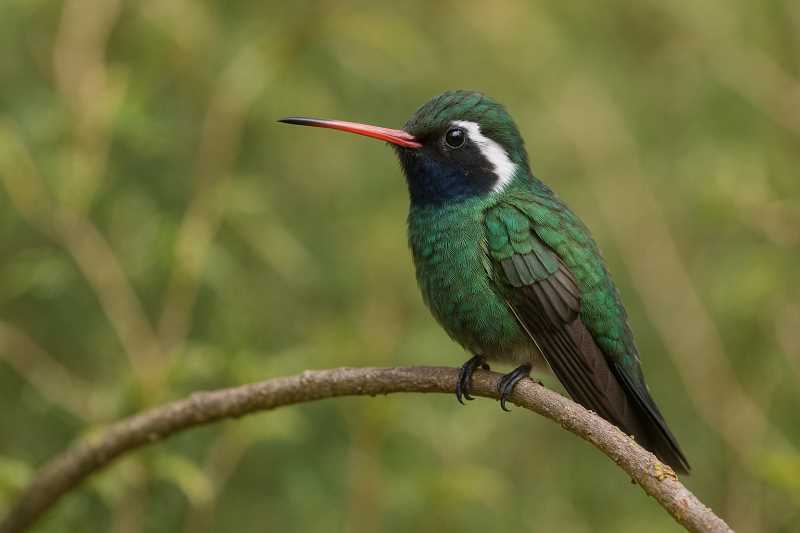
The White-eared Hummingbird (Basilinna leucotis) is a small mountain hummingbird named for the bold white stripe behind the eye. It occurs mainly in the highlands of Mexico and Central America, with occasional records and some breeding in the south-western United States. Its vivid plumage, precise hovering flight and preference for flowering forest edges make it a distinctive species of pine, oak and mixed montane habitats.
Physical Description
The White-eared Hummingbird is approximately 9–10 centimetres long and weighs about 3–4 grams. Both sexes have a dark head, a prominent white ear-stripe extending behind the eye, green upperparts and a straight to slightly curved bill with a reddish base and dark tip.
Adult males are more strongly coloured. In good light, the face and throat can flash violet and green, while the rest of the head may appear almost black. Females have a paler throat and breast marked with green spotting, and their bill usually shows less red. Immature males resemble females until the adult iridescent plumage develops.
Range and Habitat
The species is distributed from northern and central Mexico south through Guatemala, El Salvador and Honduras to Nicaragua. It also occurs in suitable mountain regions of southern Mexico and is an uncommon but regular visitor to south-eastern Arizona, where it has occasionally bred. The main range does not extend across all of Central America, and local distribution is closely associated with highland forests and clearings.
White-eared Hummingbirds are generally resident within the main range, although local and seasonal movements occur. Northern populations may move in response to temperature and food availability, while birds reaching Arizona are usually seasonal visitors.
BirdLife International records the species mainly between about 1,200 and 3,500 metres above sea level. Typical habitats include pine forest, pine-oak woodland, evergreen mountain forest, scrubby slopes, forest edges, roadside clearings and gardens with flowering plants. The species often forages low in open areas rather than remaining exclusively in dense forest.
Where to See This Species
Parque Nacional El Potosí, San Luis Potosí, Mexico
The White-eared Hummingbird is included in the official bird list for Parque Nacional El Potosí. The park protects highland forest and associated mountain habitats, and its management programme recognises birdwatching, wildlife observation and interpretive trails as suitable low-impact activities. Look along forest edges, flowering clearings and woodland paths, particularly where pine and oak habitats meet.
Nearby accommodation: Rioverde and Ciudad Fernández provide the nearest practical bases, with hotels, guest houses and other town-based accommodation suitable for visiting the park.
Parque Nacional Benito Juárez, Oaxaca, Mexico
Parque Nacional Benito Juárez supports montane pine and oak forests and lists the White-eared Hummingbird as a resident species. The accessible areas around San Pablo Etla and other community-managed visitor zones offer forest trails and wildlife-viewing opportunities. Birders should concentrate on flowering edges, open woodland and sheltered forest paths, while checking local access arrangements before travelling.
Nearby accommodation: Oaxaca City is the most practical accommodation base, with hotels, guest houses, hostels and self-catering options. Community visitor areas may also offer locally managed cabins or basic lodging when available.
Behaviour and Diet
White-eared Hummingbirds are active during the day and usually forage alone. They hover with remarkable precision while taking nectar from a variety of flowers, often at low or middle levels in forest clearings and along edges. They also capture small insects and other arthropods, which provide important protein, especially during the breeding season.
The species is not restricted to red or orange flowers. It uses a broad range of flowering plants and may also visit garden feeders. Males defend feeding territories and may gather in loose display areas where they sing and perform aerial manoeuvres to attract females.
Breeding behaviour is typical of many hummingbirds. The female builds the small cup-shaped nest and is responsible for incubation and care of the young. Nests are made from plant fibres and other fine materials, often bound with spider silk and camouflaged with lichen or vegetation. A typical clutch contains two eggs. Incubation lasts about 14–16 days, and young usually leave the nest after approximately 23–28 days.
Identification Tips
- Look for the broad, bright white stripe behind the eye, set against a dark head.
- The bill is relatively short and straight to slightly curved, with a reddish base and dark tip.
- Adult males may show a striking violet face and glittering green throat when viewed in direct light.
- Females and immature males are duller, with a pale throat and breast marked by green spots.
- The species is a stocky, medium-sized hummingbird of mountain woodland and clearings, usually feeding low to the middle levels.
- In areas where it overlaps with Broad-billed Hummingbirds, the White-eared Hummingbird is best separated by its bold white ear-stripe, darker head and more compact appearance. Broad-billed Hummingbirds generally have a broader bill and lack the same sharply contrasting facial pattern.
Conservation Status
The White-eared Hummingbird is currently assessed as Least Concern on the IUCN Red List. BirdLife International estimates a large global population but reports a decreasing population trend.
The principal conservation concern is the loss or degradation of montane forest, woodland edges and flowering habitats through land conversion, agriculture, development and other forms of human disturbance. Changes in climate may also affect flowering periods and the availability of nectar and insect prey, although the effects are likely to vary between regions.
Protecting pine, oak and mixed montane forests, maintaining flowering corridors and managing protected areas effectively can help retain feeding and nesting habitat. Local monitoring is also important, particularly at the northern edge of the range where the species is less regularly recorded.
Frequently Asked Questions
Where does the White-eared Hummingbird live?
It occurs mainly in mountain forests and forest edges from Mexico through parts of Central America to Nicaragua. It is also an uncommon visitor to south-eastern Arizona.
Is the White-eared Hummingbird migratory?
It is generally resident across much of its main range, but local and seasonal movements occur. Birds at the northern edge, including those seen in Arizona, may move in response to temperature and food availability.
What does the White-eared Hummingbird eat?
Its diet consists mainly of flower nectar, supplemented by small insects and other arthropods. It feeds at a range of flowering plants and is not limited to red or orange flowers.
How can the White-eared Hummingbird be identified?
The most useful field mark is the bold white stripe behind the eye on an otherwise dark head. Males may show violet and green iridescence, while females and immature birds have paler underparts with green spotting.
Where is the best place to see a White-eared Hummingbird?
Highland pine, oak and mixed montane forests in Mexico and Central America are the most reliable habitats. Officially documented viewing opportunities include Parque Nacional El Potosí in San Luis Potosí and Parque Nacional Benito Juárez in Oaxaca.
Is the White-eared Hummingbird endangered?
No. It is currently classified as Least Concern, although its population trend is decreasing and habitat loss remains an important conservation concern.
References
- BirdLife International
- Cornell Lab of Ornithology
- Comisión Nacional de Áreas Naturales Protegidas
Related posts