
Introduction
The Spot-breasted Cuckoo-Dove (Macropygia mackinlayi) is a medium-sized pigeon in the family Columbidae. It is also known as MacKinlay’s Cuckoo-Dove in some modern bird lists. The species is native to islands in Melanesia, where it occupies a range of forested habitats and feeds mainly on fruit and seeds.
Physical Description
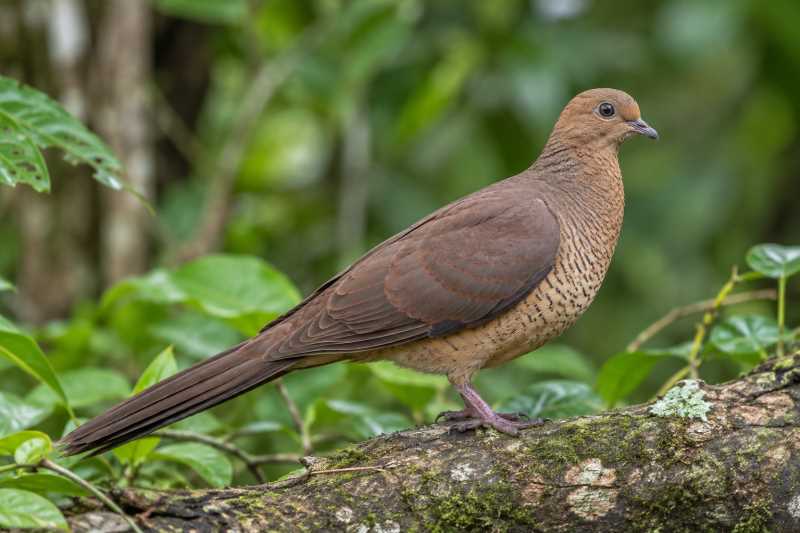
The Spot-breasted Cuckoo-Dove is about 27–31 centimetres long and weighs approximately 87 grams. It has the elongated tail and relatively small head typical of cuckoo-doves, with a short, dark bill and warm yellow, orange or reddish eyes.
Plumage varies considerably between individuals and island populations. Birds may be predominantly reddish brown or greyish brown. The upperparts are generally darker, while the head, neck and underparts are paler. The breast has a spotted or mottled appearance, which gives the species its common name. The tail is dark, often with a broad darker band near the tip.
Males and females are broadly similar, although some females may show greyer tones around the head and neck. Reliable information on age-related plumage differences is limited, and colour variation appears to be more significant than clearly defined seasonal sexual differences.
Range and Habitat
The species occurs across parts of the Bismarck Archipelago, the Solomon Islands and Vanuatu, including the Banks Islands and islands extending southwards to Aneityum. Several geographically variable forms have been described within this broad distribution.
It uses lowland and hill forest, montane rainforest, secondary regrowth, gardens near forest and, in some areas, mangrove habitats. On Kolombangara in the Solomon Islands, it has been recorded from lowland areas through to higher forest, with records reaching approximately 1,300 metres. It is a resident island species rather than a long-distance migrant.
Where to See This Species
Kolombangara Island, Western Province, Solomon Islands
Kolombangara supports extensive rainforest and is a well-established destination for guided forest walks and birdwatching. The species has been documented on the island, where it occurs in forest across a broad elevation range and may be encountered singly or in small groups, particularly around fruiting trees. The Imbu Rano area and associated rainforest trails provide practical places to search, although access generally requires local arrangements and a guide.
Nearby accommodation: Ringgi is the main gateway settlement, with guesthouses and lodge-style accommodation. Imbu Rano Lodge provides a forest-based option for visitors undertaking guided rainforest walks.
Mount Austen, Guadalcanal, Solomon Islands
Mount Austen and its surrounding forested areas are documented birdwatching locations for Guadalcanal. Spot-breasted Cuckoo-Doves have been recorded there, and the habitat of mature and secondary forest is suitable for a species that also uses disturbed woodland and forest edges. Early morning visits with a local bird guide offer the best chance of locating the species by its repeated cooing calls.
Nearby accommodation: Honiara is the practical accommodation base, with hotels, guest houses and self-catering accommodation, subject to local transport and access arrangements.
Behaviour and Diet
The Spot-breasted Cuckoo-Dove is usually seen alone, in pairs or in small groups. On Kolombangara, groups of up to five or six birds have been observed foraging in low fruiting trees. Males may interact aggressively around food sources, and the species can be noticeably vocal and social when several birds are present.
Its diet consists mainly of fruit and seeds. Observations of birds feeding in fruiting trees, including trees bearing small dark or purple fruits, support its primarily frugivorous feeding habits. By consuming fruit and passing seeds through the forest, it may contribute to local seed dispersal, although the importance of this ecological role has not been quantified.
The species is associated with soft, repeated cooing calls. These calls may help birds maintain contact, attract mates or advertise occupancy of an area. Breeding information is limited, but available accounts indicate that the female lays a single egg, with both adults involved in parental care.
Identification Tips
- Look for a medium-sized, long-tailed dove in forest, regrowth or gardens close to woodland.
- Check for the warm reddish-brown or grey-brown plumage and the spotted appearance of the breast.
- The short dark bill, contrasting dark tail and relatively small head help separate it from larger island pigeons.
- Plumage colour is variable, so do not rely on a single overall colour. Rufous and greyish birds may belong to the same species.
- Listen for repeated, soft cooing calls, particularly in the morning.
- On islands where it occurs, compare it carefully with other cuckoo-doves. The Spot-breasted Cuckoo-Dove is generally smaller and more variable in colour than many larger, strongly barred cuckoo-doves.
Conservation Status
The Spot-breasted Cuckoo-Dove is currently assessed as Least Concern on the IUCN Red List. Its broad distribution across the Bismarck Archipelago, the Solomon Islands and Vanuatu, together with its occurrence in both intact and modified habitats, means that it is not presently considered globally threatened.
A detailed global population estimate is not available. Local populations may nevertheless be affected by forest clearance, logging, agricultural expansion and the degradation of island habitats. Introduced predators can also be a concern for island birds, particularly during nesting, although major species-wide impacts have not been established for this cuckoo-dove. Maintaining native forest and monitoring populations on smaller islands remain important conservation measures.
Frequently Asked Questions
Where does the Spot-breasted Cuckoo-Dove live?
It lives on islands in the Bismarck Archipelago, the Solomon Islands and Vanuatu. It uses lowland forest, hill forest, montane rainforest, secondary regrowth and some gardens or mangrove areas near woodland.
What does the Spot-breasted Cuckoo-Dove eat?
It feeds mainly on fruit and seeds, especially in fruiting trees. It may help disperse seeds through its movements between feeding sites and forest habitats.
How can the Spot-breasted Cuckoo-Dove be identified?
Look for a medium-sized, long-tailed dove with variable reddish-brown or greyish-brown plumage, a spotted breast, a short dark bill and a dark-banded tail. Its repeated cooing call can also help locate it.
Is the Spot-breasted Cuckoo-Dove migratory?
No. It is regarded as a resident island species, although individuals may move locally between forest, regrowth and nearby feeding areas.
Where is the best place to see this species?
Kolombangara Island and forested areas around Mount Austen on Guadalcanal are documented places to look. Local guides are recommended because access can be difficult and the bird may remain high in fruiting trees.
Is the Spot-breasted Cuckoo-Dove endangered?
It is currently classified as Least Concern. The species is not considered globally threatened, but habitat loss and introduced predators may create local risks on some islands.
References
- IUCN Red List of Threatened Species
- IOC World Bird List
- The Wilson Journal of Ornithology
Related posts


