Introduction
The Sahul Brush Cuckoo (Cacomantis variolosus), also known as the Brush Cuckoo, is a medium-sized cuckoo of eastern Indonesia, New Guinea and northern and eastern Australia. It is usually detected by its far-carrying call rather than by sight. Like other parasitic cuckoos, it lays its eggs in the nests of other bird species, which then raise the young.
Physical Description
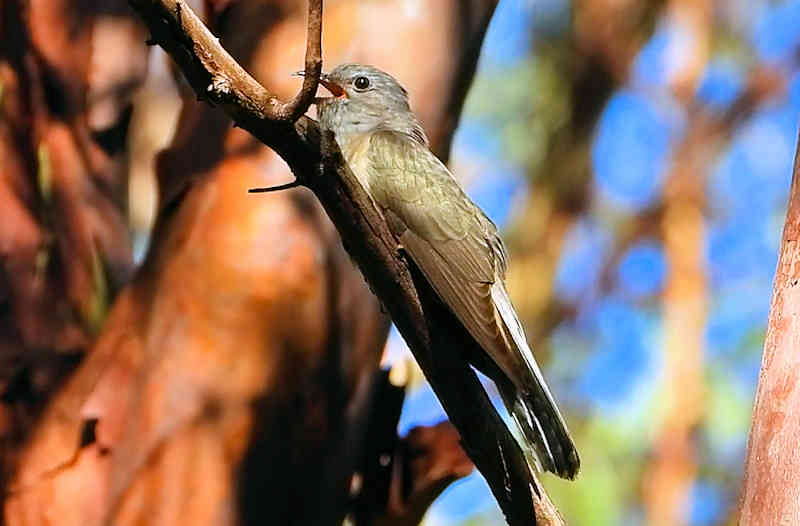
The Sahul Brush Cuckoo measures approximately 22–26 cm in length. Adults have a grey head and chin, greyish-brown back and wings, buff underparts, and a pale grey eye-ring. A small white shoulder mark and whitish notches on the undertail are useful field characters.
Males and females are similar in appearance. Juveniles are more heavily marked, with mottled brown upperparts and stronger brown barring across the greyish underparts. In flight, the species has pointed wings and a long tail, but it is more often seen perched quietly within vegetation.
Range and Habitat
The species occurs from eastern Indonesia and New Guinea through northern and eastern Australia, including parts of Queensland, the Northern Territory, New South Wales and Victoria. Taxonomic treatments of the wider Brush Cuckoo complex have changed in recent years, and some island populations formerly included within this species are now treated separately.
In Australia, the Sahul Brush Cuckoo uses a range of well-treed habitats, including rainforest margins, monsoon forest, mangroves, wet forest, open forest and woodland with a dense shrub layer. It is generally associated with cover and is often found in the middle and lower vegetation strata.
Southern Australian populations are migratory or partially migratory, moving north after the breeding season and returning south in spring. Movement patterns vary across the species’ broad range.
Where to See This Species
Litchfield National Park, Northern Territory, Australia
The Sahul Brush Cuckoo is included on the official bird list for Litchfield National Park, where it is recorded in woodland and wet-season habitats. Look for it in areas with dense vegetation, particularly around monsoon forest, creek lines and woodland edges. Listening is often more productive than scanning the canopy because the bird may remain concealed while calling.
Nearby accommodation: Batchelor is the main gateway settlement, with hotels, guest houses, cabins, campsites and self-catering accommodation.
Cutta Cutta Caves Nature Park, Northern Territory, Australia
The Sahul Brush Cuckoo is documented in the park’s fauna records. The surrounding limestone woodland and patches of denser vegetation provide suitable habitat, especially where shrubs and trees occur near seasonal drainage lines. Early morning and the wet-season period can be productive for locating calling birds, although sightings are often brief.
Nearby accommodation: Katherine provides the nearest practical base, with hotels, motels, cabins, campsites and other visitor accommodation.
Judbarra / Gregory National Park, Northern Territory, Australia
The species is included on the official bird list for Judbarra / Gregory National Park. Its combination of riparian forest, woodland and denser vegetation offers appropriate habitat. Search quietly along watercourses and forest edges, and pause frequently to listen for the descending call before attempting to locate the bird.
Nearby accommodation: Timber Creek is the principal gateway settlement, with motel-style accommodation, cabins, campsites and basic visitor facilities.
Behaviour and Diet
Sahul Brush Cuckoos are usually encountered singly or in pairs. They can sit motionless on a branch for long periods, relying on their subdued plumage for concealment. When feeding, they commonly use a perch-and-pounce technique, dropping or sallying out to take prey from foliage.
The diet consists mainly of insects, especially caterpillars. Hairy caterpillars are a notable food item, along with other arthropods taken from leaves and branches.
The species is a brood parasite. Females lay a single egg in the nest of a suitable host, with known Australian hosts including flycatchers, fantails, robins, fairy-wrens and honeyeaters. The cuckoo egg often resembles the host’s eggs. After hatching, the young cuckoo may eject host eggs or nestlings and is then fed by the foster parents.
Breeding timing varies geographically. In much of Australia, breeding activity is concentrated from spring into summer, although records from tropical regions show a broader seasonal range. Males advertise with persistent calls and may also perform courtship displays and courtship feeding.
Identification Tips
- Listen for the distinctive, plaintive descending call, often described phonetically as repeated "fear" notes.
- During the breeding season, males may give more excited, rising calls.
- Look for a medium-sized, slender cuckoo with a grey head, grey-brown upperparts, buff underparts and a pale grey eye-ring.
- Check for the small white shoulder mark and whitish notches on the undertail.
- Juveniles are more strongly barred and mottled than adults.
- The species is often concealed in foliage, so a calling bird may be easier to detect than to see.
- Where several cuckoo species occur together, rely on the combination of call, eye-ring, underpart colour and tail pattern rather than size alone.
Conservation Status
The Sahul Brush Cuckoo is listed as Least Concern globally. It remains widespread, but its conservation depends on the continued availability of suitable forest, woodland and shrub habitats, as well as healthy populations of host birds.
Habitat clearing, degradation of dense vegetation and changes to food availability may affect local populations. Protecting native forest and woodland, maintaining riparian vegetation and conserving the small passerines used as hosts are important conservation measures. Reliable global population estimates are not available for this species.
Frequently Asked Questions
Where is the Sahul Brush Cuckoo found?
It occurs in eastern Indonesia, New Guinea and northern and eastern Australia. In Australia, it is recorded from tropical regions south through parts of the eastern states, with some southern populations moving north in winter.
What does the Sahul Brush Cuckoo look like?
It is a 22–26 cm cuckoo with a grey head, greyish-brown upperparts, buff underparts, a pale grey eye-ring and a small white shoulder mark. Juveniles are more heavily barred and mottled.
What does the Sahul Brush Cuckoo eat?
It feeds mainly on insects, particularly caterpillars, which it captures from foliage using a perch-and-pounce foraging technique.
Is the Sahul Brush Cuckoo a brood parasite?
Yes. It lays its eggs in the nests of other birds, including flycatchers, fantails, robins, fairy-wrens and honeyeaters. The foster parents incubate the egg and feed the cuckoo chick.
How can I hear a Sahul Brush Cuckoo?
Listen for a far-carrying, plaintive descending call that is often described as repeated "fear" notes. The bird may call from a concealed perch in dense vegetation.
Is the Sahul Brush Cuckoo endangered?
No. It is currently assessed as Least Concern, although local populations may be affected by habitat loss, habitat degradation and declines in suitable host species.
References
- IOC World Bird List
- Museums Victoria
- Australian Faunal Directory
Related posts