Introduction
Ruspoli’s Turaco (Menelikornis ruspolii) is a striking turaco endemic to southern Ethiopia. Also known as Prince Ruspoli’s Turaco, it belongs to the family Musophagidae and is named after the Italian explorer Prince Eugenio Ruspoli. The species was formally described in 1896 and remains one of Ethiopia’s most localised forest birds.
Physical Description
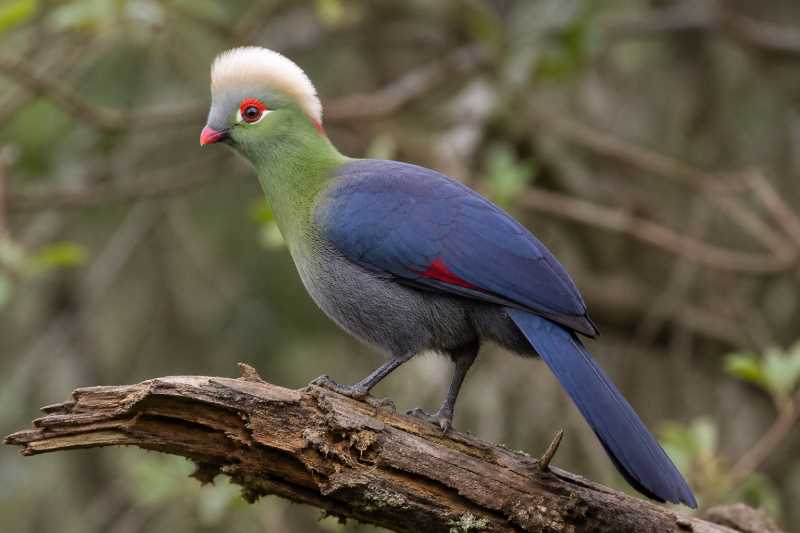
Ruspoli’s Turaco is a medium-sized, long-tailed bird measuring approximately 40 cm from bill to tail and weighing about 200 to 290 g. Its plumage is predominantly green, with paler green on the head, neck and breast and darker, often metallic green on the back, wings and tail.
The rounded crest is a distinctive pale whitish or pinkish colour and extends towards the nape. The bill and bare skin around the eye are reddish to orange-red. Bright crimson flight feathers are usually concealed when the bird is perched but become conspicuous when it flies.
Males and females are externally similar, and no consistent sexual dimorphism is recognised. Reliable information on juvenile plumage and age-related differences is limited.
Range and Habitat
Ruspoli’s Turaco is endemic to southern Ethiopia. Its known range includes woodland and forest areas around Arero, Bobela, Sokora, Negele, Wadera and nearby parts of the Guji and Borena areas.
It is associated mainly with dry woodland, juniper woodland with dense evergreen undergrowth, forest edges, acacia-conifer woodland and mixed broadleaf scrub. It generally occurs at about 1,250 to 1,860 metres above sea level, although local observations have been recorded across a somewhat wider elevational range.
The species is not regarded as a long-distance migrant. Some local or seasonal movements may occur as birds track fruiting trees and changing conditions. Its distribution is naturally restricted and has become increasingly fragmented as woodland is cleared or degraded.
Where to See This Species
Arero State Forest, Oromia Region, Ethiopia
Arero is one of the best-known areas for Ruspoli’s Turaco and contains important juniper woodland habitat. Birds have been recorded in and around the forest, particularly where mature trees, woodland edges and fruiting plants remain. Early morning and late afternoon are generally the most practical times to search, when the species is more active and vocal.
Nearby accommodation: Arero town provides basic guest houses and small hotels suitable for birdwatchers travelling through the southern Ethiopian highlands.
Wadera and Kibre Mengist Forests, Oromia Region, Ethiopia
The forested areas between Wadera and Kibre Mengist support suitable habitat and have been documented for Ruspoli’s Turaco. Look for relatively dry forest, woodland margins and areas containing juniper, podocarpus and fruiting trees. Access is often along roads and local tracks, so conditions and local guidance should be checked before travelling.
Nearby accommodation: Wadera and Kibre Mengist offer basic local accommodation, including guest houses and small hotels, although facilities may be limited.
Yabelo Wildlife Sanctuary, Oromia Region, Ethiopia
Yabelo is an established wildlife-viewing area in the wider southern Ethiopian range and is commonly included on birding routes linking the Borena woodlands with Arero and Negele. Ruspoli’s Turaco is more reliably sought in suitable woodland around the Arero and Negele areas than in open sections of the sanctuary itself, but Yabelo can serve as a practical base for exploring the surrounding habitat.
Nearby accommodation: Yabelo town has small hotels, guest houses and basic accommodation for travellers visiting the sanctuary and nearby birding sites.
Behaviour and Diet
Ruspoli’s Turaco is diurnal and mainly arboreal. It feeds, rests and moves through the canopy and dense woodland, usually descending to the ground only occasionally, particularly to drink. Birds may be seen singly, in pairs or in small family groups, and groups can gather in fruiting trees.
The species is primarily frugivorous. Recorded food plants include figs, juniper, podocarpus and fruits from several broadleaf trees and shrubs. Fruit is generally swallowed whole, and the bird may contribute to seed dispersal. In field observations, feeding activity was strongest during the morning, while calling increased later in the day.
Its calls include resonant, hollow notes and sharper metallic sounds. The species can be unobtrusive during the hottest part of the day, remaining quiet within foliage or dense scrub.
Detailed information on breeding remains limited. Local reports and observations suggest that nesting may occur after the rainy season, but the nest, clutch size and incubation behaviour have not been documented sufficiently to support confident species-specific descriptions. Generalised claims that the female lays two or three eggs and that both parents incubate them should therefore be treated cautiously.
Identification Tips
Look for a large green turaco with a long tail, a rounded pale crest, a reddish bill and eye-ring, and bright crimson wing panels visible in flight. The combination of the pale crest and red wing flash is particularly useful when the bird moves through dense woodland.
Search quietly in fruiting trees, juniper woodland and dry forest edges. Birds often perch motionless in the canopy, but their deep calls may reveal their presence before they are seen. Early morning and late afternoon are usually more productive than the middle of the day.
The related White-cheeked Turaco (Menelikornis leucotis) occurs in some of the same parts of Ethiopia. Ruspoli’s Turaco is generally associated with drier woodland and forest-edge habitats, while White-cheeked Turaco is more often linked with wetter forest and has different facial and crest markings. Hybridisation has been reported where the two species meet, so identification should be based on the overall combination of crest, facial pattern, habitat and wing colour.
Conservation Status
Ruspoli’s Turaco is currently listed as Near Threatened on the IUCN Red List. The species has a restricted range, and its suitable habitat is fragmented and declining in parts of southern Ethiopia.
The principal threats are habitat clearance, timber and fuelwood cutting, agricultural expansion, overgrazing, uncontrolled fire and the degradation of mature juniper and other woodland trees. Habitat loss may also increase contact with the White-cheeked Turaco, creating opportunities for hybridisation in areas where both species occur.
Important conservation measures include protecting remaining forests and woodland, maintaining mature fruiting trees, reducing unsustainable cutting and fire, and involving local communities in habitat management. Further field surveys are needed to clarify the species’ distribution, population trend and breeding ecology.
Frequently Asked Questions
Where is Ruspoli’s Turaco found?
Ruspoli’s Turaco is found only in southern Ethiopia, particularly around Arero, Bobela, Sokora, Negele and Wadera. It occupies dry woodland, juniper forest, forest edges and mixed scrub.
Is Ruspoli’s Turaco migratory?
It is generally considered sedentary rather than a long-distance migrant. Local movements may occur when birds follow fruiting trees or changing seasonal conditions.
What does Ruspoli’s Turaco eat?
It eats mainly fruit, including figs and fruits from juniper, podocarpus and other woodland plants. It may use a broad range of soft fruits available within its habitat.
How can Ruspoli’s Turaco be identified?
Look for its green body, pale rounded crest, reddish bill and eye-ring, long tail and bright crimson wing feathers. The red wing panels are especially noticeable in flight.
Where is the best place to look for this species?
Arero State Forest is one of the best-known areas to search. Suitable woodland around Wadera, Kibre Mengist and Negele can also produce sightings, particularly in the early morning and late afternoon.
Why is Ruspoli’s Turaco threatened?
Its restricted range is being affected by woodland clearance, fuelwood collection, logging, agriculture, grazing and fire. Habitat fragmentation may also increase contact and hybridisation with the White-cheeked Turaco.
References
- IUCN Red List of Threatened Species
- IOC World Bird List
- African Journal of Ecology
Related posts