Introduction
The Rufous-fronted Wood Quail (Odontophorus erythrops) is a secretive member of the New World quail family, Odontophoridae. It occurs in humid forests of Colombia and Ecuador, where it usually remains on the forest floor and is more often heard than seen. The species is largely sedentary and is associated with dense vegetation, leaf litter and forested landscapes.
Physical Description
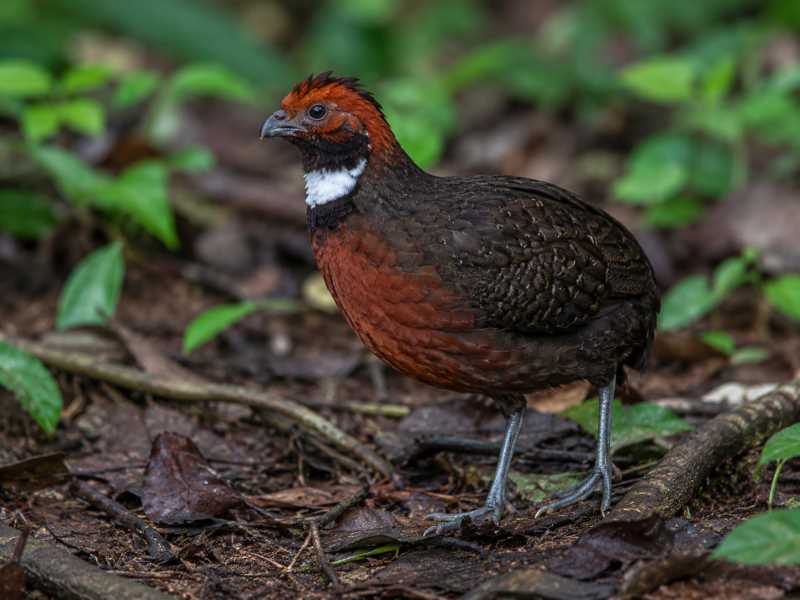
The Rufous-fronted Wood Quail is a robust, medium-sized bird measuring approximately 23–28 cm in length. Adult males have a rufous crown, crest and face, with bare purple skin around the eye. The back and rump are blackish or olive, often marked with fine cinnamon vermiculation and darker spotting. The breast and belly are deep rufous, while the bill is black and the legs and feet are generally blue-black or greenish-grey.
Females are similar but usually have a duller, darker chestnut face and a blue-black eye-ring. Juveniles resemble females but have a duller crest, paler shaft streaks on the back and more conspicuous black spotting or barring on the underparts. Estimated body masses are about 340 g for males and 329 g for females, although published measurements are limited.
Some populations, particularly those assigned to the subspecies O. e. parambae, are darker above and may show a noticeable white band across the lower throat or jugular region. Subspecific treatment and relationships within the genus have been discussed in recent taxonomic and phylogenetic literature.
Range and Habitat
The Rufous-fronted Wood Quail is native to Colombia and Ecuador. The nominate form occurs in south-western Ecuador, while O. e. parambae has been reported from the Pacific slope of western Colombia and Ecuador, with records extending into parts of the Magdalena Valley.
It inhabits humid tropical forest, including primary forest and mature secondary growth. The species is mainly associated with dense understorey and the forest floor rather than open farmland or exposed woodland. It generally occurs at lower elevations than many Andean forest birds, reaching about 1,100 m in much of Colombia and up to approximately 1,600 m in Ecuador, although local records vary.
The species is not known to undertake regular long-distance migration. Its distribution is naturally fragmented by the geography of the western Andes and by the loss and degradation of humid forest.
Behaviour and Diet
Rufous-fronted Wood Quails are shy, ground-dwelling birds that usually move quietly through leaf litter and dense undergrowth. They may occur in pairs, family groups or small coveys, but their secretive behaviour makes group size and social organisation difficult to study.
The diet has not been investigated in detail. Available observations indicate that the species takes fallen fruit, berries, seeds and insects or other small invertebrates while foraging on the ground. It may occasionally visit grain at feeding stations. Claims about a specialised role in seed dispersal or pest control are not sufficiently documented for this species and should therefore be treated cautiously.
The species is most likely to reveal its presence through its ringing calls, particularly around dawn and dusk. Published descriptions include rapidly repeated calls and duets between members of a pair or group. It is considered sedentary within its range.
Breeding information remains limited. The breeding season has been suggested to extend from approximately January to May, but detailed information on nest construction, clutch size, incubation and parental care is sparse. The species is believed to nest on or close to the ground, as is typical of many wood-quails, but the available evidence does not support presenting precise clutch or incubation figures as established facts.
Identification Tips
- Look for a compact, rounded quail moving quietly through dense forest undergrowth or leaf litter.
- The combination of a rufous crown and face, dark back, deep rufous underparts and bare purplish skin around the eye is distinctive.
- The bird is more often detected by its repeated calls than by direct observation.
- In areas where similar dark wood-quails occur, check the throat pattern carefully. Rufous-fronted Wood Quail may show a contrasting white jugular band, especially in O. e. parambae.
- Avoid relying on the original article’s description of a red eye-ring. The exposed skin around the eye is generally described as purple in adults and blue-black in females.
Conservation Status
The Rufous-fronted Wood Quail is currently assessed as Least Concern on the IUCN Red List. This global category does not mean that all populations are secure. Deforestation, agricultural expansion, logging, infrastructure development and the resulting fragmentation of humid forest are important concerns. Hunting may also affect local populations.
The species occurs in several protected areas, and the protection and restoration of remaining humid forest are important conservation measures. Maintaining connected forest, limiting further clearance and improving knowledge of population trends and breeding ecology would help inform conservation planning. No reliable global population estimate is available, so population size should not be inferred from its Least Concern classification.
Frequently Asked Questions
Where does the Rufous-fronted Wood Quail live?
It is native to Colombia and Ecuador, where it occupies humid tropical forest, mature secondary growth and dense understorey, mainly on the Pacific-facing slopes and adjacent valleys of the Andes.
How high does the Rufous-fronted Wood Quail occur?
It is usually found below about 1,100 m in Colombia and may reach approximately 1,600 m in Ecuador. The exact upper limit varies between regions and records.
What does the Rufous-fronted Wood Quail eat?
Its diet is poorly studied, but available information indicates that it takes fallen fruit, berries, seeds and insects or other small invertebrates from the forest floor.
Is the Rufous-fronted Wood Quail migratory?
No regular long-distance migration is known. It is generally considered sedentary, remaining within suitable forest habitat throughout the year.
How can the species be identified in the field?
Look for a stocky ground bird with a rufous crown and face, dark upperparts, deep rufous underparts and bare purplish skin around the eye. Its repeated calls are often easier to detect than the bird itself.
Is the Rufous-fronted Wood Quail endangered?
It is currently assessed as Least Concern globally by the IUCN. Nevertheless, habitat loss, forest fragmentation and possible hunting remain local threats, particularly where humid forest is being cleared or degraded.
References
- BirdLife International. 2024. Rufous-fronted Wood-quail Odontophorus erythrops. IUCN Red List of Threatened Species. Available from: BirdLife International species factsheet. Accessed 8 September 2026.
- Gill, F., Donsker, D. and Rasmussen, P., eds. 2026. IOC World Bird List, version 15.2. International Ornithologists’ Union. Available from: IOC World Bird List. Accessed 8 September 2026.
- Carroll, J. P., Kirwan, G. M. and Boesman, P. F. D. 2020. Rufous-fronted Wood-Quail (Odontophorus erythrops), version 1.0. In Birds of the World, edited by J. del Hoyo, A. Elliott, J. Sargatal, D. A. Christie and E. de Juana. Cornell Lab of Ornithology, Ithaca, New York. https://doi.org/10.2173/bow.rfwqua1.01.
- Donegan, T. M. 2012. Range extensions and other notes on Colombian birds. Bulletin of the British Ornithologists’ Club 132(3): 145–161. Available from: Bulletin of the British Ornithologists’ Club PDF.
- Salter, J. F., Hosner, P. A., Tsai, W. L. E., McCormack, J. E., Braun, E. L., Kimball, R. T., Brumfield, R. T. and Faircloth, B. C. 2022. Historical specimens and the limits of subspecies phylogenomics in the New World quails (Odontophoridae). Molecular Phylogenetics and Evolution 175: 107559. https://doi.org/10.1016/j.ympev.2022.107559.
- Ayerbe-Quiñones, F. 2018. Guía ilustrada de la avifauna colombiana. Wildlife Conservation Society Colombia, Bogotá. Distribution information is also documented in the Atlas of the Birds of Colombia species account. Accessed 8 September 2026.
- Instituto Nacional de Biodiversidad, Ecuador. n.d. Odontophorus erythrops specimen records in the Ecuadorian biodiversity database. Available from: Symbiota INABIO collection records. Accessed 8 September 2026.
Related posts