The Nuttall’s Woodpecker (Dryobates nuttallii) is a small, charismatic woodpecker species found almost exclusively in the oak woodlands of California and northern Baja California. Known for its striking black-and-white plumage and preference for dense deciduous forests, this bird is a quintessential representative of California’s unique biodiversity. Despite its relatively narrow geographic range, Nuttall’s Woodpecker is widespread and commonly observed within its habitat, where it plays a vital ecological role as both predator and prey.
Identification and Appearance
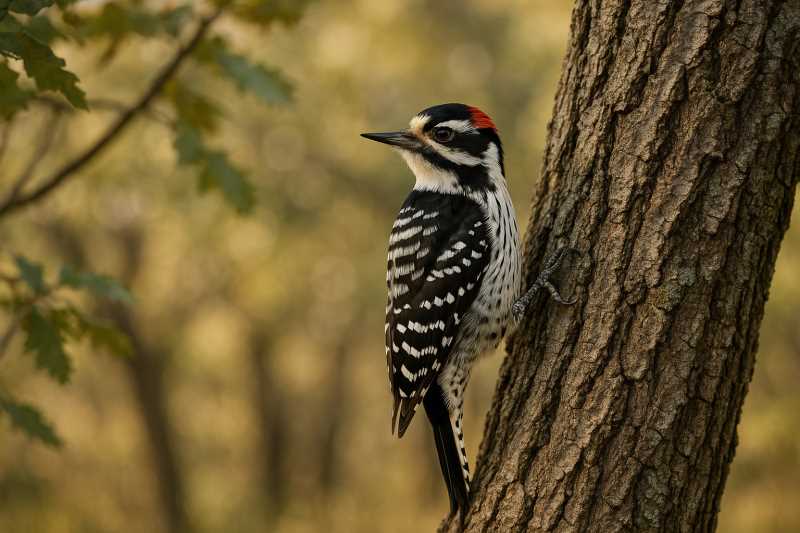
Nuttall’s Woodpecker is a small to medium-sized woodpecker, measuring approximately 16–18 cm (6.3–7.1 inches) in length with a wingspan of about 29–33 cm (11.4–13 inches). It is easily recognizable by its boldly patterned black-and-white plumage. The back and wings display horizontal white barring on a black background, giving it a “zebra-backed” appearance. The underparts are a dull white with subtle dark spotting on the flanks.
Sexual dimorphism is subtle but apparent: males have a distinctive red crown patch at the rear of the head, while females have an all-black crown. Both sexes share a black facial mask bordered by white, with white stripes extending from the bill over the eye and down the cheek.
Habitat and Range
Endemic to California and parts of northern Baja California, Nuttall’s Woodpecker is closely associated with oak woodlands. It thrives in habitats where mature oaks dominate the canopy, often in mixed stands with sycamores, cottonwoods, and willows. Unlike many woodpecker species that favor coniferous forests, Nuttall’s relies heavily on broadleaf trees for foraging and nesting.
Its range is predominantly along the western side of California’s Central Valley and the coastal foothills. While it can be seen in urban parks and riparian corridors, it remains most abundant in undisturbed oak groves, particularly in foothill regions such as the Sierra Nevada and Coast Ranges.
Behavior and Diet
Nuttall’s Woodpecker exhibits the classic climbing and pecking behavior typical of its family. It forages by hitching up tree trunks and probing into bark and crevices for insects, particularly beetle larvae, ants, and caterpillars. Though primarily insectivorous, it also supplements its diet with acorns, seeds, and berries—especially in winter.
These woodpeckers are typically solitary or found in pairs, especially outside the breeding season. They are non-migratory and remain in their home range year-round. Their calls are sharp and metallic, often described as a rapid “pik-pik-pik” or a rattling trill used in territorial displays.
Males and females often share foraging territories, and they tend to exhibit high site fidelity, returning to the same area season after season. This strong territoriality is enforced through drumming and vocalizations, which help ward off intruders and attract mates.
Breeding and Nesting
Breeding occurs from March through June, with the male initiating courtship by drumming on resonant branches and performing display flights. Once paired, both sexes participate in excavating a nest cavity, typically in a dead or decaying limb of an oak or similar hardwood. Nest height varies but is usually between 2 to 10 meters above ground.
The female lays between 3 to 6 white eggs. Both parents share incubation duties over a period of about 14 days. After hatching, the young are fed by regurgitation and fledge approximately 3 to 4 weeks later. Parents continue to feed the fledglings for a short time post-fledging before they become fully independent.
Conservation Status and Threats
Nuttall’s Woodpecker is currently listed as a species of Least Concern by the IUCN and is not considered threatened. However, its dependence on oak woodlands makes it vulnerable to habitat loss, particularly from urban development, agricultural conversion, and the decline of mature oak trees due to drought, disease, and fire.
Oak woodland conservation efforts indirectly support this species. Protecting large stands of native oaks and maintaining riparian corridors are critical for sustaining healthy populations. The species’ ability to coexist in semi-urban environments suggests some adaptability, but long-term preservation hinges on proactive habitat management.
Significance in Ecosystem
As insectivores, Nuttall’s Woodpeckers help control tree pests and contribute to the overall health of forest ecosystems. Their nest cavities are often reused by other species, including owls, small mammals, and other birds, making them valuable contributors to forest biodiversity.
In California’s oak woodlands, Nuttall’s Woodpecker serves as an indicator species—its presence signals a healthy, functioning ecosystem. Birdwatchers and naturalists often regard it as a highlight of any woodland excursion, especially given its vocal nature and striking appearance.
Conclusion
Nuttall’s Woodpecker stands as a symbol of California’s unique natural heritage. Its restricted range and specialized habitat preferences underscore the importance of preserving oak woodlands and riparian forests across the state. For birdwatchers, ecologists, and land managers alike, this woodpecker offers both aesthetic and ecological value, reminding us of the delicate balance required to maintain biodiversity in a changing world.
Related posts