Introduction
The Mourning Collared Dove, also known as the African Mourning Dove, is a widespread African dove with the accepted scientific name Streptopelia decipiens. It is a resident species of sub-Saharan Africa, especially associated with open, dry-country habitats where trees, cultivated land and reliable water occur. (worldbirdnames.org)
Physical Description
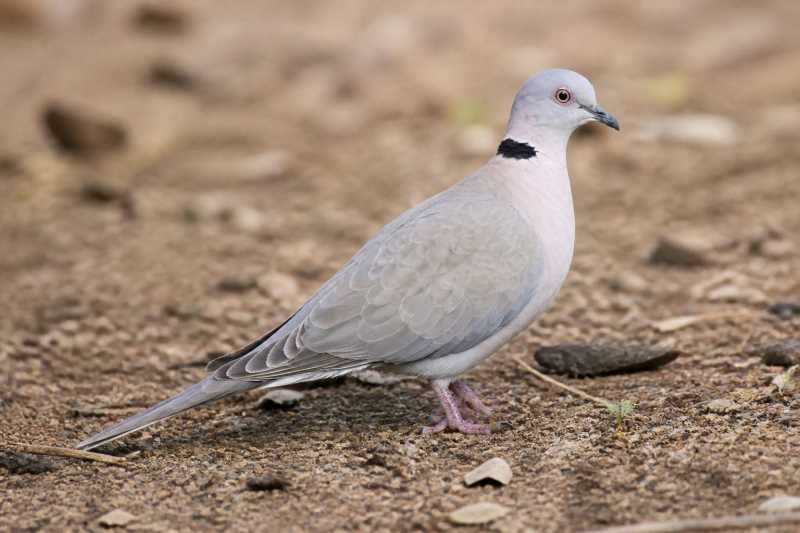
The Mourning Collared Dove is a stocky, medium-sized dove measuring approximately 28–32 centimetres in length. Adults have a grey head, pale grey-brown upperparts and pinkish or warm buff underparts. A dark, usually black, patch on the hindneck is edged with pale feathers and forms a distinctive half-collar.
The eye is typically pale yellow to yellowish, surrounded by conspicuous red bare skin. The legs are also reddish. Plumage can vary geographically, and the collar and body tones may appear more or less strongly marked between subspecies. Males and females are broadly similar in appearance, while immature birds are generally duller and may show less clearly defined head and collar markings.
Range and Habitat
The species occurs widely across sub-Saharan Africa, from the Sahel and Sudan region through East Africa and southwards into parts of southern Africa. Its distribution is discontinuous in some areas and follows suitable woodland, savanna and river systems rather than forming an unbroken range. Several geographical forms are recognised in current taxonomic treatments. (itis.gov)
Mourning Collared Doves are most often associated with open and semi-open habitats, including dry savanna, thornscrub, cultivated areas, villages and riverine woodland. They are particularly likely near rivers, floodplains, waterholes and other sources of drinking water. In southern Africa, mature trees along larger rivers and floodplains can be important habitat. The species is generally resident rather than a long-distance migrant. (biodiversityexplorer.info)
Where to See This Species
Kruger National Park, Limpopo and Mpumalanga, South Africa
The Mourning Collared Dove is included on the official Kruger National Park bird checklist as Streptopelia decipiens. Look for it in open woodland and around large trees near rivers, watercourses and other well-watered parts of the park. It can be overlooked among other collared and turtle doves, so listening for its distinctive call is useful. (sanparks.org)
Nearby accommodation: Practical bases include Kruger rest camps and the gateway towns of Phalaborwa, Hoedspruit, Hazyview and Komatipoort, with campsites, self-catering units, guest houses and hotels available in the wider area.
Behaviour and Diet
Mourning Collared Doves are mainly terrestrial foragers. They walk and peck on bare ground, paths, clearings and cultivated areas, feeding primarily on seeds and grains. Small amounts of fruit and invertebrate food may also be taken. They commonly drink at water sources and may gather in pairs or small groups.
The species is usually active during daylight. It often perches in trees near feeding grounds or water and may associate peacefully with other dove species. Its call is a soft, drawn-out, mournful coo, which can carry across open woodland and riverine habitats.
Breeding is reported during periods when food and water are available. The nest is a light platform of twigs and plant material, usually placed in a tree or shrub. A clutch commonly consists of one or two eggs, with both adults involved in incubation and care of the young.
Identification Tips
- Look for a medium-sized, rather heavy dove with a grey head and pinkish underparts.
- The dark half-collar on the back of the neck is an important field mark.
- Check for the reddish bare skin around the pale eye and the red legs, especially at close range.
- Search near water, riverine trees, open woodland, dry savanna and cultivated land.
- The species can resemble the Cape Turtle Dove and other Streptopelia doves. The combination of the red eye-skin, pale eye, grey head, pinkish underparts and dark hindneck patch is more useful than any single feature.
- Do not confuse it with the North American Mourning Dove, Zenaida macroura, which belongs to a different genus and occurs in the Americas.
Conservation Status
The Mourning Collared Dove is currently assessed as Least Concern. Its broad African distribution and use of a range of open and human-modified habitats contribute to this assessment. However, local populations may be affected by the loss of riverine woodland, degradation of water sources, agricultural change and wider habitat conversion. The available information does not justify describing the global population trend as definitively stable.
Maintaining natural woodland along rivers, protecting wetlands and waterholes, and conserving connected savanna and agricultural mosaics are appropriate measures for the species. (worldbirdnames.com)
Frequently Asked Questions
Where can the Mourning Collared Dove be found?
It is found across much of sub-Saharan Africa, from the Sahel and Sudan region through East Africa and into parts of southern Africa.
What habitat does the Mourning Collared Dove prefer?
It favours open and semi-open habitats with trees and access to water, including savanna, thornscrub, cultivated land, villages, floodplains and riverine woodland.
How can the Mourning Collared Dove be identified?
Look for its grey head, pinkish underparts, dark half-collar on the hindneck, pale eye surrounded by red bare skin and reddish legs.
What does the Mourning Collared Dove eat?
Its diet consists mainly of seeds and grains collected from the ground. It may also take small amounts of fruit and invertebrate food.
Is the Mourning Collared Dove migratory?
It is generally a resident species. Local movements may occur in response to water availability, food supplies or changing conditions, but it is not considered a long-distance migrant.
Is the Mourning Collared Dove endangered?
No. It is currently assessed as Least Concern, although local habitat loss and the degradation of rivers, wetlands and woodland can still affect populations.
References
- IOC World Bird List
- IUCN Red List of Threatened Species
- South African National Parks
Related posts