Introduction
The Mexican Whip-poor-will (Antrostomus arizonae) is a medium-sized nocturnal nightjar in the family Caprimulgidae. It was formerly treated as part of the Eastern Whip-poor-will, but was recognised as a separate species in 2010 because of consistent differences in vocalisations, morphology and genetic evidence. It is best known for its repetitive, low-pitched song, cryptic plumage and habit of becoming active at dusk and during the night. (allaboutbirds.org)
Physical Description
The Mexican Whip-poor-will measures approximately 23–24 cm in length, weighs about 42–62 g and has a wingspan of roughly 48 cm. It has a large head, a short bill surrounded by long rictal bristles, rounded wings and a relatively long, rounded tail. (allaboutbirds.org)
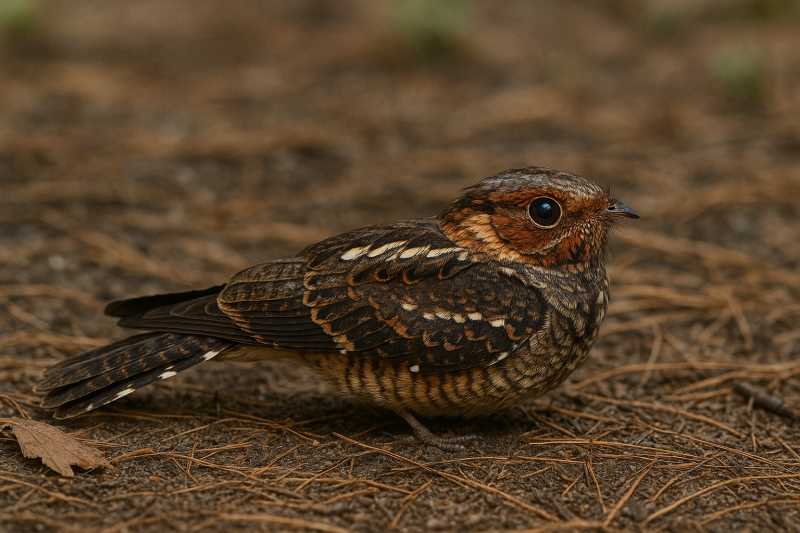
Its plumage is a finely mottled mixture of black, brown, grey, buff and rufous, providing excellent camouflage among leaf litter, rocks and woodland vegetation. A narrow buffy-white collar contrasts with the darker throat and breast. Adult males usually have conspicuous white tips on the outer tail feathers, whereas females show smaller and duller buffy or pale tips. Plumage can vary with age, individual variation and lighting, and juveniles may be less distinctive than adults. (allaboutbirds.org)
Range and Habitat
The species occurs from the southwestern United States through Mexico and into parts of northern Central America. In the United States, its breeding range includes parts of California, Nevada, Arizona, New Mexico and western Texas. It is associated particularly with wooded canyons, pine woodland and pine-oak forest, including relatively moist montane areas with mature trees, varied canopy structure and a substantial understorey. (explorer.natureserve.org)
Northern populations are partly migratory. Birds breeding in the United States and northern Mexico generally move south for winter, while populations farther south are resident or may move locally to lower elevations. The species is therefore not uniformly migratory across its entire range. (allaboutbirds.org)
Important geographic variation occurs across the range, and several subspecies have been recognised. However, the biology and distribution of some southern populations remain poorly documented. (en.wikipedia.org)
Behaviour and Diet
The Mexican Whip-poor-will roosts quietly during the day on or near the ground, where its plumage makes it extremely difficult to detect. It becomes active at dusk, before dawn and on moonlit nights. It usually captures flying insects during short sallies from a low perch or occasionally from the ground. Moths and beetles are among the prey reported or inferred to be important in its diet. (allaboutbirds.org)
The male’s principal song is a continuous, repetitive "whip-poor-will" chant. Compared with the song of the Eastern Whip-poor-will, it is generally lower-pitched and has a distinctly rougher or burr-like quality. The species also gives short contact or alarm calls, including notes described as "quirt" or "grip", and may produce growling or clucking sounds. Wing clapping has also been recorded, although its precise function in this species is not fully understood. (allaboutbirds.org)
Breeding information remains limited because the species is nocturnal, cryptic and often occupies remote mountain habitats. The clutch usually consists of two eggs laid directly on leaf litter, without a conventional nest. In Arizona, laying has been recorded in May and early June, but breeding dates and behaviour are less well documented across the rest of the range. (en.wikipedia.org)
Identification Tips
- Listen after sunset, before sunrise or on bright moonlit nights for the repeated, low and slightly buzzy "whip-poor-will" song.
- Look for a large-headed nightjar with rounded wings, a horizontal posture and heavily mottled brown, grey, black, buff and rufous plumage.
- A thin buffy-white collar and dark throat are useful visual features when the bird is seen at close range.
- Adult males show stronger white markings on the outer tail feathers than females.
- The species is more likely to be heard than seen. During daylight, search carefully along leaf litter, shaded ground and low branches in pine or pine-oak woodland.
- The Eastern Whip-poor-will has a faster, higher-pitched and less burred song. The Common Poorwill is generally shorter-tailed and has a different voice, while nighthawks have more pointed wings and a different flight style. Range and habitat are also important when separating these species. (allaboutbirds.org)
Conservation Status
The Mexican Whip-poor-will is currently assessed as Least Concern. However, its population trend is not well established because standard bird-monitoring methods are less effective for nocturnal species, and reliable range-wide data are limited. (audubon.org)
Potential pressures include the loss and alteration of pine and pine-oak woodland, changes to mature forest structure, development in wooded canyons and severe or poorly managed wildfire. Maintaining a mixed forest structure, protecting suitable canyon woodland and retaining dense understorey vegetation can help preserve roosting, nesting and foraging habitat. Further monitoring is important because the species remains among the least-studied breeding birds in North America. (explorer.natureserve.org)
Frequently Asked Questions
Where does the Mexican Whip-poor-will live?
It occurs from the southwestern United States through Mexico and into parts of northern Central America. It is most often associated with pine, pine-oak and other montane woodland, especially wooded canyons and relatively moist forest areas.
Is the Mexican Whip-poor-will nocturnal?
Yes. It roosts during the day and is most active around dusk, dawn and during the night. It may forage for longer periods on moonlit nights.
What does the Mexican Whip-poor-will eat?
It is an aerial insectivore that catches flying insects in short flights from a perch or, less often, from the ground. Moths and beetles are important reported or inferred prey.
What does the Mexican Whip-poor-will sound like?
Its main song is a repeated "whip-poor-will" chant. The song is usually lower-pitched and rougher or more burred than the song of the Eastern Whip-poor-will.
How can the Mexican Whip-poor-will be identified?
Look or listen for a large-headed, heavily mottled nightjar with rounded wings, a thin pale collar and a horizontal resting posture. Its distinctive low, repetitive song is often the most reliable way to locate it.
Is the Mexican Whip-poor-will endangered?
No. It is currently assessed as Least Concern, although its population trend is uncertain and its habitat may be affected by woodland loss, altered forest structure, development and wildfire.
References
- Audubon. n.d. “Mexican Whip-poor-will.” Audubon Field Guide. Accessed 8 September 2026. https://www.audubon.org/field-guide/bird/mexican-whip-poor-will
- Chesser, R. T., Banks, R. C., Barker, F. K., Cicero, C., Dunn, J. L., Kratter, A. W., Lovette, I. J., Rasmussen, P. C., Remsen, J. V., Rising, J. D., Stotz, D. F., and Winker, K. 2010. “Fifty-first Supplement to the American Ornithologists’ Union Check-list of North American Birds.” The Auk 127(3): 726–744. https://doi.org/10.1525/auk.2010.127.3.726
- Cink, C. L., Pyle, P., and Patten, M. A. 2020. “Mexican Whip-poor-will (Antrostomus arizonae), version 1.0.” In Birds of the World, edited by P. G. Rodewald. Cornell Lab of Ornithology, Ithaca, New York. https://doi.org/10.2173/bow.souwpw1.01
- Cornell Lab of Ornithology. n.d. “Mexican Whip-poor-will: Identification.” All About Birds. Accessed 8 September 2026. https://www.allaboutbirds.org/guide/Mexican_Whip-poor-will/id
- Cornell Lab of Ornithology. n.d. “Mexican Whip-poor-will: Life History.” All About Birds. Accessed 8 September 2026. https://www.allaboutbirds.org/guide/Mexican_Whip-poor-will/lifehistory
- Cornell Lab of Ornithology. n.d. “Mexican Whip-poor-will: Range Map.” All About Birds. Accessed 8 September 2026. https://www.allaboutbirds.org/guide/Mexican_Whip-poor-will/maps-range
- Cornell Lab of Ornithology. n.d. “Mexican Whip-poor-will: Sounds.” All About Birds. Accessed 8 September 2026. https://www.allaboutbirds.org/guide/Mexican_Whip-poor-will/sounds
- NatureServe. n.d. “Antrostomus arizonae, Mexican Whip-poor-will.” NatureServe Explorer. Accessed 8 September 2026. https://explorer.natureserve.org/Taxon/ELEMENT_GLOBAL.2.720758/Antrostomus_arizonae
Related posts