Introduction
Letitia’s Thorntail (Discosura letitiae), also known as the Coppery Thorntail, is one of the least-known hummingbirds in South America. The species was described in 1852 from a small number of museum specimens labelled as originating from Bolivia, but its precise collection locality, habitat and current existence remain uncertain. No confirmed living record has been reported for many decades.
Physical Description
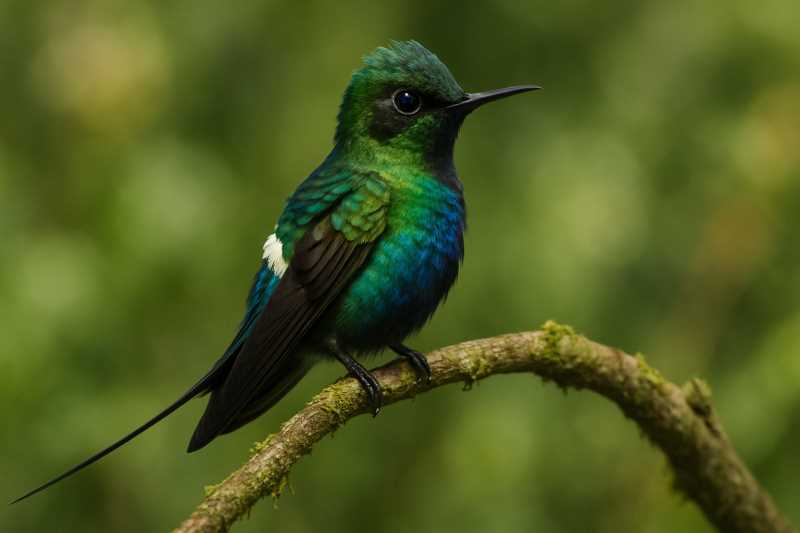
Letitia’s Thorntail is a very small hummingbird, with the original description giving a total length of approximately 9 centimetres. The known specimens are males. They have a glossy golden-green head and throat, coppery-bronze upperparts, a narrow white band across the lower back and a coppery to reddish rump.
The lower breast is bronze-green with coppery iridescence, while the lower belly and flanks are paler. The tail is relatively short compared with that of some other thorntails. Its outer tail feathers are pointed and progressively longer towards the outside, but they do not form the pronounced racket-like extensions seen in the Racket-tipped Thorntail.
The female has never been reliably described, and there is no dependable information about juvenile plumage or age-related variation. Examination of the known skins indicates that Letitia’s Thorntail is a distinct taxon rather than an immature or geographical form of the Racket-tipped Thorntail.
Range and Habitat
The species is known only from historical specimens labelled “Bolivia”. The labels provide no precise locality, and the provenance of 19th-century hummingbird skins was not always reliable. Changes in political borders also make it difficult to relate the historical label to a precise modern distribution.
Earlier ornithological assessments suggested that the species might have occurred in the lowland forests of northern or north-eastern Bolivia, possibly within the wider Amazonian region. This remains a hypothesis rather than a confirmed range. There are no reliable records establishing its presence in Ecuador, Peru or Brazil.
Its habitat preferences, elevation range and degree of endemism are unknown. If the species survives, it may occupy humid lowland forest, but this cannot be confirmed from the available evidence.
Where to See This Species
No current wildlife-viewing venue can be verified for Letitia’s Thorntail. The species is known from historical museum specimens with uncertain locality data and has not been reliably recorded in the wild for many decades. Consequently, no national park, reserve or public birding site can be recommended as a realistic place to search for it.
Behaviour and Diet
Almost nothing is known about the behaviour of Letitia’s Thorntail. There are no reliable observations documenting its flight behaviour, territoriality, social interactions, breeding biology, movements or migration.
As a hummingbird, it would probably have fed on nectar and may also have taken small insects or other arthropods, as many related species do. However, species-specific feeding records are unavailable, so its diet and role as a pollinator should be regarded as unconfirmed.
Identification Tips
A living identification is currently impossible because there are no confirmed modern field records. Any claimed sighting would require exceptionally strong documentation, including clear photographs, recordings or comparison with museum material.
The most useful identification features from the known specimens are:
- A brilliant golden-green head and throat.
- Coppery-bronze upperparts and rump.
- A narrow white band across the lower back.
- A relatively short, pointed tail rather than a strongly racketed tail.
- Coppery iridescence on the breast and rump.
The species was once confused with, or compared closely to, the Racket-tipped Thorntail. Museum examination has found consistent differences in plumage, bill colour and tail structure, supporting its treatment as a distinct species.
Conservation Status
Letitia’s Thorntail is currently assessed as Data Deficient. This does not indicate that the species is safe. It means that the available information is insufficient to determine whether it is extant, extinct or threatened under the formal criteria.
The species has not been reliably observed for many decades, and its uncertain provenance makes the absence of recent records difficult to interpret. Some ornithologists have considered it possibly extinct, but the evidence is not sufficient for a formal Extinct assessment.
No species-specific population estimate, trend or confirmed threat assessment is available. If a surviving population occurs in Amazonian forest, habitat loss from deforestation, agricultural expansion and other land-use changes could be relevant, but these threats remain hypothetical because the living range is unknown. Further searches and careful examination of museum collections are needed before effective conservation measures can be designed.
Frequently Asked Questions
Where is Letitia’s Thorntail found?
The species is known from historical specimens labelled as coming from Bolivia. The precise locality is unknown, and its current distribution has not been established.
Is Letitia’s Thorntail extinct?
Its survival is uncertain. The species has not been reliably recorded in the wild for many decades, but the available evidence is insufficient for a formal classification as Extinct.
What does Letitia’s Thorntail look like?
It is a very small hummingbird with a glossy golden-green head and throat, coppery-bronze upperparts, a white rump band and a short pointed tail. The known specimens are males.
How many Letitia’s Thorntails are known?
The species is generally treated as being known from two historical male museum specimens, although older accounts have referred to a possible additional skin. No verified wild population is known.
Where can I see Letitia’s Thorntail?
There is currently no verified public wildlife venue where the species can be seen. Its historical locality is uncertain and there are no confirmed modern field records.
What is the conservation status of Letitia’s Thorntail?
The species is assessed as Data Deficient. Its population size, trend, exact range and threats cannot currently be determined with confidence.
References
- BirdLife International
- IUCN Red List of Threatened Species
- Gary R. Graves, Proceedings of the Biological Society of Washington
Related posts