Kittlitz’s Murrelet: A Mysterious Seabird of the North
The Kittlitz’s Murrelet (Brachyramphus brevirostris) remains one of the most enigmatic seabirds inhabiting the cold, remote waters of the North Pacific. This small alcid, named after the 19th-century German naturalist Heinrich von Kittlitz, is primarily found in Alaska and parts of eastern Russia. Despite its relatively small size, this bird plays a significant role in its ecosystem, and its conservation status raises concerns among ornithologists and environmentalists alike.
Physical Characteristics and Behavior
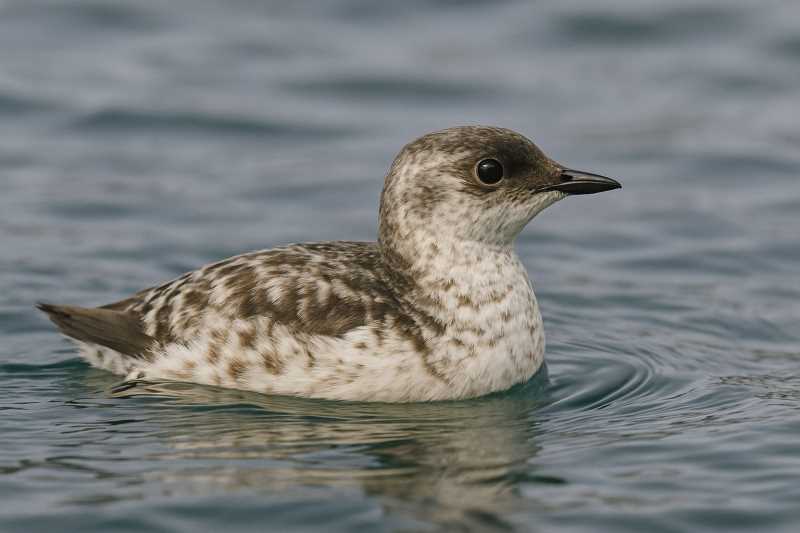
Kittlitz’s Murrelet is distinguished by its compact body, short neck, and small bill. In breeding plumage, it exhibits a mottled brown and white appearance that helps it camouflage against the rocky, glacial environments where it breeds. During the non-breeding season, its plumage turns a more uniform gray, making it less conspicuous in the open ocean.
These birds are typically seen alone or in pairs, although they may gather in small groups in areas rich in food resources. Their diet primarily consists of small fish and invertebrates, which they catch by diving underwater. Kittlitz’s Murrelet is known for its remarkable diving abilities, using its wings to ‘fly’ underwater in pursuit of prey.
Habitat and Distribution
The habitat of Kittlitz’s Murrelet is closely tied to glacial environments. During the breeding season, they are often found in glacially influenced regions, nesting on bare ground near glaciers or on isolated scree slopes. This preference makes them one of the few bird species directly dependent on glacial ecosystems.
Outside the breeding season, these murrelets disperse into coastal marine waters, often near tidewater glaciers and fjords, where they continue to forage. They are known to inhabit the coastal regions of Alaska, from the Aleutian Islands to southeast Alaska, and parts of Russia’s Kamchatka Peninsula and the Kuril Islands.
Conservation Status and Challenges
The International Union for Conservation of Nature (IUCN) currently lists Kittlitz’s Murrelet as "Near Threatened." This classification arises from several factors, including habitat loss, climate change, and human activities. The bird’s reliance on glacial environments makes it particularly vulnerable to climate change, as rising temperatures lead to glacier retreat and loss of nesting habitats.
In addition to habitat challenges, Kittlitz’s Murrelet faces threats from oil spills, human disturbance, and gillnet fisheries. Efforts to monitor and protect this species are complicated by its remote and sparse distribution, making population assessments difficult. Conservation strategies often involve monitoring populations in key breeding areas and minimizing human disturbances.
Research and Conservation Efforts
Research efforts have increasingly focused on understanding the ecology and behavior of Kittlitz’s Murrelet. Satellite tracking and banding studies have provided insights into their migration patterns and habitat use. These studies are crucial for developing effective conservation strategies as they highlight critical areas that require protection.
Conservationists are also working with local communities and governments to implement measures that reduce human impact on critical habitats. These include establishing protected areas, enforcing regulations on fishing practices, and raising awareness about the species and its ecological importance.
The Future of Kittlitz’s Murrelet
The future of Kittlitz’s Murrelet is intrinsically linked to the health of glacial ecosystems. As climate change continues to reshape these environments, the species’ resilience will be tested. However, with concerted conservation efforts and increased awareness, there is hope that this unique seabird can continue to thrive in its natural habitat.
Understanding and mitigating the impacts of human activities and climate change on Kittlitz’s Murrelet is essential. By prioritizing research and conservation, we can ensure that future generations will have the opportunity to marvel at this mysterious bird and its icy home.
Related posts