Introduction
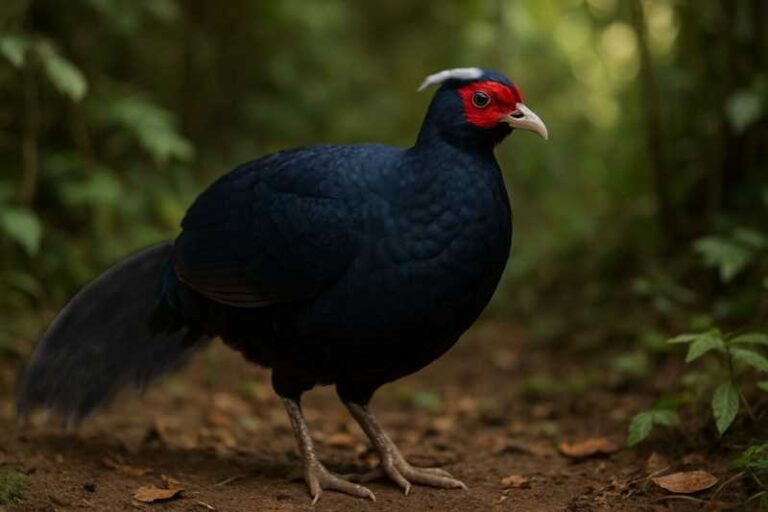
The Helmeted Guineafowl, Numida meleagris, is a stocky, ground-dwelling gamebird native to sub-Saharan Africa. It is the most widespread and commonly domesticated guineafowl species. The bird is recognised by its dark, white-spotted plumage, bare blue and red head, and prominent bony casque, or helmet, on the crown.
Physical Description
Adult Helmeted Guineafowl are approximately 53–58 centimetres long. They have rounded bodies, short tails and strong legs suited to walking and running. The plumage is dark grey to blackish, with numerous small white spots that give the bird a finely spotted or pearled appearance.
The head and upper neck are largely bare. Bare skin is commonly blue or bluish-grey, with red facial skin and wattles around the bill. A hard, helmet-like casque rises from the crown. Males and females are broadly similar in colour and pattern, although males may have slightly larger casques and wattles in some populations.
Juveniles have less developed head ornamentation and paler, duller facial skin. Their body plumage is generally browner and their white spotting is less strongly defined. Newly hatched chicks, often called keets in domestic and avicultural contexts, are downy and mobile soon after hatching.
Range and Habitat
The species is native to much of sub-Saharan Africa, with a range extending from West Africa across eastern Africa and southwards to southern Africa. It occurs in several geographic forms, with regional differences in head coloration, casque shape, wattles and plumage details.
Helmeted Guineafowl favour open or semi-open habitats, including savannas, grasslands, scrub, open woodland, cultivated land and rural landscapes. They generally avoid dense forest, extensive deserts and permanently wet marshes. Suitable habitat usually provides ground cover for nesting, open areas for foraging and trees or other elevated sites for night-time roosting.
The species is non-migratory, although individuals and flocks may travel considerable distances while foraging. Domesticated birds have been introduced to regions outside Africa, where some populations are maintained on farms or occur as escapes and feral birds.
Behaviour and Diet
Helmeted Guineafowl are diurnal and highly social. Outside the breeding period, they commonly form flocks ranging from small groups to several dozen birds. Southern African observations describe relatively stable non-breeding flocks of about 15–40 birds, although group size varies with habitat, season and local conditions.
They spend much of the day walking and running across the ground while searching for food. Their diet is omnivorous and includes seeds, grains, grass, shoots, leaves, berries and other plant material, together with insects, snails and other invertebrates. Small vertebrates may occasionally be eaten. Like many ground-feeding birds, they swallow small stones to assist digestion in the gizzard.
The species is noisy and communicates with loud, far-carrying calls. Alarm calls can alert flock members to predators or other dangers, while contact calls help birds maintain cohesion as they move through vegetation. At night, flocks commonly roost in trees, where they are less vulnerable to some ground predators.
Breeding generally coincides with the rainy season or another period of increased food availability, although the timing varies geographically. Pairs form within the wider flock, and males may guard females during egg laying and incubation. The female lays a clutch in a concealed scrape on the ground, usually hidden among grass or other vegetation. Clutch size commonly falls within the range of 6–15 eggs, and incubation lasts about 26–30 days. The female performs most or all of the incubation, while both parents may protect and brood the chicks after hatching. The young are precocial and begin moving and feeding with the adults soon after they hatch.
The species is hunted in parts of Africa and is also widely kept for meat and eggs. Domesticated Helmeted Guineafowl may be used in small-scale farming and are sometimes kept as ornamental or alert birds.
Identification Tips
Look for the following combination of features:
- A large, rounded, chicken-sized body.
- Dark grey or blackish plumage covered with many small white spots.
- A mostly bare head and upper neck with blue, bluish-grey and red skin.
- A distinct bony casque on the crown.
- A flock that walks or runs together while making loud, harsh calls.
- Strong preference for walking on the ground, despite the ability to fly short distances.
The Helmeted Guineafowl can be separated from other guineafowl by its widespread distribution, spotted dark body and relatively compact casque. The Vulturine Guineafowl, Acryllium vulturinum, is more elongated, has a much longer neck and tail, and shows conspicuous blue, white and chestnut patterning rather than the Helmeted Guineafowl’s uniformly spotted dark plumage.
Conservation Status
The Helmeted Guineafowl is classified as Least Concern on the IUCN Red List. It remains widespread and adaptable, and it occurs in natural, agricultural and human-modified landscapes. A reliable global population estimate is not required for the Least Concern assessment and is not given here.
Local populations may nevertheless be affected by habitat conversion, unsustainable hunting, nest disturbance, predation and changes in agricultural practices. Conservation is best supported by retaining suitable savanna, grassland and open woodland, protecting nesting and roosting sites, and managing hunting and domestication responsibly. Local monitoring remains important because a species with a secure global status can still decline in particular regions.
Frequently Asked Questions
Where does the Helmeted Guineafowl live?
It is native to much of sub-Saharan Africa, where it inhabits savannas, grasslands, scrub, open woodland, cultivated land and other open habitats with cover and nearby roosting sites.
What does the Helmeted Guineafowl eat?
It eats a broad omnivorous diet that includes seeds, grains, shoots, leaves, berries, insects, snails and other invertebrates. Small vertebrates may occasionally be taken.
Can Helmeted Guineafowl fly?
Yes. They are capable of strong but usually short flights, although they spend most of their time walking and running on the ground. They may fly into trees to roost or escape immediate danger.
How many eggs does a Helmeted Guineafowl lay?
A clutch commonly contains about 6–15 eggs. The nest is usually a concealed scrape on the ground, and incubation takes approximately 26–30 days.
Are Helmeted Guineafowl endangered?
No. The species is currently assessed as Least Concern globally. Hunting and habitat loss can still threaten local populations, so regional conservation and monitoring remain important.
What is the helmet on its head?
The helmet is a bony casque that projects from the crown. Both sexes possess one, although its size and shape can vary among individuals and geographic forms.
References
- BirdLife International. 2024. Handbook of the Birds of the World and BirdLife International Digital Checklist of the Birds of the World, Version 9. BirdLife International and Lynx Edicions. Stable database source: https://datazone.birdlife.org/ . Accessed 8 September 2026.
- Elbin, S. B., Crowe, T. M. and Graves, H. B. 1986. Reproductive behavior of Helmeted Guinea Fowl (Numida meleagris): Mating system and parental care. Applied Animal Behaviour Science, 16(2): 179–197. https://doi.org/10.1016/0168-1591(86)90110-3.
- International Union for Conservation of Nature. 2026. Numida meleagris, Helmeted Guineafowl. The IUCN Red List of Threatened Species. https://www.iucnredlist.org/species/22679555/0. Accessed 8 September 2026.
- Portner, M. 2021. Numida meleagris, Helmeted Guineafowl. Animal Diversity Web, University of Michigan Museum of Zoology. https://animaldiversity.org/accounts/Numida_meleagris/. Accessed 8 September 2026.
- South African National Biodiversity Institute. 2020. Helmeted Guinea-fowl, Numida meleagris. SANBI Animal of the Week. https://www.sanbi.org/animal-of-the-week/helmeted-guinea-fowl/. Accessed 8 September 2026.
- Berhanu, Y. A., Bekele, A. and Bogale, B. A. 2023. Breeding biology of the helmeted guineafowl (Numida meleagris meleagris, Linnaeus 1758) in Western Ethiopia. Ornithology Research, 31(3): 173–181. https://doi.org/10.1007/s43388-023-00132-6.
- Gill, F., Donsker, D. and Rasmussen, P., eds. 2026. IOC World Bird List, version 15.2. International Ornithologists’ Union. https://www.worldbirdnames.org/ . Accessed 8 September 2026.
Related posts