Introduction
Gould’s Inca (Coeligena inca) is a medium-sized hummingbird of the eastern Andes. It is recognised as a distinct species by the IOC World Bird List and BirdLife International, although some South American taxonomic treatments have historically included it within the Collared Inca complex. The species occurs in south-eastern Peru and Bolivia, where it inhabits humid montane forest and adjoining highland vegetation.
Physical Description
Gould’s Inca measures about 14.5 centimetres in length and weighs approximately 6.8 to 7.2 grams. Like other members of the genus Coeligena, it has a long, straight, black bill and a compact, powerful flight style.
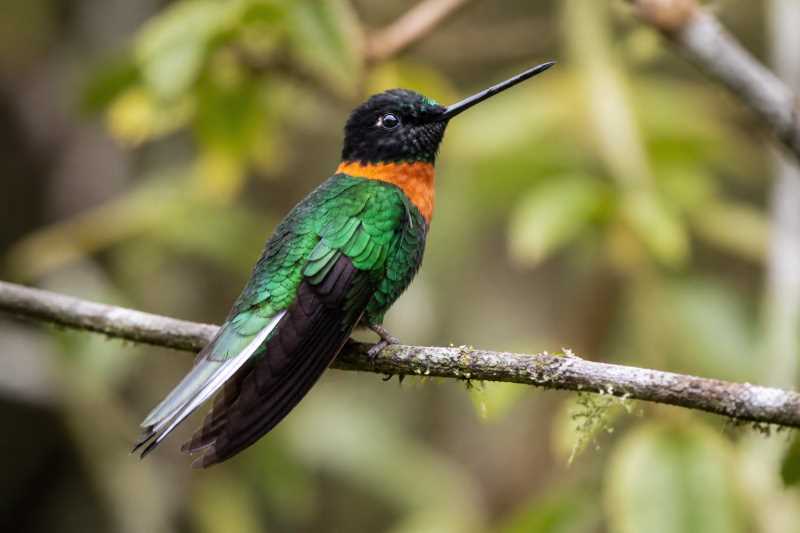
The adult male has a mostly velvety black head, a green forehead and a small white spot behind the eye. Its upperparts are golden-green, becoming brighter towards the lower back. The throat is dark, while the upper breast has a conspicuous rufous-orange collar. The belly is glittering green, and the undertail coverts are golden-green with pale fringes. The tail is dark in the centre, with contrasting pale or whitish areas towards the outer feathers.
Females are less strongly marked. They generally have a lighter, more spotted head, a less intense collar and more subdued green-and-rufous plumage below. Young birds resemble females and acquire the stronger adult pattern as they mature. Birds from the Peruvian form traditionally called omissa tend to have a bluer forehead, a greener throat and darker green overall plumage than birds of the nominate form in Bolivia.
Range and Habitat
Gould’s Inca is found along the eastern slopes of the Andes from south-eastern Peru to central Bolivia. In Peru, its range includes the departments of Cusco and Puno. In Bolivia, it occurs particularly in the departments of La Paz and Cochabamba.
It is associated mainly with wet montane forest, cloud-forest edges, dense lower growth and the lower canopy. The species has been recorded from approximately 1,600 to 3,200 metres above sea level, although local records vary with terrain and habitat. It is a resident species across its range, with short local or seasonal movements possible.
The original article placed Gould’s Inca in Colombia and Ecuador, but those countries belong primarily to other members of the former Collared Inca complex. Gould’s Inca itself is a bird of Peru and Bolivia.
Where to See This Species
Wayqecha Biological Station, Cusco, Peru
Wayqecha lies in the upper Kosñipata Valley near the transition between humid montane forest, elfin forest and puna. Gould’s Inca has been documented at the station and has also been the subject of nesting research in the surrounding Manu landscape. The site’s trails, flowering plants and varied elevations make it a realistic place to search the forest edge and lower vegetation, particularly with a local guide or research-station arrangement.
Nearby accommodation: Paucartambo is the nearest practical town for guest houses and small hotels. Wayqecha itself may offer research or visitor accommodation subject to prior arrangement.
Manu National Park and its buffer zone, Cusco and Madre de Dios, Peru
The upper-elevation forests around Manu provide suitable habitat for Gould’s Inca, and detailed breeding observations have been made in the park’s buffer zone. Access is regulated and normally involves authorised operators, guides and advance planning. Birders should concentrate on humid montane forest, forest margins and flowering vegetation along accessible upper Manu routes.
Nearby accommodation: Paucartambo is a useful gateway for the highland approach, while Salvación and other authorised Manu gateway settlements provide basic lodges, guest houses and guided-tour accommodation farther into the region.
Machu Picchu Historic Sanctuary, Cusco, Peru
Gould’s Inca has been documented around the Machu Picchu area, where humid Andean forest and dense vegetation provide appropriate habitat. The species is most likely to be encountered away from the busiest ruins, along forested paths and on quieter trails at suitable elevations. Sightings are not guaranteed, so careful observation of flowering plants and shaded forest edges is recommended.
Nearby accommodation: Aguas Calientes, also known as Machu Picchu Pueblo, is the practical base, with hotels, guest houses and other visitor accommodation.
Behaviour and Diet
Gould’s Inca is generally encountered alone while feeding, although several individuals may use the same productive area. Like many hummingbirds, it may defend a profitable feeding site and chase other hummingbirds from flowers or perches. It usually forages in the understory and lower canopy, moving rapidly between flowers and returning repeatedly to favoured perches.
Its diet consists mainly of nectar from tubular flowers, including plants associated with humid Andean forest such as bromeliads and other nectar-rich shrubs and herbs. It also captures small insects and spiders, especially when breeding, to obtain protein and other nutrients.
The species is a trap-liner, visiting a regular circuit of flowering plants rather than remaining at one flower patch continuously. This behaviour also makes it an important pollinator of high-elevation plants.
Breeding information is limited, but research in the Manu region recorded mossy, cup-shaped nests lined with fern scales at elevations of about 2,200 to 3,000 metres. The female undertakes incubation and most or all nest care. Nesting observations have included one or two eggs, but the original article’s general figures for incubation and fledging should not be treated as confirmed species-wide averages.
Identification Tips
- Look for a medium-sized, long-billed hummingbird in humid montane forest between roughly 1,600 and 3,200 metres.
- The rufous-orange breast collar is the most useful field mark. It contrasts with the broad white breast patch of the typical Collared Inca, Coeligena torquata.
- The dark head, green forehead, white spot behind the eye and green lower body are useful supporting features.
- In poor light, the bird can appear almost black. Direct sunlight may reveal the golden-green upperparts and iridescent green belly.
- Peruvian birds traditionally assigned to omissa may show a bluer forehead and greener throat than Bolivian birds.
- Take care with older field guides, which may list this bird as Gould’s or southern Collared Inca, Coeligena torquata inca or Coeligena torquata omissa.
Conservation Status
Gould’s Inca is classified as Least Concern by the IUCN Red List. It has a broad range in the eastern Andes and is not currently considered to face a high global risk of extinction.
Nevertheless, humid montane forests remain vulnerable to deforestation, agricultural expansion, road construction, fire and changes in rainfall and temperature. Protection of cloud forest, maintenance of connected habitat and careful management of tourism are important conservation measures. Local habitat loss may be significant even where the species remains secure at a global level.
Frequently Asked Questions
Where does Gould’s Inca live?
Gould’s Inca lives in the eastern Andes of south-eastern Peru and Bolivia. It favours humid montane forest, cloud-forest edges and dense lower-canopy vegetation.
Is Gould’s Inca the same bird as the Collared Inca?
No. Gould’s Inca was formerly treated as part of the Collared Inca complex, but the IOC World Bird List and BirdLife International recognise it as Coeligena inca. Some other taxonomic authorities may still treat the complex differently.
What does Gould’s Inca look like?
It is about 14.5 centimetres long, with a long black bill, a dark head, a green forehead, a white spot behind the eye and a distinctive rufous-orange breast collar. The lower body is mainly green.
What does Gould’s Inca eat?
It feeds mainly on nectar from tubular flowers and supplements this diet with small insects and spiders. It often follows a regular route between productive flowers.
Is Gould’s Inca migratory?
It is considered resident throughout its range. Short-distance movements may occur in response to local conditions and flowering patterns, but long-distance migration is not known.
Where is the best place to look for Gould’s Inca?
Wayqecha Biological Station and the upper Manu region in Cusco are well-documented places to search. The Machu Picchu area also has records, particularly in suitable humid forest and forest-edge habitat.
References
- IOC World Bird List
- BirdLife International and the IUCN Red List of Threatened Species
- The Wilson Journal of Ornithology
Related posts