Introduction
The Dwarf Cassowary, also known as Bennett’s Cassowary or the Mountain Cassowary, is a flightless forest bird of the cassowary family, Casuariidae. Its accepted scientific name is Casuarius bennetti. It is the smallest of the three living cassowary species and is native primarily to the mountainous forests of New Guinea, with records from several nearby islands.
Physical Description
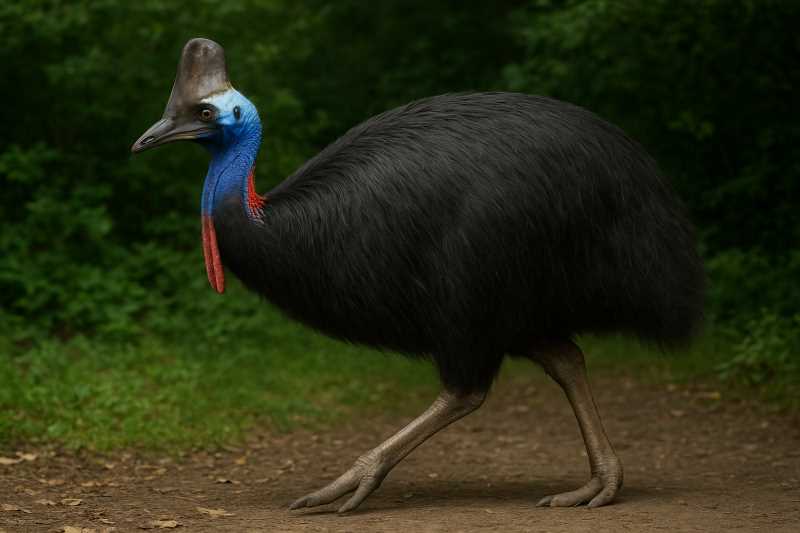
The Dwarf Cassowary stands about 99–135 cm tall and weighs approximately 18–29 kg, although measurements vary between sources and populations. It has coarse, black plumage, greatly reduced wings and powerful, unfeathered legs. Each foot has three toes, with the inner toe bearing a large, sharp claw.
The head and neck are largely bare. The skin is predominantly blue, with red areas on the neck, and the head carries a low, triangular casque. Unlike the Southern and Northern Cassowaries, the Dwarf Cassowary does not have prominent hanging wattles.
Females are generally larger than males and may have a taller casque. Juveniles are browner and less vividly coloured than adults, while chicks have a striped pattern that provides camouflage in forest vegetation.
Range and Habitat
The Dwarf Cassowary is endemic to the New Guinea region. Its main range extends across Papua New Guinea and the Indonesian provinces of Papua and West Papua. It is associated especially with hill, montane and cloud forests, although it can occur at lower elevations where suitable forest remains. Published records place it from roughly 300 m to about 3,000–3,300 m above sea level.
The species inhabits dense tropical and subtropical forest, including steep terrain, forest edges and areas containing fruiting trees. It is not migratory in the conventional long-distance sense, but some individuals may move between elevations as fruit availability changes. Reports from islands such as New Britain and Yapen should be interpreted with some caution because cassowaries have been traded and moved by people, making the natural status of some island populations uncertain.
Behaviour and Diet
Dwarf Cassowaries are generally solitary and difficult to observe in dense forest. They are mainly active during the day and use their strong legs to move through steep, heavily vegetated terrain. When threatened, a cassowary may stand its ground, hiss or display aggressively. A persistent intruder can be injured by a forceful kick and the bird’s inner claw.
Fruit forms the main part of the diet. Studies in Papua New Guinea found that fruit accounted for more than 90 per cent of the diet at the study site, although the birds also consume fungi, leaves, plant material, insects and other small animals when available. Fallen fruit and fruit growing close to the ground are particularly important.
By swallowing large fruits and passing their seeds in droppings, Dwarf Cassowaries disperse plants through the forest. Research has shown that their movements can carry seeds considerable distances and may move them uphill or to level ground, contributing to forest regeneration and the distribution of large-seeded plants.
Breeding is polygynous or polyandrous in structure. After courtship and mating, the female lays her eggs in a ground nest and usually leaves, while the male incubates the clutch and raises the chicks. The male provides protection and care until the young become more independent. The timing of breeding varies with local conditions, including food availability.
Identification Tips
- Look for a medium-sized cassowary with entirely black body plumage, a blue-and-red bare neck and a relatively low, triangular casque.
- The species lacks the prominent wattles seen in the Southern and Northern Cassowaries.
- It is usually encountered in hill or montane forest rather than the lowland habitats most strongly associated with the Northern Cassowary.
- Females are larger than males, but sex is not always possible to determine in the field.
- Juveniles are browner and duller than adults, while chicks are striped and much smaller.
- Tracks, droppings containing large seeds and narrow forest paths used repeatedly by the birds may provide evidence of the species even when no bird is seen.
Conservation Status
The Dwarf Cassowary is currently assessed as Near Threatened on the IUCN Red List. Available assessments indicate that the population is declining, although a reliable global population estimate is not available.
The principal threats are hunting for meat and feathers, habitat loss and degradation caused by logging, agricultural expansion, forest clearance and associated development. Hunting pressure can be particularly serious because the species is slow-breeding and depends on extensive forest landscapes. Local capture and trade may also affect some populations and complicate the interpretation of records from nearby islands.
Important conservation measures include protecting large areas of hill and montane forest, maintaining forest corridors, reducing unsustainable hunting and supporting community-led wildlife management. Conservation planning should also account for the Dwarf Cassowary’s role as a major disperser of large seeds and for its seasonal movements between elevations.
Frequently Asked Questions
Where does the Dwarf Cassowary live?
It lives mainly in the hill, montane and cloud forests of New Guinea, including Papua New Guinea and Indonesian New Guinea. It has also been reported from nearby islands, although the origin of some island populations is uncertain.
How large is a Dwarf Cassowary?
Adults are approximately 99–135 cm tall and commonly weigh around 18–29 kg. Females are usually larger than males.
What does the Dwarf Cassowary eat?
Fruit makes up most of its diet, particularly fallen fruit and fruit growing close to the ground. It also eats fungi, plant material, insects and small vertebrates or other invertebrates when available.
Can the Dwarf Cassowary fly?
No. Like other cassowaries, it is flightless and has greatly reduced wings. Its strong legs allow it to travel effectively through dense and mountainous forest.
Does the male or female care for the chicks?
The male normally incubates the eggs and cares for the chicks after hatching. The female may leave after laying and subsequently mate with another male.
Why is the Dwarf Cassowary important to the forest?
It is an important disperser of large seeds. Seeds carried in cassowary droppings can be moved away from parent trees and deposited in locations suitable for germination, helping maintain forest diversity.
References
- BirdLife International. 2024. Casuarius bennetti. BirdLife DataZone and IUCN Red List assessment resources. BirdLife International. https://datazone.birdlife.org/; accessed 8 September 2026.
- International Union for Conservation of Nature. 2021. Casuarius bennetti. The IUCN Red List of Threatened Species, species account. https://www.iucnredlist.org/species/22678111/92755192; accessed 8 September 2026.
- Gill, F., Donsker, D. and Rasmussen, P. (eds.). 2026. IOC World Bird List, version 15.2. International Ornithologists’ Union. https://www.worldbirdnames.org/; accessed 8 September 2026.
- Wright, D. D. 2005. Diet, keystone resources and altitudinal movement of Dwarf Cassowaries in relation to fruiting phenology in a Papua New Guinean rainforest. In J. L. Dew and J. P. Boubli (eds.), Tropical Fruits and Frugivores: The Search for Strong Interactors, pp. 205–236. Springer, Dordrecht. https://doi.org/10.1007/1-4020-3833-X_11.
- Mack, A. L. 1995. Distance and non-randomness of seed dispersal by the Dwarf Cassowary Casuarius bennetti. Ecography 18(3): 286–295. https://doi.org/10.1111/j.1600-0587.1995.tb00131.x.
- Pratt, T. K. 1983. Diet of the Dwarf Cassowary Casuarius bennetti picticollis at Wau, Papua New Guinea. Emu, publication details as cited in Wright (2005).
- Australian Museum. n.d. Cassowaries. Australian Museum, animal species information and breeding behaviour overview. https://australian.museum/learn/animals/birds/southern-cassowary/; accessed 8 September 2026.
- Wildlife Conservation Society Papua New Guinea. 2021. First camera-trap videos of Dwarf Cassowaries in the Mt Goplom Conservation Area along the Bismarck forest corridor ecosystem. Wildlife Conservation Society. https://programs.wcs.org/png/About-Us/News/articleType/ArticleView/articleId/16928/; accessed 8 September 2026.
Related posts