Introduction
The Chestnut Teal, Anas castanea, is a small Australian dabbling duck in the family Anatidae. It is best known for the strong contrast between the male’s glossy green head and chestnut body and the female’s mottled brown plumage. The species uses both freshwater and saline wetlands, including estuaries, lagoons, swamps, reservoirs and some urban waterbodies.
Physical Description
The Chestnut Teal is a compact duck measuring approximately 35 to 50 centimetres in length. It is strongly sexually dimorphic, meaning that adult males and females have distinctly different plumage.
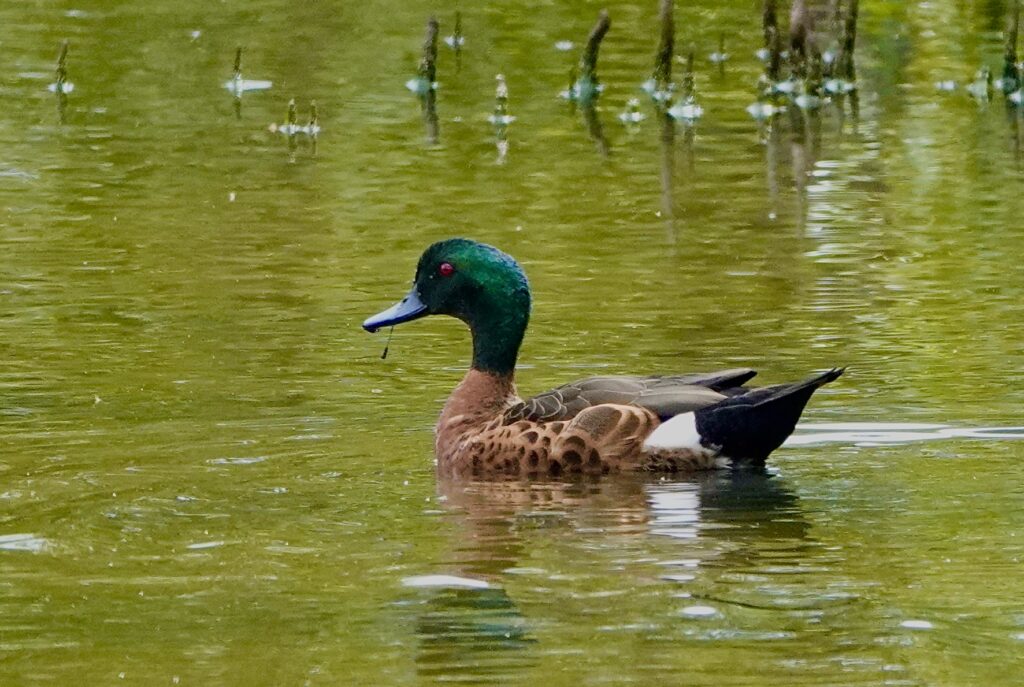
Adult males have a glossy green head and neck, chestnut-brown breast, neck and flanks, darker brown upperparts and wings, and a black undertail area with a contrasting white patch. Adult females are mottled brown and grey overall, with a paler throat, brown streaking and a dark eye stripe. Both sexes have a deep red iris, a blue-grey bill, greenish-grey legs and feet, and a glossy green to purple wing speculum edged with white.
Young birds and non-breeding males are generally duller and may be more difficult to distinguish from females or the related Grey Teal. Plumage characters, including the throat pattern, body colour and wing markings, are useful when ageing or identifying less brightly coloured birds.
Range and Habitat
The Chestnut Teal is native to Australia and is concentrated in the south-eastern and south-western parts of the country. In eastern Australia, it occurs from around Rockhampton in Queensland south through New South Wales, Victoria and Tasmania, and westwards to South Australia. It is most common in the south-east. Occasional records have also been reported from Lord Howe Island and New Guinea.
The species occurs in coastal wetlands and estuaries, as well as freshwater lakes, lagoons, swamps, reservoirs, sewage ponds and suitable urban parks. It is one of the few Australian ducks that can tolerate relatively saline water, although access to fresh water for drinking remains important.
Chestnut Teal commonly breeds near wetlands with suitable tree hollows or dense vegetation. It may use hollows in trees standing over or close to water, short grassland near water, and artificial nest boxes. Most individuals are resident or move only short distances, although some seasonal movement occurs between breeding and non-breeding areas.
Behaviour and Diet
Chestnut Teal are dabbling ducks. They feed at the water’s edge, particularly around rising tides, and also dabble while swimming, up-end to reach food below the surface, and take items from the water surface. Their diet includes seeds, aquatic and terrestrial vegetation, insects, molluscs and crustaceans. The balance of plant and animal food varies with habitat and seasonal availability.
They are often seen singly, in pairs or in small groups. Larger gatherings may form outside the breeding season, especially where food and shelter are concentrated. Calls include whistles and grunts from males and chuckling quacks from females.
Breeding commonly occurs from July to November, although timing can vary with local conditions. Pairs select and defend nest sites, and the female usually incubates the eggs. Nests are frequently placed in down-lined tree hollows, sometimes several metres above the ground, but ground nests in vegetation and artificial nest boxes are also used. A typical clutch contains about nine to eleven eggs, and incubation lasts approximately 28 days. Ducklings are precocial and leave the nest soon after hatching. Both parents may contribute to brood protection, although male attendance generally declines as the ducklings grow.
Identification Tips
- Look for a small, compact dabbling duck with a high forehead and rounded head.
- An adult male is distinctive: the glossy green head contrasts with the chestnut breast, flanks and neck.
- Check for the white patch beneath the tail, red eye, blue-grey bill and greenish wing speculum.
- An adult female is mottled brown and grey, with a pale, brown-streaked throat and dark eye stripe.
- In flight, both sexes show a glossy green to purple speculum with white edging and pale wing panels.
- Grey Teal is the most likely confusion species. Grey Teal is generally less strongly patterned between the sexes, whereas male Chestnut Teal has a glossy green head and rich chestnut underparts. Juvenile and non-breeding Chestnut Teal can be harder to separate and should be assessed using several features rather than colour alone.
Conservation Status
The Chestnut Teal is currently assessed as Least Concern globally. No reliable evidence supports describing its overall population as stable in every part of its range, and local abundance can vary with wetland conditions and habitat quality.
Important threats include wetland drainage and modification, loss or degradation of estuaries and inlets, increased salinity, clearing, grazing, burning, urban development and pollution. Introduced foxes can prey on eggs, ducklings and adults. The species is also hunted in parts of Australia where regulated native-game hunting is permitted.
Conservation measures include protecting and restoring freshwater and saline wetlands, retaining mature trees with suitable hollows, managing predators, maintaining freshwater access and monitoring populations at important wetland sites. Artificial nest boxes can provide additional breeding opportunities where natural hollows are scarce, but they do not replace protection of the wider wetland habitat.
Frequently Asked Questions
Where does the Chestnut Teal live?
It lives mainly in south-eastern and south-western Australia, including Tasmania. It uses estuaries, lagoons, swamps, freshwater lakes, reservoirs, sewage ponds and other suitable wetlands.
What does a Chestnut Teal look like?
The adult male has a glossy green head, chestnut neck, breast and flanks, darker wings and a white patch beneath the tail. The female is mottled brown and grey, with a pale streaked throat and dark eye stripe.
What does the Chestnut Teal eat?
Its diet includes seeds, vegetation, insects, molluscs and crustaceans. It feeds by dabbling, up-ending, surface feeding and searching along wetland edges.
Is the Chestnut Teal migratory?
It is not generally a long-distance migrant. Many birds remain near their breeding areas, although some make local or seasonal movements between wetlands.
Where does the Chestnut Teal nest?
It commonly nests in down-lined tree hollows near or over water. It may also nest in ground vegetation and readily uses suitable artificial nest boxes.
Is the Chestnut Teal threatened?
The species is assessed as Least Concern globally. Nevertheless, local populations can be affected by wetland loss, salinity, development, predation, pollution and other forms of habitat degradation.
References
- Australian Museum. 2024. “Chestnut Teal, Anas castanea.” Australian Museum, updated 18 July 2024. Available at: https://australian.museum/learn/animals/birds/chestnut-teal/ Accessed 8 September 2026.
- Gill, F., Donsker, D. and Rasmussen, P. (eds). 2026. IOC World Bird List, version 15.2. International Ornithologists’ Union. Available at: https://www.worldbirdnames.org/ Accessed 8 September 2026.
- Museums Victoria. n.d. “Anas castanea, Chestnut Teal.” Museums Victoria Collections. Available at: https://collections.museumsvictoria.com.au/species/8240 Accessed 8 September 2026.
- Norman, F. I. and McKinney, F. 1987. “Clutches, broods, and brood care behaviour in Chestnut Teal.” Wildfowl, 38: 117–126. Available at: https://tidsskrift.dk/Wildfowl/article/view/154797 Accessed 8 September 2026.
- Rogers, D., Menkhorst, P. and Davies, J. 2018. Ageing and Sexing Victorian Native Game Birds Using Plumage Characters. Arthur Rylah Institute for Environmental Research Technical Report Series No. 294. Victorian Government, Melbourne. Available at: https://www.ari.vic.gov.au/__data/assets/pdf_file/0016/415330/ARI-Technical-Report-294-Ageing-and-sexing-Victorian-native-game-birds-using-plumage-characters.pdf Accessed 8 September 2026.
- Marchant, S. and Higgins, P. J. (eds). 1990. Handbook of Australian, New Zealand and Antarctic Birds, Volume 1: Ratites to Ducks, Part B: Australian Pelicans to Ducks. Oxford University Press, Melbourne.
Related posts