
Introduction
The Brushland Tinamou (Nothoprocta cinerascens) is a medium-sized ground-dwelling bird in the tinamou family, Tinamidae. It occurs mainly in dry habitats of southern South America, especially the Chaco and adjoining shrublands of Argentina, Bolivia and Paraguay. Secretive and well camouflaged, it is more often detected by its sudden, noisy flight or the whistle of a male than by prolonged observation. (ww.worldbirdnames.org)
Physical Description
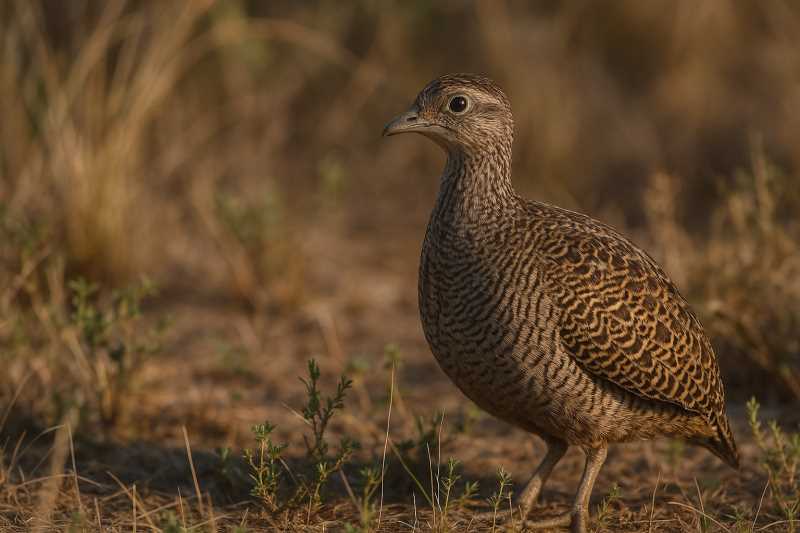
The Brushland Tinamou is approximately 29–32 centimetres long, with a compact, rounded body, short wings and a short tail. Its plumage is predominantly grey-brown or brownish-grey, marked with irregular dark barring, pale streaks and mottling that provide effective camouflage in thorn scrub and dry woodland.
The head is brown and black, with a small crest. The throat is white, while the grey breast has irregular dark lines and rounded pale spots. The wings are brown with ochre and black markings, and the grey-brown tail is barred with black and whitish tones. The bill is dark brown with a paler base to the lower mandible, the legs are cream to ivory, and the iris is pale yellow or yellowish-orange. (fcv.unl.edu.ar)
Reliable sources do not support the original article’s broad estimate of 400–600 grams as a standard field measurement for all individuals, and pronounced age-related differences are not well documented in the sources reviewed. As with many tinamous, the sexes are not readily separated in the field, although females may be slightly larger or more strongly marked in some populations. (lib.ysu.am)
Range and Habitat
The Brushland Tinamou is a resident of southern South America. Its confirmed range includes parts of Argentina, Bolivia and Paraguay, with its principal distribution associated with the Chaco and adjacent dry regions. The available sources do not support including Brazil as a regular part of its accepted range. (itis.gov)
It inhabits dry savanna woodland, Chaco forest, thorn scrub, shrub-steppe, grassland and woodland edges. It may also occur in cultivated areas, particularly where suitable cover remains. Most records are from relatively low elevations, although the species has been reported to approximately 2,000 metres in some parts of its range. In Bolivia it is regarded as a lowland Nothoprocta, associated especially with dry forest and thorn scrub. (encyclopedia.com)
The species is generally considered sedentary rather than migratory. Its distribution includes more than one recognised subspecies, but geographic variation is not sufficiently consistent across the sources reviewed to justify a detailed treatment here.
Behaviour and Diet
Brushland Tinamous are usually solitary and secretive. They move through dense vegetation on the ground and may remain motionless when danger approaches. When flushed, they leave the cover with a loud wingbeat and fly rapidly for a short distance before dropping back into vegetation. The species is therefore easily overlooked, especially where the habitat is dense. (fcv.unl.edu.ar)
The male’s advertising call is a clear, carrying whistle. In some areas the species is quieter during the austral winter, which can make detection more difficult. Its diet is taken mainly from the ground and includes seeds, fruit, tubers, shoots and buds, together with invertebrates such as insects, termites, earthworms and their larvae. The relative importance of plant and animal food varies with season and local conditions. (lib.ysu.am)
Breeding follows the unusual tinamou pattern in which females may mate with more than one male and lay eggs in a nest associated with a male’s territory. The male is responsible for incubating the eggs and caring for the chicks. The nest is a simple scrape concealed in dense vegetation. The eggs are glossy, and incubation is approximately 19–20 days according to the principal breeding study cited in the ornithological literature. The original claim that both parents normally share incubation is therefore not supported. (sora.unm.edu)
Identification Tips
Look for the following combination of features:
- A fairly large, compact tinamou, about 30 centimetres long.
- Grey-brown upperparts with irregular dark barring and pale streaks.
- A small head crest, white throat and spotted or irregularly marked grey breast.
- A relatively long, slightly downcurved bill.
- Cream-coloured legs and a short, barred tail.
- A sudden, noisy flush from thorn scrub, dry woodland or tall grass.
In Bolivia, the Brushland Tinamou can be distinguished from the smaller White-bellied Nothura by its larger size, more prominent crest, longer downcurved bill and spotted neck and breast. Field identification is often difficult because the bird spends much of its time concealed and its plumage blends closely with dry vegetation. (birdsofbolivia.org)
Conservation Status
The Brushland Tinamou is currently assessed as Least Concern at global level. It remains locally common in parts of its range, but local abundance varies and the species depends on suitable ground cover within dry woodland, shrubland and grassland habitats. (sib.gob.ar)
Habitat conversion for agriculture, removal of thorn scrub, fragmentation of dry woodland and local hunting may affect populations in some areas. The species’ ability to use certain cultivated landscapes does not remove the need to retain dense cover and connected patches of native habitat. Important conservation measures include protecting Chaco and dry-forest remnants, maintaining native vegetation within working landscapes, monitoring local populations and managing hunting pressure where it is significant. A reliable current species-wide population estimate was not identified in the sources reviewed.
Frequently Asked Questions
Where does the Brushland Tinamou live?
It occurs in Argentina, Bolivia and Paraguay, mainly in the Chaco and other dry regions with thorn scrub, dry woodland, shrub-steppe and grassland.
Is the Brushland Tinamou migratory?
It is generally regarded as a resident, sedentary species. Seasonal changes in calling activity can make it seem less common at particular times of year.
What does the Brushland Tinamou eat?
Its diet includes seeds, fruit, tubers, shoots and buds, supplemented by insects, termites, earthworms and other small invertebrates found on or near the ground.
How can the Brushland Tinamou be identified?
Useful features include its grey-brown barred plumage, small crest, white throat, spotted grey breast, long slightly downcurved bill, cream-coloured legs and loud, sudden flight from dense cover.
Does the male Brushland Tinamou incubate the eggs?
Yes. In the documented breeding system, the male incubates the eggs and cares for the chicks, while females may lay in a nest associated with more than one mating partner.
Is the Brushland Tinamou endangered?
No. It is currently classified as Least Concern globally, although habitat loss, fragmentation and local hunting may create important pressures in parts of its range.
References
- BirdLife International. n.d. “Brushland Tinamou Nothoprocta cinerascens.” BirdLife Data Zone. Accessed 8 September 2026. https://datazone.birdlife.org/species/factsheet/brushland-tinamou-nothoprocta-cinerascens
- Gill, F., Donsker, D. and Rasmussen, P., eds. 2026. IOC World Bird List, version 15.2. International Ornithologists’ Union. Accessed 8 September 2026. https://www.worldbirdnames.org/
- Lancaster, D. A. 1964. “Biology of the Brushland Tinamou, Nothoprocta cinerascens.” Bulletin of the American Museum of Natural History 127: 269–314.
- Universidad Nacional del Litoral, Facultad de Ciencias Veterinarias. 2026. “Inambú Montaraz, Nothoprocta cinerascens.” Aves Argentinas species account. Accessed 8 September 2026. https://www.fcv.unl.edu.ar/aves/categorias/tinamidae/inambu-montaraz/
- Sistema de Información de Biodiversidad, Administración de Parques Nacionales, Argentina. n.d. “Nothoprocta cinerascens, Inambú Montaraz.” Accessed 8 September 2026. https://sib.gob.ar/especies/nothoprocta-cinerascens
- Birds of Bolivia. 2019. “Nothoprocta cinerascens, Brushland Tinamou.” Species account, last updated 5 October 2019. Accessed 8 September 2026. https://birdsofbolivia.org/species-fact-sheets-2/tinamous-perdices/nothoprocta-cinerascens/
- del Hoyo, J., Elliott, A., Sargatal, J., Christie, D. A. and de Juana, E., eds. 2013. Handbook of the Birds of the World Alive. Lynx Edicions, Barcelona. Taxonomic information accessed through the Integrated Taxonomic Information System species record for Nothoprocta cinerascens. https://www.itis.gov/servlet/SingleRpt/SingleRpt?search_topic=TSN&search_value=553800
- Burton, M. 1985. “Tinamous.” In Grzimek’s Animal Life Encyclopedia, 2nd ed., Vol. 8, Birds I. Gale Research. Species account for Nothoprocta cinerascens.
Related posts


