Introduction
The Black-throated Hermit (Phaethornis atrimentalis) is a small hummingbird in the family Trochilidae. It occurs in western Amazonia and along the eastern Andean foothills of Colombia, Ecuador and Peru. Like other hermit hummingbirds, it has a long, decurved bill and is adapted to feeding on nectar in forest understorey habitats.
Physical Description
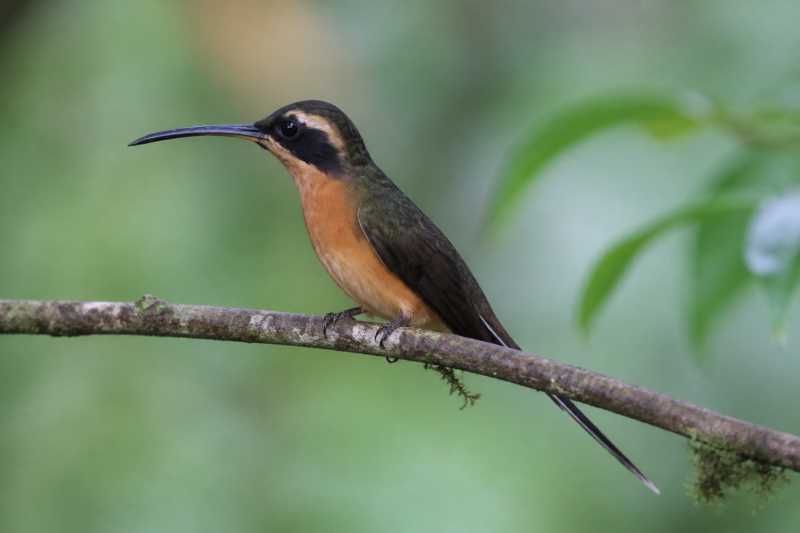
The Black-throated Hermit measures approximately 10.5–11.5 centimetres in length, with a bill about 23–25 millimetres long. Its upperparts are generally rufous or reddish-brown with darker markings, while the throat is dark brown to blackish. The breast, belly and rump are warm rusty or orange-red, contrasting with paler underwing coverts.
The long, decurved bill is characteristic of hermit hummingbirds and allows the bird to reach nectar in tubular flowers. The sexes are broadly similar in overall appearance, although individual plumage can vary with age, wear and subspecies. Juveniles may appear less sharply marked than adults.
Range and Habitat
The Black-throated Hermit is a resident species of Colombia, Ecuador and Peru. Its distribution extends from the eastern foothills of the Andes into western Amazonia, including parts of the departments and provinces east of the main Andean range. The species is not endemic to a single country and is not considered a regular long-distance migrant.
It is found mainly in humid lowland and foothill forest, particularly dense understorey, forest edges, secondary growth, swampy woodland and other transitional habitats with plentiful flowering plants. It can occur in modified landscapes and plantations when suitable vegetation remains. In Ecuador, records extend across Amazonian, eastern montane and foothill regions. The species is mostly associated with low elevations, although it can reach approximately 1,200 metres in parts of the Andean foothills.
Two subspecies are commonly recognised: P. a. atrimentalis in Colombia, Ecuador and northern Peru, and P. a. riojae in parts of central-eastern Peru. Their ranges and identification can be difficult to separate in the field without a clear location and good views.
Where to See This Species
Waqanki Private Conservation Area, San Martín, Peru
Waqanki, near Moyobamba, is a recognised birdwatching venue in the species’ known range. Black-throated Hermits have been recorded at the site, including around flowering plants and hummingbird-feeding areas associated with humid forest and forest edge. The species is resident, so it may be encountered throughout the year, although sightings depend on local flowering conditions.
Nearby accommodation: Moyobamba provides hotels, guest houses, lodges and other accommodation suitable for birdwatchers visiting the surrounding reserves.
Arenas Blancas Reserve, San Martín, Peru
Arenas Blancas Reserve near Moyobamba supports humid foothill forest and flowering understorey suitable for hermit hummingbirds. Black-throated Hermit has been recorded there during organised birding visits, making it a realistic site for observers exploring the San Martín region.
Nearby accommodation: Moyobamba is the nearest practical accommodation base, with hotels, guest houses, lodges and self-catering options in and around the town.
Huembo Center and Reserve, Amazonas, Peru
Huembo Center and Reserve, in the eastern Andean region of northern Peru, has Black-throated Hermit on its documented bird checklist. The reserve’s forest, edges and flowering vegetation provide suitable habitat, although visitors should expect the species to be less conspicuous than the more frequently seen hummingbirds at feeding stations.
Nearby accommodation: Pomacochas is the nearest recognised settlement for local accommodation, while Chachapoyas offers a wider choice of hotels, guest houses, lodges and tour services.
Behaviour and Diet
The Black-throated Hermit is usually encountered alone. It often moves quietly through shaded vegetation and may remain difficult to detect until it visits a flower or passes close to an observer. Like other hermits, it may follow a regular trap-line, visiting a series of flowering plants along a repeated route rather than defending one individual flower continuously.
Its diet consists mainly of nectar from tubular flowers. Reported food plants include members of the genera Costus, Aechmea, Palicourea and Drymonia. Small insects and other arthropods provide additional protein, particularly during periods of breeding and chick-rearing.
Species-specific information on breeding dates and nesting success is limited. As in other Phaethornis hummingbirds, the female is expected to undertake most or all nest construction, incubation and care of the young. Hermit hummingbirds commonly use plant fibres and spider silk to build small suspended nests in sheltered vegetation, but detailed nesting measurements should not be assumed for every population of this species.
Identification Tips
- Look for a small, long-billed hummingbird in shaded forest understorey, forest edge or dense secondary growth.
- The combination of a strongly decurved bill, dark throat and warm rusty-orange underparts is useful for identification.
- The plumage is generally less brightly iridescent than that of many other hummingbirds, so movement, habitat and shape can be more helpful than colour alone.
- Distinguish it from the Grey-chinned Hermit by the darker throat and the warmer rusty tones on the underparts, although lighting and plumage variation can make brief views difficult.
- Compare carefully with other small Phaethornis species in the region. Local distribution, bill shape, throat colour and the pattern of the underparts are more reliable than size alone.
Conservation Status
The Black-throated Hermit is currently assessed as Least Concern. Its relatively broad distribution across Colombia, Ecuador and Peru reduces the likelihood of an immediate global extinction risk, although a reliable global population estimate is not available in the sources consulted.
The principal concern is the loss and degradation of humid forest and forest-edge habitat through agricultural expansion, logging, infrastructure development and other land-use changes. Maintaining connected forest, protecting flowering understorey vegetation and conserving eastern Andean foothill and western Amazonian habitats are important measures for the species and the wider hummingbird community.
Frequently Asked Questions
Where does the Black-throated Hermit live?
It occurs in Colombia, Ecuador and Peru, mainly in humid lowland forest, eastern Andean foothills, forest edges, secondary growth and other dense habitats in western Amazonia.
Is the Black-throated Hermit migratory?
It is generally regarded as a resident species. Local movements may follow flowering conditions, but regular long-distance migration is not documented.
What does the Black-throated Hermit eat?
It feeds mainly on flower nectar and supplements this diet with small insects and other arthropods. Recorded plant resources include Costus, Aechmea, Palicourea and Drymonia.
How can the Black-throated Hermit be identified?
Look for a small hermit hummingbird with a long, decurved bill, a dark throat and rusty or orange-red underparts. It is most often found in shaded understorey and forest-edge vegetation.
Where is the best place to see this species?
Documented birdwatching venues include Waqanki and Arenas Blancas near Moyobamba in Peru, as well as Huembo Center and Reserve in Amazonas. Sightings are not guaranteed, because the species can be quiet and inconspicuous.
What is the conservation status of the Black-throated Hermit?
The species is classified as Least Concern. Habitat loss and degradation remain important local pressures, particularly where humid forest and dense understorey are cleared or heavily altered.
References
- BirdLife International
- IOC World Bird List
- Museo de Zoología, Pontificia Universidad Católica del Ecuador
Related posts