Introduction
The Black-eared Cuckoo (Chalcites osculans) is a small Australian cuckoo associated mainly with dry woodland, mallee and open shrubland. It is an obligate brood parasite, laying its eggs in the nests of other small birds rather than raising its own young. Although widespread across mainland Australia, it is often uncommon and can be difficult to detect outside suitable habitat and breeding periods.
Physical Description
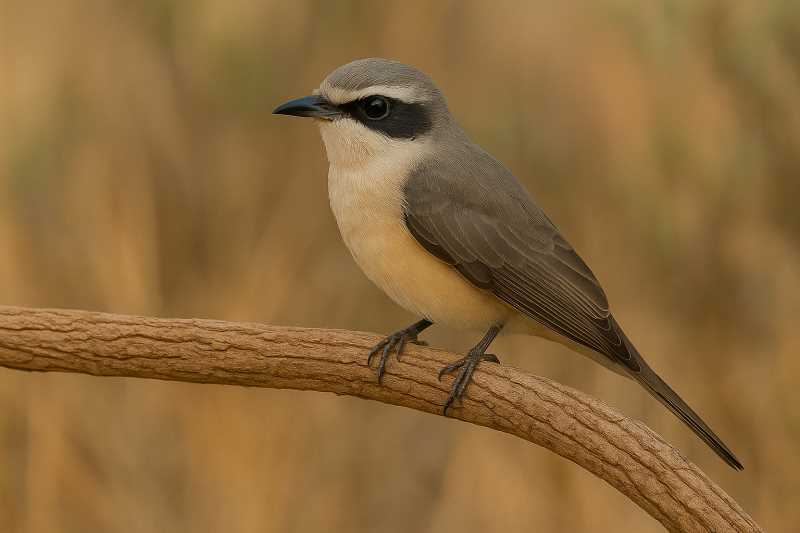
The Black-eared Cuckoo is approximately 19 to 21 centimetres long. It has grey to greyish-brown upperparts, warm cinnamon or orange-brown underparts, and a slender body with a long tail. A strong black stripe extends from the bill across the eye and along the side of the head, creating the distinctive dark ear-like marking for which the species is named.
The tail is grey-brown above and finely barred below, with pale or white tips. The bill, legs and feet are dark, and the eyes are brown. Unlike several Australian bronze-cuckoos, the Black-eared Cuckoo lacks strongly metallic green or bronze upperparts. Juveniles are generally duller and browner than adults, with less sharply defined facial markings. Reliable evidence of pronounced sexual dimorphism is limited, so males and females are usually identified by the same general field characters.
Range and Habitat
The Black-eared Cuckoo is native to mainland Australia and is distributed widely but patchily, particularly through inland and southern regions. It occurs in dry forests, open eucalypt woodland, mallee, mulga, cypress-pine woodland, riverine woodland and open shrubland dominated by species such as saltbush, bluebush and eremophila.
It is most often associated with open vegetation containing a mixture of trees, shrubs and ground cover. Suitable breeding habitat depends not only on vegetation structure but also on the presence of appropriate host birds. Records may therefore be scattered, and breeding locations can shift in response to rainfall, fire, grazing pressure and changes in host abundance.
The species is not reliably described as either wholly resident or wholly migratory. Some individuals appear to remain in parts of their range, while others move seasonally or in response to rainfall and breeding opportunities. Breeding is concentrated mainly south of the Tropic of Capricorn and is often linked to periods when host species are nesting.
Where to See This Species
Clarkesdale Bird Sanctuary, Victoria, Australia
Clarkesdale Bird Sanctuary supports woodland and wetland birdlife and specifically records the Black-eared Cuckoo among its more than 150 bird species. The surrounding woodland and re-established native vegetation provide suitable habitat. Spring and summer offer particularly active birding conditions, although the sanctuary can be visited throughout the year.
Nearby accommodation: Camping is available at the sanctuary, while guest houses, hotels, cabins and other accommodation can be found in nearby towns such as Linton and Ballarat.
Wyperfeld National Park, Victoria, Australia
Wyperfeld National Park is a recognised Victorian location for Black-eared Cuckoo, particularly in its mallee woodland and other dry inland habitats. The species is generally scarce, so listening for its call and searching patiently through suitable woodland during the warmer months offers a better chance than relying on roadside sightings alone.
Nearby accommodation: The nearest practical bases include Hopetoun and Patchewollock, with hotels, guest houses, cabins and camping options available in the wider Wimmera-Mallee region.
Behaviour and Diet
Black-eared Cuckoos are usually seen singly or in pairs, although several birds may interact at the beginning of the breeding season. They are active during the day and are often detected by their vocalisations before they are seen. The call has been described as a repeated, plaintive or descending whistle.
The species is predominantly insectivorous. It commonly forages on or close to the ground and may also make short sallies from shrubs to capture prey. Its diet includes insects and their larvae. Cuckoos can be important predators of insect larvae, although the ecological significance of this feeding role has not been quantified specifically for the Black-eared Cuckoo.
The Black-eared Cuckoo is an obligate brood parasite. It lays its eggs in the nests of other birds, leaving the host to incubate the egg and feed the young cuckoo. The most frequently documented hosts include the Speckled Warbler and Redthroat, although more than 24 host species have been recorded. Potential or reported hosts also include some heathwrens and fieldwrens with suitable domed nests.
The cuckoo’s dark egg can resemble the eggs of important host species, and its dark nestling plumage may also reduce recognition by some hosts. However, the presence of a cuckoo egg in a nest does not necessarily indicate successful breeding, as eggs may be rejected and nests may be abandoned or destroyed by predators.
Identification Tips
Look for a small, slender cuckoo with the following combination of features:
- Grey-brown upperparts without a strong metallic bronze sheen.
- Warm cinnamon or orange-brown underparts.
- A prominent black facial stripe running from the bill through the eye towards the neck.
- A long, grey-brown tail with pale tips and fine barring underneath.
- A preference for open mallee, dry woodland and shrubland rather than dense forest.
The black facial stripe and plain grey-brown upperparts help separate it from the more brightly coloured Horsfield’s Bronze-Cuckoo. The Black-eared Cuckoo is also generally less glossy and less strongly marked on the back than several other small Australian bronze-cuckoos. Because it is often concealed in foliage and is more frequently heard than seen, learning its call is useful for field identification.
Conservation Status
The Black-eared Cuckoo is listed as Least Concern globally by the IUCN Red List. In Australia, it is not listed under the Environment Protection and Biodiversity Conservation Act 1999. However, an Australian conservation assessment identified the species as data deficient for national listing purposes, with insufficient information to quantify any population decline.
There is evidence of concern in parts of the range, particularly where woodland habitat and the species’ main host birds have declined. Major threats include:
- Clearing and fragmentation of mallee, woodland and shrubland.
- Loss of ground cover through intensive grazing and introduced herbivores.
- Predation of adults, nests and young by feral cats, foxes, pigs and other predators.
- Reduced insect availability associated with pesticide use and environmental change.
- Drought, altered rainfall patterns and climate change, which may reduce both insect prey and breeding opportunities.
Conservation measures should protect large, connected areas of dry woodland and shrubland, maintain native ground cover, reduce pressures from feral predators and overgrazing, and conserve populations of host species such as the Speckled Warbler and Redthroat. Better monitoring of breeding success, movements and population trends is also needed.
Frequently Asked Questions
Where does the Black-eared Cuckoo live?
It occurs across mainland Australia, especially in inland and southern areas with dry woodland, mallee, open forest and shrubland.
What does the Black-eared Cuckoo eat?
It is mainly insectivorous, feeding on insects and their larvae. It often forages on the ground or makes short flights from shrubs to capture prey.
Is the Black-eared Cuckoo a brood parasite?
Yes. It lays its eggs in the nests of other bird species, which then incubate the egg and raise the young cuckoo.
Which birds host Black-eared Cuckoo eggs?
The Speckled Warbler and Redthroat are the most frequently documented hosts. Other small birds with suitable domed nests may also be used, but successful breeding has not been confirmed for every reported host.
How can the Black-eared Cuckoo be identified?
Look for a small grey-brown cuckoo with cinnamon underparts, a bold black stripe through the eye and along the side of the head, and a long barred tail. Its lack of metallic bronze upperparts is also helpful.
Is the Black-eared Cuckoo endangered?
It is classified globally as Least Concern, but reliable population data are limited. Habitat loss, declining host populations, predation and changing rainfall patterns may affect the species in some regions.
References
- NSW Threatened Species Scientific Committee, Conservation Advice for the Black-eared Cuckoo
- Museums Victoria
- BirdLife Australia
Related posts