Introduction
The Bar-headed Goose (Anser indicus) is a medium-sized goose of Central and South Asia. It breeds on high-altitude wetlands across the Tibetan Plateau and neighbouring regions, then migrates to lower-elevation wetlands and agricultural areas in South Asia. The species is especially well known for trans-Himalayan migration, although the exact altitude reached varies with weather, terrain and wind conditions. (doi.org)
Physical Description
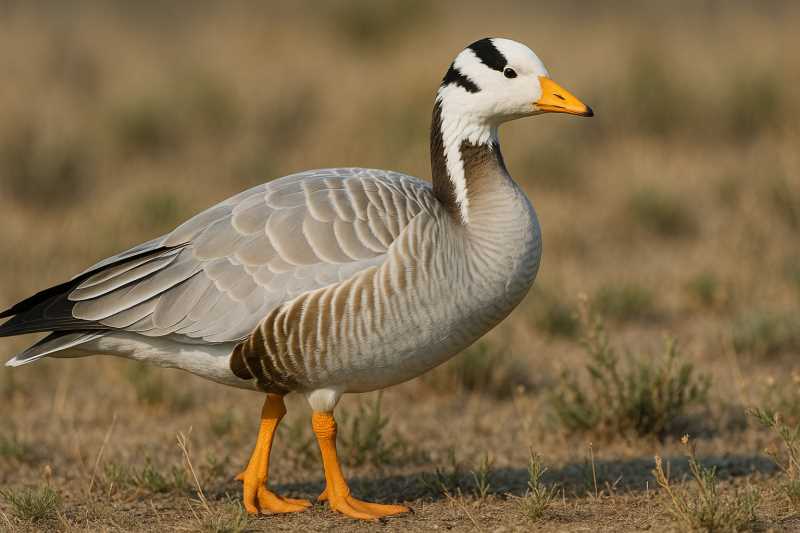
The Bar-headed Goose measures approximately 68–78 cm in length, has a wingspan of about 140–160 cm and generally weighs 2–3 kg. Adults are pale grey above with lighter underparts, a white head and two dark, horseshoe-shaped bars across the crown and nape. The neck is mostly pale with a dark line extending from the eye towards the rear of the head. The bill is yellowish or orange-yellow, often with a darker tip, and the legs and feet are orange to yellow-orange.
Males and females are alike in plumage, although males may be slightly larger. Juveniles are duller, with less sharply defined head markings and a greyer head and neck. In flight, the species appears relatively pale, with dark trailing edges to the wings. (animaldiversity.org)
Range and Habitat
The Bar-headed Goose breeds across highland wetlands of Central Asia, including parts of Mongolia, southern Russia, western China, the Tibetan Plateau, the Himalayas and Ladakh. It uses mountain lakes, marshes, river valleys and other open wetlands, often at elevations of several thousand metres.
After breeding, many birds migrate south through or around the Himalayas to winter in India, Pakistan, Nepal, Bangladesh, Myanmar and parts of southern and eastern China. Wintering birds use freshwater lakes, reservoirs, rivers, floodplains, marshes, coastal wetlands and nearby agricultural fields. Some populations, particularly in eastern Asia, follow routes that do not require the same trans-Himalayan crossing as western populations. The species is generally treated as monotypic in current global bird lists. (doi.org)
Behaviour and Diet
Bar-headed Geese are social and commonly gather in pairs, family groups or large flocks. They are mainly diurnal, feeding on land and in shallow water. Their diet consists largely of grasses, sedges, aquatic vegetation and other plant material. During winter, they may also graze cultivated fields and feed on grain or other agricultural crops.
Breeding usually takes place during the warmer months in high-altitude areas. Pairs often nest near lakes and marshes, including on islands, shorelines and other sites with some protection from terrestrial predators. The species is generally monogamous, and both parents participate in caring for the precocial young.
Migration is energetically demanding. Bar-headed Geese have physiological characteristics that assist oxygen uptake and delivery in thin air, including haemoglobin with a high affinity for oxygen and an ability to increase ventilation under severe hypoxia. Satellite tracking and other studies show that migratory routes are influenced by terrain and favourable winds, so the birds do not necessarily fly at the same altitude throughout a crossing. (journals.physiology.org)
Identification Tips
- Look for a pale grey goose with a white head and two prominent dark bars across the crown and nape.
- The orange-yellow bill and orange legs provide useful additional field marks.
- In flight, the bird looks paler than many other Anser geese and shows dark wing edges.
- The sexes have similar plumage, so sex cannot usually be determined by appearance alone.
- Barnacle Goose (Branta leucopsis) may appear superficially similar because of its contrasting black-and-white head pattern, but it has a much darker black neck and upper breast. Greylag Goose (Anser anser) is generally darker and lacks the Bar-headed Goose’s two dark head bars.
Conservation Status
The Bar-headed Goose is assessed as Least Concern on the IUCN Red List. This reflects its broad range and substantial population, although regional conditions vary and some population assessments have identified declines. A global population estimate is not included here because published estimates differ and are affected by incomplete or uneven surveys. (eunis.eea.europa.eu)
Important pressures include the loss and degradation of breeding and wintering wetlands, disturbance, hunting in some parts of the range, agricultural intensification and pollution. Climate change may alter the timing and availability of wetlands, snowmelt and food along migration routes. Conservation measures include protecting important lakes, marshes and wintering sites, maintaining habitat across international flyways, regulating hunting and improving coordinated monitoring. Because the species crosses several national borders, effective conservation depends on international cooperation.
Frequently Asked Questions
Where does the Bar-headed Goose live?
It breeds mainly in high-altitude wetlands of Central Asia, Mongolia, western China, the Tibetan Plateau and the Himalayan region. It winters across South Asia and parts of southern and eastern China.
Does the Bar-headed Goose fly over the Himalayas?
Many populations cross the Himalayas during migration, particularly between breeding areas on the Tibetan Plateau and wintering grounds in South Asia. Some eastern populations use different routes.
How high can a Bar-headed Goose fly?
The species has been recorded or reported at elevations approaching 9,000 m during migration. However, altitude varies with terrain and wind, and not every widely repeated claim of flight over the highest Himalayan summits is based on direct measurement. (journals.physiology.org)
What does the Bar-headed Goose eat?
It mainly grazes on grasses, sedges and other vegetation. It also feeds in shallow wetlands and may use cultivated fields for grain and other plant foods during winter.
How can it survive in thin mountain air?
Its respiratory and circulatory systems are well suited to hypoxic conditions. High-affinity haemoglobin, strong ventilatory responses and adaptations that improve oxygen delivery help it maintain aerobic activity at high altitude.
Is the Bar-headed Goose endangered?
No. The species is currently assessed as Least Concern, but local populations remain vulnerable to wetland loss, disturbance, hunting and changes affecting migratory habitats.
References
- BirdLife International. 2018. Anser indicus. The IUCN Red List of Threatened Species 2018: e.T22679893A131908564. https://doi.org/10.2305/IUCN.UK.2018-2.RLTS.T22679893A131908564.en. Accessed 8 September 2026.
- Carboneras, C. and G. M. Kirwan. 2020. Bar-headed Goose (Anser indicus), version 1.0. In J. del Hoyo, A. Elliott, J. Sargatal, D. A. Christie and E. de Juana, eds, Birds of the World. Cornell Lab of Ornithology, Ithaca, New York. https://doi.org/10.2173/bow.bahgoo.01.
- Gill, F., D. Donsker and P. Rasmussen, eds. 2026. IOC World Bird List, version 15.2. International Ornithologists’ Union. https://www.worldbirdnames.org/.
- Hawkes, L. A., S. Balachandran, N. M. Batbayar, P. J. Butler, S. Chua, P. J. Frappell, D. T. M. F. Hu, Y. Hou, W. D. Milsom, S. Newman, S. P. Sathiyaselvam, J. G. Scott, S. Takekawa, M. Wikelski and P. J. N. de Vries. 2011. The trans-Himalayan flights of bar-headed geese (Anser indicus). Proceedings of the National Academy of Sciences 108(23): 9516–9519. https://pmc.ncbi.nlm.nih.gov/articles/PMC3111297/.
- Scott, G. R. and W. K. Milsom. 2007. Control of breathing and adaptation to high altitude in the bar-headed goose. American Journal of Physiology-Regulatory, Integrative and Comparative Physiology 293(1): R379–R391. https://doi.org/10.1152/ajpregu.00161.2007.
- Takekawa, J. Y., Y. X. Liu, I. Woo, T. J.甲, S. Balachandran, M. A. Bishop, D. J. Douglas, J. J. Newman, D. J. Prosser, S. H. Y. Yan, S. P. Sathiyaselvam, S. P. Choudhury, A. Rahmani, B. B. Javed, S. N. Natsagdorj, A. Batbayar, B. P. A. Butler, P. J. Frappell, P. J. Milsom, G. R. Scott, L. A. Hawkes and M. Wikelski. 2009. Geographic variation in Bar-headed Geese Anser indicus: connectivity of wintering areas and breeding grounds across a broad front. Wildfowl 59: 100–123. https://www.wildfowljournals.org/index.php/wildfowl/article/view/113.
- Wright, S., C. J. H. B. Bishop, G. R. Scott, W. K. Milsom and P. J. Butler. 2012. The paradox of extreme high-altitude migration in bar-headed geese Anser indicus. Proceedings of the Royal Society B: Biological Sciences 279(1731): 1594–1602. https://pmc.ncbi.nlm.nih.gov/articles/PMC3574432/.
Related posts