Understanding the Banded Bay Cuckoo: A Comprehensive Overview
The Banded Bay Cuckoo (Cacomantis sonneratii) is a fascinating member of the cuckoo family, Cuculidae. Known for its distinctive appearance and intriguing behavioral patterns, this bird is a subject of interest for ornithologists and bird enthusiasts alike. It is primarily found in the Indian subcontinent and Southeast Asia, residing in a range of habitats from dense forests to open woodlands.
Physical Characteristics
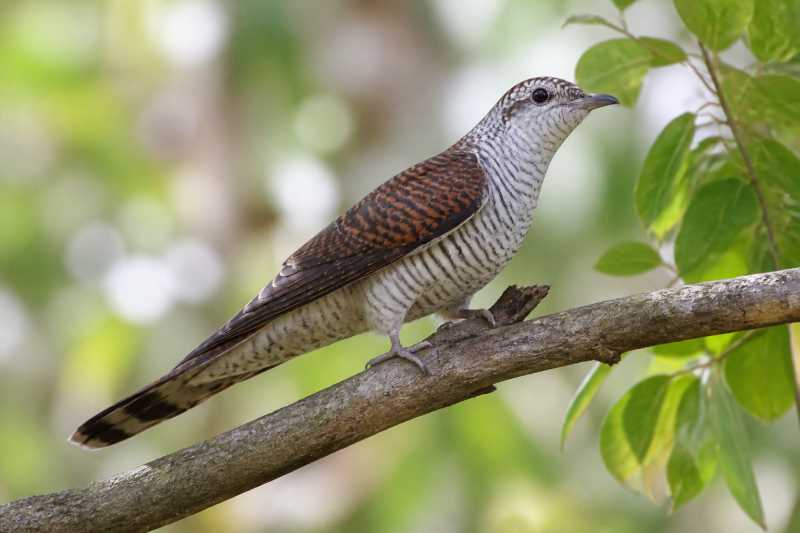
The Banded Bay Cuckoo is a medium-sized bird, measuring approximately 25–28 centimeters in length. It is characterized by its slender body, long tail, and slightly curved bill. The plumage is predominantly grayish-brown with a distinctive barred pattern across its body, which gives it its name. The underparts are lighter, with a creamy or whitish hue. Notably, the Banded Bay Cuckoo has striking rufous-brown wings that stand out in flight.
Habitat and Distribution
This species is widely distributed across the Indian subcontinent, including India, Sri Lanka, Nepal, and Bangladesh, and extends eastward to the Andaman Islands, Myanmar, and parts of Southeast Asia, including Thailand, Malaysia, and Indonesia. The Banded Bay Cuckoo is highly adaptable and can thrive in a variety of environments. It is commonly found in deciduous and evergreen forests, as well as in plantations and gardens.
Behavior and Diet
The Banded Bay Cuckoo is known for its elusive nature and is often heard rather than seen. Its call is a series of melodious whistles, often described as ‘pee-poo’ or ‘pee-pee-poo’, which it repeats in rapid succession. This call is a vital tool for communication, especially during the breeding season.
In terms of diet, the Banded Bay Cuckoo primarily feeds on insects, with a particular preference for caterpillars and beetles. It employs a sit-and-wait strategy, perching quietly before swooping down to capture prey. This feeding behavior not only helps control insect populations but also plays a crucial role in the ecosystem by managing pest populations.
Breeding and Reproduction
One of the most intriguing aspects of the Banded Bay Cuckoo is its breeding behavior. Like many cuckoos, it is a brood parasite, laying its eggs in the nests of other bird species. The preferred hosts are typically smaller passerine birds, such as warblers and babblers. The female Banded Bay Cuckoo is known for its stealth and cunning, often removing an egg from the host’s nest before laying its own. This ensures that the host bird raises the cuckoo chick, often at the expense of its own offspring.
The cuckoo chick hatches earlier than the host’s eggs and is instinctively programmed to push the other eggs or chicks out of the nest. This behavior ensures that the cuckoo chick receives undivided attention and resources from the host parents.
Conservation Status
Currently, the Banded Bay Cuckoo is listed as a species of Least Concern by the International Union for Conservation of Nature (IUCN). Despite habitat loss and fragmentation in some regions, its wide distribution and adaptability have helped maintain stable population numbers. However, continued monitoring is essential to ensure that this species does not face future threats from environmental changes and human activity.
Importance in Ecosystem
The Banded Bay Cuckoo plays a vital role in its ecosystem. By controlling insect populations, it helps maintain ecological balance. Additionally, its brood parasitism influences the breeding success and evolutionary strategies of its host species, contributing to the dynamic balance of avian communities.
Conclusion
The Banded Bay Cuckoo, with its distinctive calls, unique breeding strategy, and adaptability, is a remarkable bird that captures the interest of ornithologists and bird watchers alike. Understanding its role in the ecosystem and the challenges it faces is crucial for ensuring its continued presence in the wild.
As we continue to study and appreciate this intriguing species, it is important to promote conservation efforts and habitat protection to safeguard the diverse avian life that enriches our natural world.
Related posts