The Enigmatic Collared Owlet: A Closer Look at Taenioptynx brodiei
The Collared Owlet, scientifically known as *Taenioptynx brodiei*, is a captivating avian species that enchants birdwatchers and ornithologists alike. As one of the smallest owls in the world, this diminutive bird is a marvel of nature, boasting a rich presence across various Asian landscapes. Despite its small stature, the Collared Owlet plays a significant role in its ecosystem, capturing the interest of researchers and conservationists.
Physical Characteristics
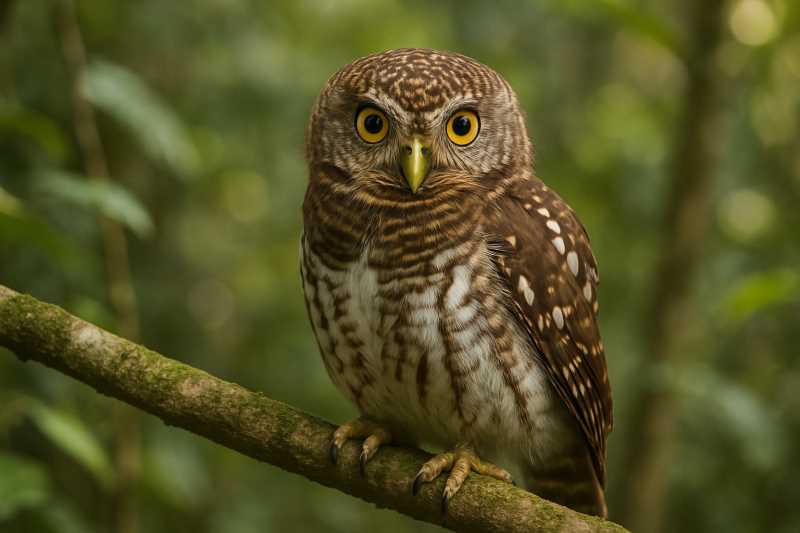
The Collared Owlet is a tiny owl, measuring a mere 15 to 17 centimeters in length, with an average wingspan of about 32 centimeters. Its compact size often leads it to be mistaken for a fledgling of a larger species. However, its distinctive physical features set it apart. The bird is adorned with a striking collar of white feathers around its neck, from which it derives its name. This collar is accentuated by the contrasting brown and white plumage that covers its body.
One of the most intriguing aspects of the Collared Owlet is its “false eyes.” These are dark spots on the back of its head that resemble eyes, a feature that confuses potential predators, making them think they are being watched even when the owlet is facing the other direction. This clever adaptation is a testament to the bird’s evolutionary brilliance.
Habitat and Distribution
The Collared Owlet inhabits a diverse range of environments across its geographical spread, which includes the forests of the Himalayas, China, Southeast Asia, and the Indian subcontinent. It is most commonly found in subtropical and tropical montane forests, where it favors the dense canopy for shelter and hunting.
These owlets are well adapted to life in the forest, often residing at elevations ranging from 600 to 2,500 meters. They prefer areas with ample tree cover, which provides both a rich hunting ground and protection from larger predators. Their presence is often indicated by their distinct call, a series of rapid, high-pitched whistles that can be heard echoing through the forest.
Behavior and Diet
The Collared Owlet is primarily a diurnal hunter, a trait that sets it apart from many other owl species that are predominantly nocturnal. This daytime activity allows it to exploit a different ecological niche, reducing competition for food with its nocturnal counterparts. Its diet consists mainly of small birds, insects, and occasionally, small mammals and reptiles.
Hunting strategies involve stealth and precision. The owlet uses its acute vision and hearing to detect prey, swooping down with surprising agility to capture its target. Its ability to rotate its head up to 270 degrees provides a broad field of vision, essential for spotting prey and avoiding danger.
Reproduction and Lifespan
The breeding season of the Collared Owlet varies depending on its geographical location, generally aligning with the warmer months when food is abundant. These owlets are cavity nesters, often utilizing natural tree hollows or abandoned nests of other birds. The female lays a clutch of 3 to 5 eggs, which she incubates for about 28 days.
Both parents are involved in rearing the young, with the male primarily responsible for providing food during the early stages of life. The chicks fledge approximately three weeks after hatching, although they continue to rely on their parents for food and protection for several more weeks.
Conservation Status and Threats
Currently, the Collared Owlet is classified as a species of ‘Least Concern’ by the International Union for Conservation of Nature (IUCN). Despite this favorable status, certain localized threats could impact their populations. Habitat loss due to deforestation and human encroachment presents a potential risk to their natural environments. Conservation efforts are essential to ensure these habitats are preserved and protected.
The Role of Collared Owlets in Culture and Ecology
In many cultures across Asia, owls are considered symbols of wisdom and protection. The Collared Owlet, in particular, is often admired for its tenacity and adaptability. Its presence in an ecosystem helps maintain the balance by controlling the population of small insects and rodents.
Moreover, as a diurnal species, the Collared Owlet provides a unique opportunity for bird enthusiasts to observe owl behavior during the day, contributing to a broader understanding of avian ecology.
Conclusion
The Collared Owlet stands as a remarkable example of nature’s intricate design, blending beauty with functionality. Its role in the ecosystem, unique behaviors, and captivating appearance make it a subject of interest and admiration. Ensuring the preservation of its natural habitats and understanding its ecological contributions are vital steps towards maintaining the biodiversity of the regions it inhabits. As we continue to explore and document the wonders of the natural world, the Collared Owlet serves as a reminder of the delicate balance that sustains life on our planet.
Related posts