Introduction
The Violet-throated Starfrontlet (Coeligena violifer) is a hummingbird in the family Trochilidae. It inhabits high-elevation Andean forests, forest edges and shrublands from Peru into Bolivia. The species is currently treated by the IOC as one species with several geographically distinct subspecies, although some taxonomic authorities recognise some of these forms as separate species.
Physical Description
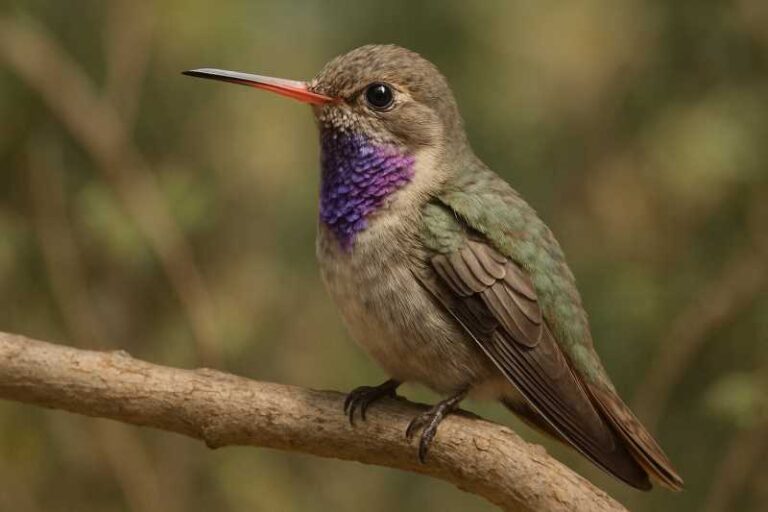
The Violet-throated Starfrontlet is a medium-sized hummingbird, measuring approximately 14 cm in length. It has a straight black bill, a green head and upper breast, and underparts that usually become paler or buff towards the belly. The forehead, or frontlet, is iridescent green.
Adult males are distinguished by a brilliant violet throat patch, or gorget, which can appear dark or subdued when the bird is not viewed in good light. Females are generally less strongly coloured and lack the male’s conspicuous violet gorget. The tail is slightly notched, with buff or pale feathers and a broad dusky terminal band. The Apurímac form, C. v. albicaudata, has a substantially whiter tail than the other recognised forms.
Plumage varies geographically. The four commonly recognised subspecies are C. v. dichroura in northern and central Peru, C. v. albicaudata in the Apurímac drainage, C. v. osculans in south-eastern Peru, and the nominate C. v. violifer in north-western Bolivia.
Range and Habitat
The species occurs along the eastern slopes of the Andes from northern and central Peru southwards into north-western Bolivia. There is also a more isolated population on the western slope in the Lima region of Peru. The extent of the range depends partly on taxonomy, because BirdLife International and the IUCN have sometimes treated several regional forms as separate species.
It is associated mainly with humid montane forest, cloud-forest edges, elfin forest, forest clearings and some secondary growth. It is generally found at elevations from about 1,500 to 3,900 metres, with many records concentrated between approximately 2,500 and 3,500 metres. The species is regarded as largely sedentary, although local movements may follow flowering resources and seasonal conditions.
Where to See This Species
Manu National Park, Cusco and Madre de Dios, Peru
The Violet-throated Starfrontlet is documented from the Manu region, including the montane section of the Manu Road and high-elevation forest near the park entrance. Look along forest edges, clearings and flowering vegetation in the cooler montane zone. The species can be difficult to find, so patient observation and local guiding are useful.
Nearby accommodation: The practical bases are the gateway settlements of Pilcopata and Salvación, with lodges, guest houses and other small-scale accommodation available in the wider Manu area.
Madidi National Park, La Paz Department, Bolivia
Official biodiversity work in Madidi has recorded the species in highland and montane habitats, including Polylepis forest and yungueño forest. These habitats are particularly suitable for searching along forest margins and flowering shrubs at higher elevations.
Nearby accommodation: Rurrenabaque is the main gateway town, with hotels, guest houses, lodges and tour-based accommodation serving visits to the park.
Machu Picchu Historic Sanctuary and surrounding cloud forest, Cusco, Peru
The species has been recorded around Machu Picchu and in the surrounding cloud forest. Forest edges, flowering plants and humid montane vegetation near Aguas Calientes provide appropriate places to look, although sightings are not guaranteed.
Nearby accommodation: Aguas Calientes, also known as Machu Picchu Pueblo, offers hotels, guest houses and other visitor accommodation.
Behaviour and Diet
The Violet-throated Starfrontlet is active during daylight hours and usually forages alone. Like other high-Andean hummingbirds, it feeds primarily on nectar from flowering plants and helps transfer pollen between flowers. It also takes small insects and spiders, which provide protein and other nutrients.
Individuals may defend productive flowers or feeding patches from other hummingbirds. Their rapid flight, hovering ability and sudden chases are typical of territorial hummingbird behaviour. The species is usually encountered singly rather than in large groups, although several birds may gather where flowering plants are abundant.
Breeding information is limited, and the timing of breeding varies between geographic forms. As in other hummingbirds, the female is expected to build the nest, incubate the eggs and feed the young without assistance from the male. Precise information on clutch size, incubation and fledging is not well documented for all populations.
Identification Tips
- Look for a medium-sized hummingbird with a green head and breast, a paler or buff lower body, and a straight black bill.
- In adult males, the iridescent violet throat is the most distinctive feature, although it may appear dark when the bird is in shade.
- The green forehead and the dusky terminal band on the pale, slightly notched tail are useful supporting characters.
- The species can be confused with the Rainbow Starfrontlet, but the Violet-throated Starfrontlet usually shows a greener head and breast and a more obvious dusky tail band.
- Check the tail carefully in southern Peru. Birds of the Apurímac form may show much more white in the tail than other regional populations.
Conservation Status
The Violet-throated Starfrontlet is assessed as Least Concern under the IUCN Red List framework used for the taxon. No reliable global population estimate is available, and some regional assessments indicate a decreasing trend.
The principal concerns are the loss and fragmentation of montane forest through agricultural expansion, deforestation and other land-use changes. Climate change may also alter the distribution of high-elevation vegetation and flowering resources. Protection of cloud forest, elfin forest and Polylepis woodland, together with sustainable land management and continued monitoring, can help conserve the species and the wider Andean bird community.
Frequently Asked Questions
Where does the Violet-throated Starfrontlet live?
It lives in the Andes of Peru and north-western Bolivia, mainly in humid montane forest, cloud-forest edges, elfin forest, clearings and some secondary growth.
What does the Violet-throated Starfrontlet look like?
It is about 14 cm long, with a green head and breast, paler lower underparts, a straight black bill and a slightly notched tail. Adult males have a vivid violet throat patch.
What does the Violet-throated Starfrontlet eat?
Its diet consists mainly of nectar, supplemented by small insects and spiders. It often forages around flowering plants in montane forest and forest-edge habitats.
Is the Violet-throated Starfrontlet migratory?
It is generally regarded as sedentary rather than a long-distance migrant. Local movements may occur as birds track flowering plants and changing conditions at different elevations.
Where is the best place to see this species?
Good documented areas include the montane section of the Manu region in Peru, Madidi National Park in Bolivia and the cloud forests around Machu Picchu. Sightings are usually dependent on habitat, flowering conditions and patient searching.
Is the Violet-throated Starfrontlet endangered?
No. The species is currently assessed as Least Concern, although habitat loss, forest fragmentation and climate-related changes remain conservation concerns.
References
- IOC World Bird List
- IUCN Red List of Threatened Species
- Servicio Nacional de Áreas Protegidas del Estado, Bolivia
Related posts