Introduction
The Black-capped Tinamou (Crypturellus atrocapillus) is a secretive, ground-dwelling bird of the western Amazon and adjacent Andean foothills. It belongs to the tinamou family, Tinamidae, and is more often detected by its distinctive call than seen. Although it can fly, it spends most of its time walking through dense forest vegetation and leaf litter.
Physical Description
The Black-capped Tinamou is approximately 27–29 cm long. It has a compact, rounded body, a short tail and strong legs suited to walking on the forest floor.
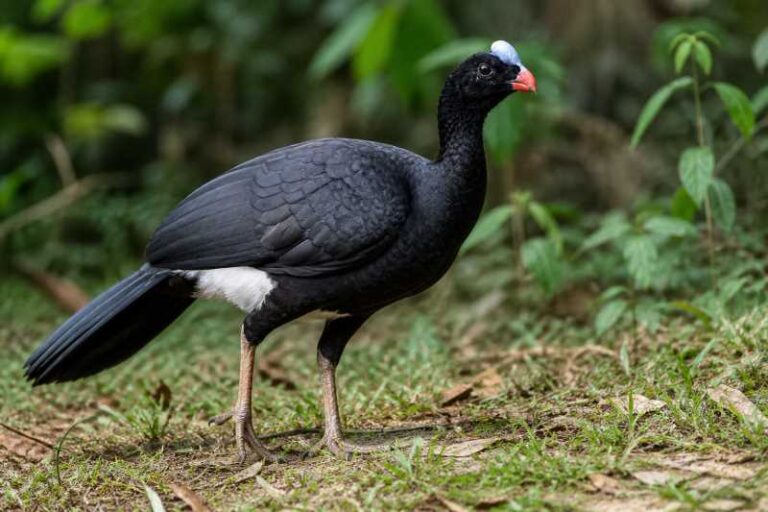
Adults have mainly brown upperparts, a dark blackish or deep grey cap, a cool grey head and neck, and a reddish-orange or tawny throat. The underparts are generally warm brown to rufous. Bright orange legs are a useful field mark, particularly when the bird is seen in open view.
The sexes are broadly similar, although females may show more noticeable dark barring on the upperparts and tend to be duller overall. Reliable information on age-related plumage differences is limited.
Range and Habitat
The species occurs mainly in south-eastern Peru and northern Bolivia, with records extending into adjacent western Brazil. Its distribution is associated with the south-western Amazon and the eastern Andean foothills rather than the whole Amazon Basin.
It uses humid lowland and foothill forest, including primary and secondary forest, bamboo thickets, dense riverside vegetation, Amazonian floodplain forest and some forest edges. In Bolivia, it has been recorded in foothill and lower Yungas forest, as well as inter-Andean dry forest. It may also occur in dense second growth and areas near agriculture when suitable cover remains.
The Black-capped Tinamou is regarded as resident. It is not known to undertake regular long-distance migration. Two subspecies are generally recognised: the nominate C. a. atrocapillus of south-eastern Peru and C. a. garleppi of northern Bolivia. The extent and limits of geographic variation require further study.
Behaviour and Diet
This is a terrestrial and highly secretive species. It usually moves quietly through dense vegetation, freezes when disturbed or slips away on foot before it can be seen. It is often heard during the day, but visual encounters are uncommon.
The call is described as a short, springy or whistled note, sometimes repeated at intervals of about a minute. Vocal activity can be especially useful for locating birds in bamboo and thick undergrowth.
The Black-capped Tinamou probably feeds on fallen fruits, seeds and small invertebrates found among leaf litter, as do many forest-dwelling tinamous. However, species-specific information on its diet remains limited, and the original claim that it plays a major role as a seed disperser should be treated cautiously until more direct evidence is available.
Little published information is available on its breeding biology. Tinamous as a group have unusual sex roles, with males commonly incubating eggs and caring for chicks, but this behaviour should not be presented as specifically confirmed for the Black-capped Tinamou without further evidence.
Identification Tips
- Look for a small to medium-sized tinamou moving through dense forest undergrowth rather than perched in a tree.
- The combination of bright orange legs, a dark cap, a greyish head and neck, brown plumage and a reddish-orange throat is distinctive.
- It is more likely to be heard than seen. Listen for a short, resonant or springy call repeated through dense vegetation.
- In south-western Amazonian forests, compare it carefully with Bartlett’s Tinamou and Undulated Tinamou. The Black-capped Tinamou is identified by its dark cap, warm throat, darker breast and bright orange legs. Undulated Tinamou has a more obviously barred breast and generally grey legs.
- Bamboo thickets, dense floodplain vegetation, secondary growth and forest edges can be more productive than open mature forest for locating the species.
Conservation Status
The Black-capped Tinamou is currently assessed as Near Threatened in the BirdLife International and IUCN-related sources consulted. Earlier sources listed it as Least Concern, so older articles may show a different category.
The species has a relatively restricted distribution and depends on dense forest habitats that are vulnerable to clearance, fragmentation, logging, agricultural expansion and infrastructure development. Hunting may also affect forest tinamous locally, although the scale of this threat for the Black-capped Tinamou is not well quantified.
Its population trend and total population size are not sufficiently documented for a reliable global estimate. Conservation priorities include protecting remaining lowland and foothill forest, maintaining habitat corridors, managing forest edges and improving field surveys using vocal monitoring, camera traps and carefully verified sight records.
Frequently Asked Questions
Where does the Black-capped Tinamou live?
It is found mainly in south-eastern Peru and northern Bolivia, with records from adjacent western Brazil. It inhabits humid lowland and foothill forests, bamboo thickets, floodplain vegetation, secondary growth and some dense forest edges.
Is the Black-capped Tinamou migratory?
No regular long-distance migration is known. The species is generally regarded as resident, although local movements may occur when birds respond to changes in food, flooding or vegetation cover.
What does the Black-capped Tinamou eat?
Its diet is not well documented, but it is expected to include fallen fruits, seeds and small invertebrates collected from the forest floor. More species-specific feeding research is needed.
How can the Black-capped Tinamou be identified?
The most useful features are its dark cap, greyish head and neck, reddish-orange throat, brown body and bright orange legs. It is also more frequently heard than seen in dense vegetation.
What is the conservation status of the Black-capped Tinamou?
It is assessed as Near Threatened in the BirdLife International and IUCN-related sources consulted. Habitat loss and fragmentation are important concerns, while population size and trend remain poorly known.
Why is the Black-capped Tinamou difficult to see?
It spends most of its time walking through dense undergrowth and has cryptic brown plumage. When disturbed, it often remains still or moves quietly through vegetation instead of flying immediately.
References
- BirdLife International. 2020. Red List status changes 2020. BirdLife International. Available at: https://forums.birdlife.org/wp-content/uploads/2022/04/Red_List_status_changes_2020.pdf (accessed 8 September 2026).
- BirdLife International and Handbook of the Birds of the World. 2018. HBW and BirdLife International Checklist of the Birds of the World, Version 3.1. BirdLife International. Species entry for Crypturellus atrocapillus.
- Cornell Lab of Ornithology. n.d. Black-capped Tinamou, Crypturellus atrocapillus. eBird species account. Available at: https://ebird.org/species/blctin1 (accessed 8 September 2026).
- Gill, F., Donsker, D. and Rasmussen, P., eds. 2026. IOC World Bird List, Version 15.2. International Ornithologists’ Union. Available at: https://www.worldbirdnames.org/ (accessed 8 September 2026).
- Schelsky, W. M. 2004. Research and conservation of forest-dependent tinamou species in Amazonia, Peru. Ornitología Neotropical, 15 (Supplement), 317–321. Available at: https://digitalcommons.usf.edu/ornitologia_neotropical/vol15/iss5/33/.
- Birds of Bolivia. 2019. Crypturellus atrocapillus, Black-capped Tinamou. Species account. Available at: https://birdsofbolivia.org/species-fact-sheets-2/tinamous-perdices/crypturellus-atrocapillus/ (accessed 8 September 2026).
- Schulenberg, T. S., Stotz, D. F. and Rico, L. 2006. Distribution Maps of the Birds of Peru, Version 1.0. Environment, Culture and Conservation, The Field Museum, Chicago. Available through the Field Museum’s Birds of Peru resources.
Related posts