Introduction
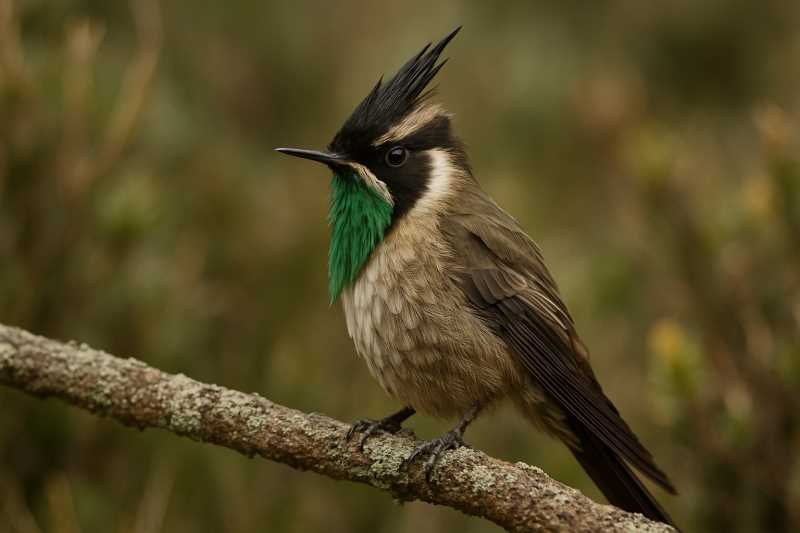
The Green-bearded Helmetcrest (Oxypogon guerinii) is a medium-sized hummingbird endemic to the páramos of Colombia’s Eastern Andes. It is recognised by its sharply pointed crest, elongated green throat feathers and bronzy-green upperparts. The species was formerly treated as part of a wider Bearded Helmetcrest complex that included populations now recognised as separate species.
Physical Description
The Green-bearded Helmetcrest is about 12 cm long, with a compact body, short pointed bill, broad wings, strong feet and a relatively long tail. Its dense, soft plumage helps insulate it in cold, exposed mountain habitats.
The adult male has bronzy-green upperparts, brownish and whitish-scaled underparts, a conspicuous pale crest with darker markings, and elongated throat feathers forming a narrow, iridescent green beard. The sides of the head may show a purplish sheen, while the tail has broad pale centres on many feathers, creating a useful field mark in flight or when perched.
Females are smaller and less ornate. They lack the male’s prominent crest and green beard and generally show a paler, more subdued throat and face. Juveniles resemble females and may acquire adult male features gradually as they mature.
Range and Habitat
The Green-bearded Helmetcrest is endemic to Colombia, where it occurs mainly in the Eastern Andes, including parts of Cundinamarca, Boyacá, Santander and Norte de Santander. Older sources may show a broader distribution extending into Venezuela, but those records largely refer to other helmetcrest species following the taxonomic division of the former Bearded Helmetcrest complex.
It inhabits high-elevation páramo, subpáramo and adjacent high-Andean vegetation, usually between about 3,000 and 4,000 metres above sea level. Favoured sites include open grassland, scattered shrubs, frailejón stands, rocky slopes and transitions between páramo and stunted woodland. The species is especially associated with flowering plants of the genus Espeletia, although it also uses other nectar-producing plants.
Its distribution is naturally fragmented because suitable páramo habitat occurs as isolated high-mountain islands. Habitat quality can decline where páramo is converted to pasture or crops, repeatedly burned, overgrazed or disturbed by infrastructure and extractive activities.
Where to See This Species
Parque Nacional Natural Sumapaz, Cundinamarca and Bogotá Capital District, Colombia
The park protects extensive páramo between approximately 3,250 and 4,250 metres and officially lists the Green-bearded Helmetcrest among its characteristic birds. Look for it in open páramo with frailejones and scattered low vegetation, particularly around flowering plants. Access arrangements and local restrictions should be checked before travelling, as conditions in this high-altitude landscape can change quickly.
Nearby accommodation: Bogotá and the southern Bogotá district of Usme provide the broadest choice of hotels, guest houses and self-catering accommodation. Rural lodging may also be available near authorised access points.
Parque Nacional Natural Chingaza, Cundinamarca, Colombia
Chingaza records the species among its high-elevation bird fauna and contains páramo habitats with frailejones, tussock grasslands and wetlands. The most suitable areas are likely to be open páramo and the upper edge of high-Andean vegetation, where nectar sources and sheltered perches occur. Birdwatching is best undertaken through permitted routes and with local park guidance.
Nearby accommodation: Guasca, Fómeque and La Calera are practical gateway settlements, with hotels, guest houses, rural lodges and self-catering accommodation available in the wider area.
Parque Nacional Natural Pisba, Boyacá, Colombia
The park’s management documentation records the Green-bearded Helmetcrest in open páramo, páramo ecotones and low, shrubby vegetation. These habitat descriptions make Pisba a realistic location for observers searching across the Eastern Andes, although access can be logistically demanding and local conditions should be confirmed in advance.
Nearby accommodation: Socha and Mongua are useful base towns, offering small hotels, guest houses and rural accommodation. Facilities may be limited outside the main settlements.
Behaviour and Diet
The Green-bearded Helmetcrest feeds mainly on nectar, especially from flowering frailejones and other high-Andean plants. Its short, fine bill is well suited to probing the small florets packed into composite flower heads. It also takes small insects and other arthropods, probably providing important protein for adults and developing young.
It can hover while feeding, but it often clings to flower heads or perches nearby between visits. Like many hummingbirds, it may defend productive flowers or feeding areas from other hummingbirds, despite its small size. Territorial chases can be rapid and conspicuous in the open páramo.
The species is considered resident rather than a long-distance migrant, although local movements may occur between páramo, subpáramo and nearby high-Andean habitats as flowering conditions change. Detailed information on nesting dates, nest placement and parental care remains limited for this species.
Identification Tips
- Look for a medium-sized hummingbird in open, high-elevation páramo rather than dense forest.
- The male’s bright green throat beard and pale, pointed crest are the strongest identification features.
- The bronzy-green back, brownish whitish-scaled underparts and pale-centred tail feathers help confirm the identification.
- Females and immature birds are plainer, lacking the adult male’s crest and green beard. Their short bill, robust build and high-altitude habitat remain useful clues.
- Do not confuse this species with other helmetcrests solely from older range maps. The former broad Bearded Helmetcrest was divided into several species, including the White-bearded, Blue-bearded and Buffy Helmetcrests.
Conservation Status
The Green-bearded Helmetcrest is currently assessed as Least Concern. Nevertheless, it has a restricted distribution and depends on páramo ecosystems that are vulnerable to habitat degradation.
The principal concerns are conversion of páramo and adjacent high-Andean vegetation for agriculture and grazing, repeated burning, mining, infrastructure development and the loss of habitat connectivity. Climate change may create additional pressure by altering temperature, rainfall, flowering cycles and the availability of suitable high-elevation habitat.
Protection of páramo reserves, restoration of degraded frailejón communities, prevention of uncontrolled burning and grazing, and cooperation with local communities are important conservation measures. Maintaining ecological links between remaining high-Andean habitats is particularly valuable because the species occurs in naturally separated mountain populations.
Frequently Asked Questions
Where is the Green-bearded Helmetcrest found?
It is endemic to Colombia, mainly occurring in the Eastern Andes in high-elevation páramo, subpáramo and nearby high-Andean vegetation.
Is the Green-bearded Helmetcrest found in Venezuela?
Not under the current species treatment. Older records included Venezuelan populations within a broader Bearded Helmetcrest concept, but those populations are now assigned to other helmetcrest species.
What does the Green-bearded Helmetcrest eat?
It feeds mainly on nectar from frailejones and other flowering plants, supplemented by small insects and other arthropods.
How can the species be identified in the field?
Adult males show a vivid green throat beard, a pointed pale crest, bronzy-green upperparts and whitish-scaled brown underparts. Females and immature birds are plainer and lack the adult male’s beard and crest.
Is the Green-bearded Helmetcrest endangered?
It is currently classified as Least Concern, but its restricted páramo range is exposed to habitat loss, burning, grazing, development and possible climate-related changes.
Which parks are good places to look for it?
Documented protected areas include Parque Nacional Natural Sumapaz, Parque Nacional Natural Chingaza and Parque Nacional Natural Pisba. Search open páramo, frailejón stands and páramo-edge vegetation, preferably with local guidance.
References
- IOC World Bird List
- BirdLife International and IUCN Red List of Threatened Species
- Parques Nacionales Naturales de Colombia
Related posts