Introduction
The White-throated Daggerbill (Schistes albogularis) is a small hummingbird of the western Andes. It is also known as the White-throated Wedgebill and Western Wedge-billed Hummingbird. The species is restricted to Colombia and western Ecuador, where it inhabits humid montane forest and forest edges. (datazone.birdlife.org)
Physical Description
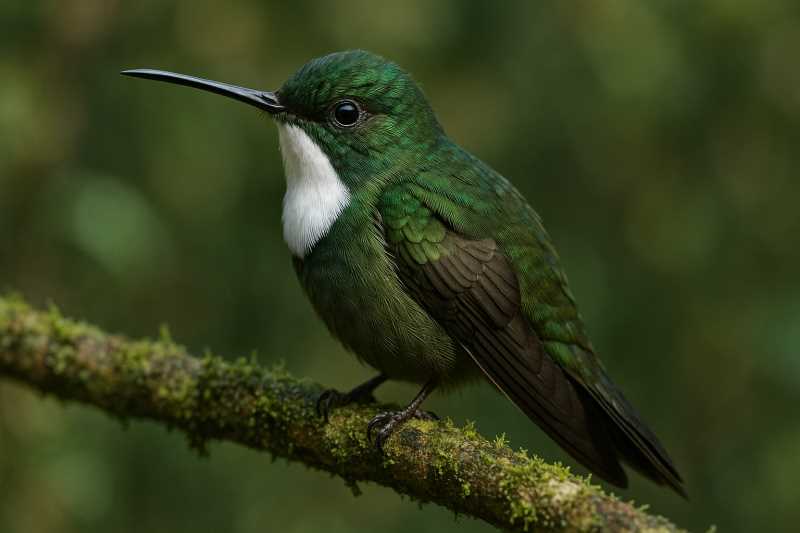
The White-throated Daggerbill is a small hummingbird, generally measuring about 8.6–9.3 centimetres in length. It has predominantly dark green upperparts and underparts, dusky wings and a rounded tail with a darker subterminal band. Its bill is long, narrow and wedge-shaped, giving the species its common name.
Adult males have a bright green forehead, a small white mark behind the eye, violet-blue feathers on the sides of the head and throat, and a contrasting white band across the lower throat or upper chest. Females are less brightly marked. They generally have a plainer green head and a largely white chin and throat, with less conspicuous blue-violet feathering. Juveniles and immature birds may be more difficult to identify because their plumage can be less strongly patterned. (museum.lsu.edu)
Range and Habitat
The species occurs in Colombia and western Ecuador. In Colombia, it is associated mainly with the western Andes and the western and central Andean cordilleras. In Ecuador, it occurs along the western slope of the Andes. It is resident rather than migratory, although some elevational movement may occur after breeding.
White-throated Daggerbills occupy dense, humid cloud forest, forest edges and shady vegetation, often near streams. They are usually found from roughly 800 to 2,600 metres above sea level, although local records and sources may give somewhat different limits. The species is often encountered in dense understorey vegetation rather than in exposed areas. (datazone.birdlife.org)
Where to See This Species
Río Blanco Ecological Reserve, Caldas, Colombia
Río Blanco, near Manizales, is one of the most reliable documented sites for White-throated Daggerbill. The reserve protects Andean cloud forest with shaded trails, flowering plants and hummingbird-rich gardens. The species has been recorded around the reserve entrance, lodge and feeding areas, although sightings are not guaranteed. (fieldguides.com)
Nearby accommodation: Manizales is the nearest practical base, with hotels, guest houses and nature-oriented accommodation. The reserve itself may also offer accommodation or day-visit arrangements subject to local conditions.
Las Gralarias Reserve, Pichincha, Ecuador
Las Gralarias is a private cloud-forest reserve near Mindo where White-throated Daggerbill has been documented visiting flowering plants. The reserve’s humid forest, dense vegetation and network of trails provide suitable habitat, but access should be arranged in advance. (avesconservacion.org)
Nearby accommodation: Mindo is the principal gateway settlement, with lodges, guest houses, small hotels and self-catering accommodation.
Tángaras Reserve, Chocó, Colombia
The ProAves Tángaras Reserve near El Carmen de Atrato supports humid western-Andean forest and has documented records of White-throated Daggerbill. It is a suitable site to investigate the species in the Chocó region, particularly in forested areas with flowering shrubs and vines. Access arrangements and local conditions should be checked before travelling. (birdsofcolombia.org)
Nearby accommodation: El Carmen de Atrato is the nearest recognised town, with simple hotels, guest houses and local accommodation. More specialised reserve accommodation may be available by prior arrangement.
Behaviour and Diet
White-throated Daggerbills are usually seen alone and forage from near ground level to the lower and middle layers of dense vegetation. They take nectar from tubular flowers of shrubs, vines and small trees. The species may also pierce the base of flowers to obtain nectar without contacting the opening, a behaviour known as nectar robbing.
Small insects and other arthropods supplement the nectar-based diet. These may be captured in flight or taken from vegetation. The bird’s rapid hovering and agile movements are typical of hummingbirds, but it may also perch for short periods while watching a feeding area.
The breeding season and nesting biology are poorly documented. Detailed information about nest placement, clutch size, incubation and parental care should therefore be treated as unavailable rather than assumed from better-known hummingbird species. (en.wikipedia.org)
Identification Tips
- Look for a small, dark green hummingbird with a long, narrow, wedge-shaped bill.
- In adult males, the bright green forehead, violet-blue feathers beside the throat and white lower-throat band are especially useful field marks.
- Females have a plainer appearance, with a more uniformly white chin and throat and less obvious blue-violet feathering.
- The species often works tubular flowers in shaded understorey or along forest edges, sometimes approaching flowers from the side or rear.
- Geoffroy’s Daggerbill (Schistes geoffroyi) is the most relevant comparison. It generally has more bronzy or coppery upperparts, a longer pale post-ocular stripe and more green in the throat pattern, especially in the male. Range is also an important clue, as Geoffroy’s Daggerbill is the eastern counterpart of the western White-throated Daggerbill. (museum.lsu.edu)
Conservation Status
The White-throated Daggerbill is currently assessed as Least Concern on the IUCN Red List. Its population size has not been quantified, but the available assessment indicates a decreasing population trend that is not currently considered rapid enough to meet a threatened-category threshold.
The principal concern is the continuing loss and degradation of humid montane forest through deforestation, agricultural expansion and other land-use changes. Protection of remaining cloud forest, maintenance of habitat connectivity and monitoring within protected areas are important conservation measures. (datazone.birdlife.org)
Frequently Asked Questions
Where does the White-throated Daggerbill live?
It lives in humid montane and cloud forests on the western side of the Andes in Colombia and western Ecuador, usually in dense understorey, forest edges and shaded streamside vegetation.
Is the White-throated Daggerbill migratory?
It is considered a resident species. Some individuals may move to different elevations seasonally, but it does not undertake long-distance migration. (datazone.birdlife.org)
What does the White-throated Daggerbill eat?
Its diet consists mainly of nectar from tubular flowers. It also eats small insects and other arthropods, which provide additional protein.
How can the species be identified in the field?
The most useful features are its small size, long wedge-shaped bill, dark green plumage, white throat band and, in males, the bright green forehead and violet-blue feathers beside the throat.
Where is the best place to look for this hummingbird?
Río Blanco Ecological Reserve near Manizales is a well-documented site. Las Gralarias Reserve in Ecuador and Tángaras Reserve in Colombia are additional documented locations, although sightings depend on local conditions and access arrangements.
Is the White-throated Daggerbill threatened?
It is currently classified as Least Concern, but habitat loss in the Andean cloud forests where it occurs remains an important conservation concern. (datazone.birdlife.org)
References
- BirdLife International
- IUCN Red List of Threatened Species
- IOC World Bird List
Related posts