Introduction
The Sooty Barbthroat (Threnetes niger) is a small hermit hummingbird of the eastern Guiana Shield. It is associated mainly with humid lowland forest and other naturally open or disturbed forest habitats in French Guiana and northern Brazil.
Physical Description
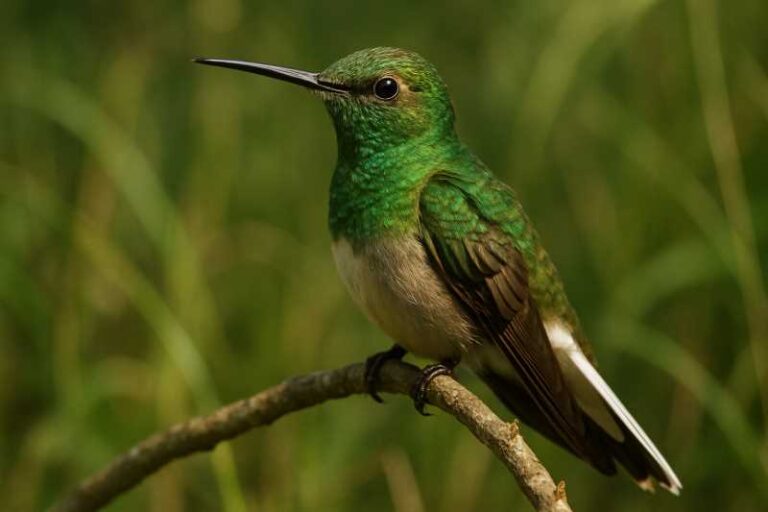
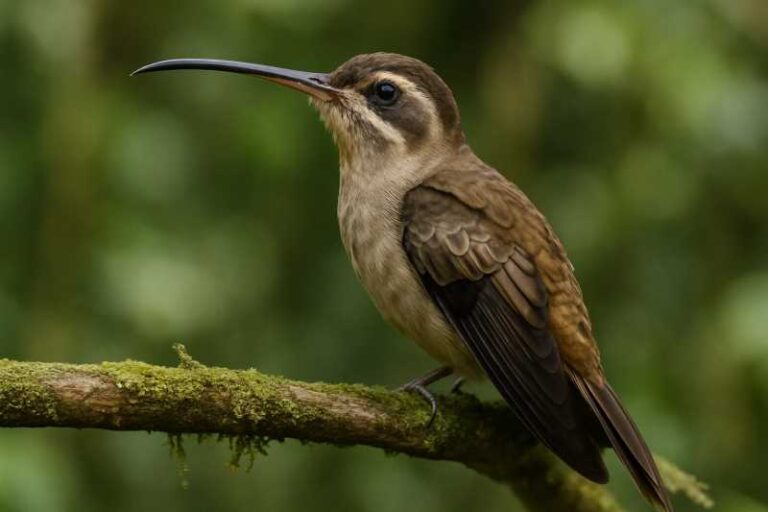
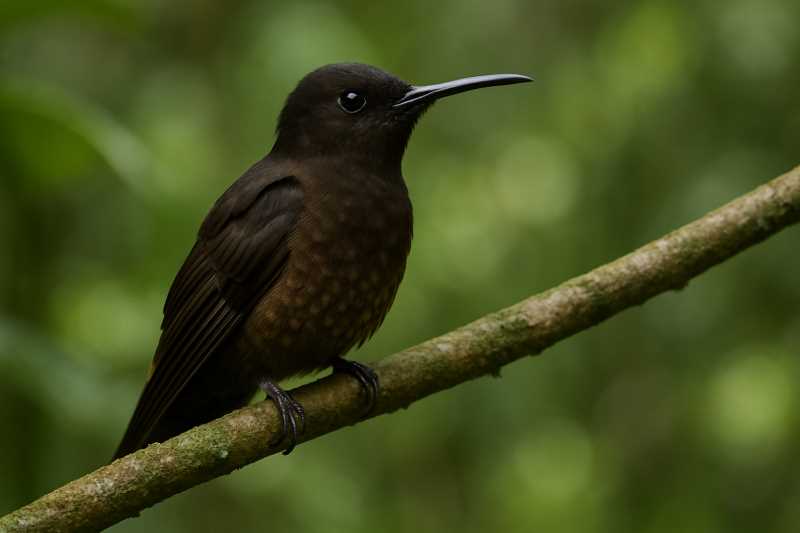
The Sooty Barbthroat is approximately 10–11 cm long. It has bronze-green upperparts, a dark ear patch, a pale malar stripe and a predominantly dark throat. The underparts are sombre, ranging from grey-green on the breast to dark brownish grey on the belly. Its bill is fairly straight compared with the more strongly curved bills of some other hermit hummingbirds.
The species is not strongly sexually dimorphic. Females are generally similar to males, although their plumage may show less contrast between the throat, breast and belly, and the bill can be slightly more decurved.
Tail pattern is important for identification. The nominate form has a predominantly dark tail, while birds traditionally treated as the subspecies T. n. loehkeni may show pale tips to some tail feathers. Juveniles are less sharply marked and can show paler edges to newly grown feathers.
Range and Habitat
The Sooty Barbthroat has a restricted distribution in the eastern Guiana Shield. It occurs in French Guiana and in northern Brazil, especially Amapá and parts of northern Pará. Some taxonomic treatments recognise geographically variable populations, including T. n. loehkeni, within Threnetes niger.
It is generally found below about 500 metres in French Guiana, although local records from the wider Guiana Shield should be interpreted according to the taxonomy and distribution map being used. Suitable habitats include humid lowland rainforest, forest margins, riverine and gallery forest, swamp forest, secondary growth, plantations and other open or semi-open areas within the forest zone.
The species is regarded as resident rather than migratory. It is local and can be difficult to find, even in areas where it is known to occur. Flowering plants in shaded forest clearings, along forest edges and beside streams may provide useful places to search.
Where to See This Species
Parc amazonien de Guyane, French Guiana
The Sooty Barbthroat has been identified as an important bird species within the Parc amazonien de Guyane. The park protects extensive humid Guianan forest, including lowland and river-associated habitats suitable for this species. Access is regulated, and local guides or organised visits are advisable because many areas are remote.
Nearby accommodation: Maripasoula, Saül and other park gateway settlements provide small hotels, guest houses, lodges or basic self-catering accommodation, depending on the access route.
Réserve naturelle nationale des Nouragues, Régina, French Guiana
The Nouragues reserve protects mature rainforest and associated clearings in an area where the species has been documented. The Sooty Barbthroat is likely to require patient observation of forest edges, open patches and flowering plants rather than casual roadside birding. Access to parts of the reserve may be controlled or arranged through authorised programmes.
Nearby accommodation: Régina is the practical gateway, with guest houses, small lodges and other accommodation suitable for visitors exploring the surrounding forest.
Behaviour and Diet
The Sooty Barbthroat is expected to be active mainly during daylight hours. Like other hermit hummingbirds, it can forage along a regular circuit of flowering plants, a behaviour often described as trap-line feeding. It may visit flowers in the shaded understory, along forest edges and in secondary vegetation.
Nectar supplies the energy required for hovering and rapid flight. Small insects and spiders are also likely to be taken, particularly when additional protein is needed. These prey items may be captured from foliage or intercepted during short sallies.
The species is usually encountered singly. Hummingbirds may defend productive flowers or feeding routes, but detailed information on territorial behaviour in the Sooty Barbthroat is limited.
Specific information on courtship, nesting dates and nest placement is comparatively scarce. As in other hermit hummingbirds, the female is expected to build the nest and raise the young without direct assistance from the male. Any species-specific breeding observations should be treated cautiously unless supported by field records.
Identification Tips
- Look for a small, sombre hermit hummingbird with bronze-green upperparts and a dark throat.
- A pale malar stripe and dark ear patch help define the head pattern.
- The underparts are generally grey-green to brownish grey rather than brightly coloured.
- The bill is fairly straight, and the bird may appear long-winged and compact-tailed in flight.
- Check the tail carefully. A mostly dark tail supports identification of the nominate form, while pale tail tips may occur in birds associated with the loehkeni form.
- Do not rely on a reddish throat patch as a defining feature. The species is better recognised by the combination of its sombre throat, pale facial stripe, bronze-green upperparts, dark underparts and geographic range.
- The Pale-tailed Barbthroat (Threnetes leucurus) is a genuinely similar species in the wider region. Tail pattern, underpart colour, facial markings and locality should be considered together, particularly where distributions approach one another.
Conservation Status
The Sooty Barbthroat is currently classified as Least Concern. A reliable global population estimate and a firmly established population trend are not available, so its status should not be described as evidence of a confirmed stable population.
The principal potential threat is the loss and degradation of humid forest through deforestation, agricultural expansion, mining, roads and other development. Protection of large forest landscapes, maintenance of riverine and swamp habitats, and retention of flowering plants in secondary and edge habitats are important conservation measures.
Frequently Asked Questions
Where does the Sooty Barbthroat live?
It occurs in French Guiana and northern Brazil, particularly in Amapá and parts of northern Pará. Its range lies within the eastern Guiana Shield.
What habitat does the Sooty Barbthroat prefer?
It uses humid lowland rainforest, forest edges, gallery forest, swamp forest, secondary growth, plantations and other open or semi-open habitats associated with forest.
Is the Sooty Barbthroat migratory?
It is generally regarded as a resident species. There is no well-established evidence of regular long-distance migration.
What does the Sooty Barbthroat eat?
Its diet is centred on nectar from flowering plants, supplemented by small insects and spiders. The species may follow regular routes between flowering plants.
How can the Sooty Barbthroat be identified?
Look for a small hummingbird with bronze-green upperparts, a dark throat, a pale malar stripe, sombre underparts and a mostly dark tail. Geographic location is also important because similar hermit hummingbirds occur elsewhere in the region.
Is the Sooty Barbthroat threatened?
It is currently assessed as Least Concern, although forest clearance and habitat degradation remain potential local threats. The species is difficult to detect, and detailed population information is limited.
References
- BirdLife International
- IOC World Bird List
- Museu Paraense Emílio Goeldi
Related posts