Introduction
The Mount Cameroon Spurfowl, also known as the Cameroon Francolin, is a range-restricted galliform endemic to Mount Cameroon in south-western Cameroon. Its accepted scientific name is Pternistis camerunensis (Alexander, 1909). It is a poorly known, non-migratory forest bird associated with dense montane vegetation and is currently regarded as Endangered because of its small range, habitat degradation and hunting pressure.
Physical Description
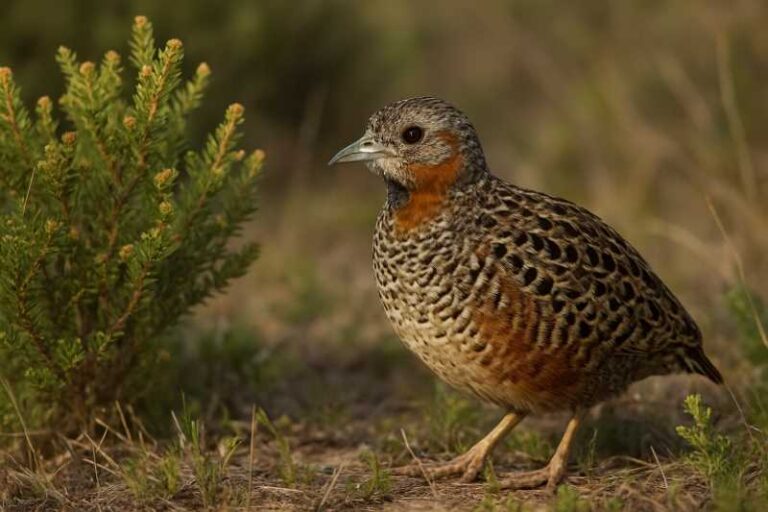
The Mount Cameroon Spurfowl is a medium-sized, robust ground-dwelling bird. Adults measure approximately 33 centimetres in length. Recorded average weights are about 593 grams for males and 509 grams for females, indicating moderate sexual size dimorphism.
The plumage is generally dark brown above, with a dark brown crown and nape, a rich brown back, and darker maroon tones on the lower neck and wing coverts. The throat is grey-buff, while the lower neck and belly are grey to chestnut, with darker feather centres and streaking. Females have more heavily mottled and vermiculated chest and belly plumage, with black, dark brown and buff markings and pale U- to V-shaped patterns on the lower neck and belly.
The bill, eye-ring and legs are orange-red. Males have one or two spurs on the tarsi, whereas females lack functional spurs or have greatly reduced spurs. Juvenile plumage and age-related variation are not sufficiently documented for a detailed field description.
Range and Habitat
The species is endemic to Mount Cameroon, where it has a very small known distribution on the mountain’s forested slopes. It is associated mainly with dense undergrowth in primary and secondary montane forest, forest clearings and some adjacent shrub-dominated habitats.
Published observations and recent surveys place it broadly between about 850 and 2,100 metres above sea level. A 2022 field study recorded the highest occurrence and group sizes mainly between 1,800 and 2,200 metres, although the full occupied elevational range may be wider. The species is sedentary rather than migratory.
Mount Cameroon supports a steep environmental gradient from lowland rainforest to high-elevation montane habitats. The spurfowl appears to depend particularly on structurally complex forest with dense ground cover and mature trees. Recent research found a positive association between its occurrence and the abundance of African Cherry, Prunus africana, although the precise ecological relationship requires further study.
Behaviour and Diet
The Mount Cameroon Spurfowl is a terrestrial and mainly diurnal bird. It is secretive and usually remains in dense vegetation, making direct observation difficult. Surveys have detected it effectively through call playback, and birds may occur singly or in small groups. Recent fieldwork recorded groups of approximately one to three individuals in suitable habitat.
Its diet is not well documented. Available observations and local ecological information indicate that it takes plant material, including fruits and seeds associated with trees such as African Cherry, and may also consume insects and other small invertebrates. It is therefore best treated as an omnivorous ground-feeder, but detailed information on seasonal diet, foraging technique and food preferences remains limited.
The species’ calls are important for detection and communication, particularly in dense forest where visual encounters are uncommon. Breeding biology is poorly known. It is presumed to nest on the ground, as do many related spurfowls, but published information on nest sites, clutch size, incubation, chick development and parental roles is insufficient to describe these features confidently. There is also no reliable evidence that breeding is consistently tied to the onset of the rainy season.
Identification Tips
Look for a medium-sized, heavy-bodied spurfowl moving quietly through dense montane undergrowth rather than in open grassland. The combination of an orange-red bill, red eye-ring and orange-red legs, dark brown upperparts, maroon tones on the lower neck and wing coverts, and grey-buff to chestnut underparts is distinctive within its very restricted range.
Useful field clues include:
- A strongly terrestrial habit and preference for dense forest undergrowth.
- A dark brown crown and back contrasting with the grey-buff throat.
- Chestnut and grey tones on the lower neck and belly, with darker streaking.
- Orange-red bare parts, especially the bill, eye-ring and legs.
- One or two tarsal spurs in males.
- Loud calls from concealed birds, often providing the first indication of its presence.
The Noble Spurfowl, Pternistis nobilis, is the closest known relative and has a broadly similar montane-forest ecology, but it occurs in the Albertine Rift region of East-Central Africa rather than on Mount Cameroon. The two species are geographically allopatric, so location is a decisive identification feature. Other African spurfowls are not normally expected within the Mount Cameroon Spurfowl’s restricted range.
Conservation Status
The Mount Cameroon Spurfowl is classified as Endangered on the IUCN Red List. It has a very small distribution, and the population is considered to be declining. Earlier assessments estimated approximately 600–1,700 mature individuals, but current population size remains uncertain and recent field estimates are not directly comparable with those assessments.
The principal threats are habitat degradation, agricultural expansion, logging and the deliberate burning of vegetation. Hunting and trapping are also significant concerns. Recent surveys found that hunting traps and other signs of human disturbance were associated with reduced occurrence and smaller groups, with no birds recorded at some sites where traps were present.
Mount Cameroon National Park, established in 2009, protects part of the species’ known habitat. Effective conservation also requires protection of remaining montane forest outside the park, control of fires and unsustainable forest use, reduction of hunting and trapping, and cooperation with communities living around the mountain. Continued monitoring using standardised surveys and call playback is important because the species is difficult to detect and its ecology remains poorly understood.
Frequently Asked Questions
Where does the Mount Cameroon Spurfowl live?
It is endemic to Mount Cameroon in south-western Cameroon. It inhabits dense undergrowth in primary and secondary montane forest, forest clearings and nearby shrub habitats, generally at middle to high elevations.
What is the scientific name of the Mount Cameroon Spurfowl?
Its scientific name is Pternistis camerunensis. The species was originally described in the genus Francolinus and is now placed in the spurfowl genus Pternistis.
Is the Mount Cameroon Spurfowl endangered?
Yes. The species is classified as Endangered because it has a very small range, a declining population and continuing threats from habitat loss, fire, hunting and trapping.
What does the Mount Cameroon Spurfowl eat?
Its diet is incompletely documented, but available evidence indicates that it takes fruits, seeds and other plant material, with insects and small invertebrates probably contributing to its diet.
How can the species be identified in the field?
Identification is based on its dark brown and maroon plumage, grey-buff throat, orange-red bill and legs, terrestrial behaviour and association with dense montane undergrowth. Its calls may be easier to detect than the bird itself.
Is the Mount Cameroon Spurfowl migratory?
No. It is considered sedentary and is not known to undertake regular seasonal migration.
References
- BirdLife International. 2023. Mount Cameroon Francolin Pternistis camerunensis. BirdLife International Data Zone species factsheet. Available at: http://datazone.birdlife.org/species/factsheet/mount-cameroon-francolin-pternistis-camerunensis (accessed 8 September 2026).
- Guetse, F., J. Riegert, S. A. Tamungang, T. Awa II, F. L. Ewome, F. N. Motombi and D. Hořák. 2024. Seasonality, African Cherry occurrence, and human threats determine the spatial distribution of the endangered restricted range Mount Cameroon Francolin (Pternistis camerunensis). Avian Conservation and Ecology 19(2):28. https://doi.org/10.5751/ACE-02769-190228
- Hall, B. P. 1963. The Francolins, a study in speciation. Bulletin of the British Museum (Natural History), Zoology 10:8–24. https://doi.org/10.5962/bhl.part.20525
- IUCN. 2023. The IUCN Red List of Threatened Species. Species assessment for Pternistis camerunensis. International Union for Conservation of Nature, Gland, Switzerland. Available at: https://www.iucnredlist.org (accessed 8 September 2026).
- Mandiwana-Neudani, T. G., R. M. Little, T. M. Crowe and R. C. K. Bowie. 2019. Taxonomy, phylogeny and biogeography of African spurfowls, Galliformes, Phasianidae, Phasianinae, Coturnicini: Pternistis spp. Ostrich 90(2):145–172. https://doi.org/10.2989/00306525.2019.1584925
- Mayaka, T. B., F. Guetse, A. Chemura, R. Tamungang and D. Hořák. 2022. A wake-up call: playback attraction data link numbers of Mount Cameroon Francolin Pternistis camerunensis to abundance and debarking of red stinkwood Prunus africana. Bird Conservation International 32(1):43–52. https://doi.org/10.1017/S0959270921000058
- Rasmussen, P. C. and D. Donsker, editors. 2026. IOC World Bird List, version 15.2. International Ornithologists’ Union. Available at: https://www.worldbirdnames.org (accessed 8 September 2026).
Related posts