Introduction
The Painted Francolin, also known as the Painted Partridge, is a ground-dwelling galliform in the pheasant family, Phasianidae. Its accepted scientific name is Francolinus pictus. The species is a resident of the Indian subcontinent, occurring mainly in India and Sri Lanka. It is secretive in dense grass and scrub but becomes easier to detect when males give their loud, repetitive calls during the breeding season.
Physical Description
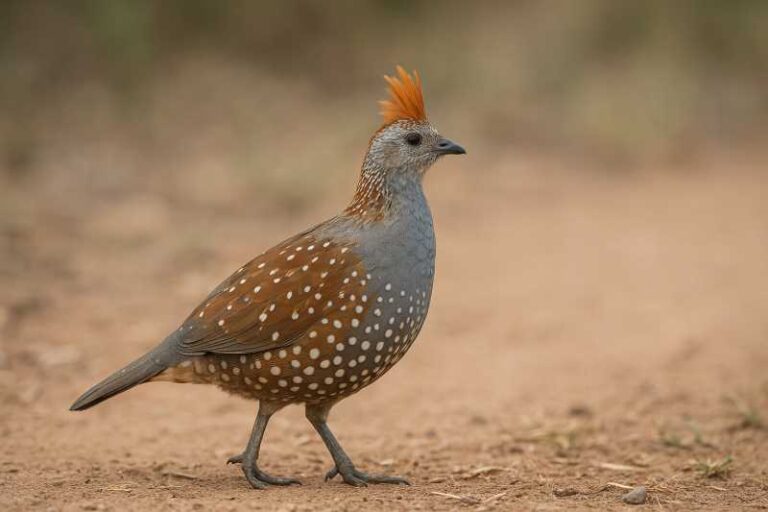
The Painted Francolin is a compact, medium-sized bird measuring about 31 cm in length. Its plumage is chiefly brown, buff, black and white, providing effective camouflage in grassland, scrub and cultivated landscapes.
The face and throat are typically warm rufous to orange-rufous. The upperparts show conspicuous white spotting, while the underparts have a spotted or barred appearance. The legs range from yellowish orange to reddish, and both sexes lack the prominent leg spurs found in some related francolins.
Males and females are broadly similar, although males usually show stronger spotting on the throat and upperparts. Females may appear duller and more heavily streaked or barred, with less distinct throat markings. Juveniles are less boldly patterned and generally have softer, browner plumage than adults.
Range and Habitat
The Painted Francolin is a resident species of India and Sri Lanka. In India, its distribution is patchy across central and peninsular regions, extending from parts of western and central India southwards. It is also found in the lowlands of south-eastern Sri Lanka. Earlier accounts have sometimes suggested a wider northern range, but current sources generally associate the species primarily with India and Sri Lanka rather than Nepal or Pakistan.
It favours semi-dry, open landscapes with sufficient cover, including tall grassland, scrub, open deciduous woodland, forest edges, cultivated fields and areas with scattered bushes or trees. Dense undergrowth is important for concealment, nesting and foraging. The species is generally associated with lowland and lower-elevation habitats, although local records may occur at higher elevations where suitable habitat is present.
Painted Francolins are resident rather than long-distance migratory. Local movements may occur in response to changing food availability, rainfall, cultivation and disturbance.
Behaviour and Diet
The Painted Francolin is mainly terrestrial and is usually encountered singly, in pairs or in small family groups. It often remains hidden in thick grass or scrub and may run into cover when approached. When flushed, it can make a short, rapid flight, but it generally relies on concealment and running rather than sustained flight.
Males may call from an exposed mound, bush or low tree, particularly during the monsoon and post-monsoon period. The call is loud, harsh and repetitive, and neighbouring birds may respond. Calling activity is often the most reliable way to locate a bird that cannot be seen in dense vegetation.
The diet is omnivorous. Seeds, grass grains, cultivated grains, shoots, roots and other plant material form an important part of the diet, supplemented by insects and other small invertebrates, including termites and beetles. The balance between plant and animal food varies with season and local availability.
Breeding generally coincides with the monsoon in many parts of the range. The nest is a shallow depression on the ground, usually concealed beneath a tussock of grass, a bush, standing crops or other dense cover. Historical field accounts describe clutches of approximately five to eight eggs, although clutch size may vary between localities. The female is reported to undertake incubation, and the chicks are precocial, leaving the nest soon after hatching to follow the parent and feed.
Identification Tips
Look for the following combination of features:
- A medium-sized, compact francolin with a strongly terrestrial posture.
- A plain rufous-orange face and throat.
- Bold white spotting on the dark upperparts and noticeable spotting or streaking below.
- Yellowish-orange to reddish legs without obvious spurs.
- A preference for running into tall grass or scrub instead of flying immediately.
- A loud, repeated call during the monsoon and breeding season.
The Painted Francolin can be confused with the female Black Francolin, especially where their ranges overlap. The Painted Francolin lacks the Black Francolin’s distinct rufous hindcollar and has a more uniformly rufous face and throat. Its conspicuous white spotting on the upperparts and spotted underparts also help separate it from the Grey Francolin, which usually appears more finely barred and less boldly spotted.
Conservation Status
The Painted Francolin is currently classified as Least Concern on the IUCN Red List. It has a relatively broad distribution and remains present in a range of modified and semi-natural habitats. However, reliable information on its overall population size and long-term population trend is limited, and national monitoring indicates that the trend is not yet conclusive.
The principal pressures are likely to include loss and fragmentation of grassland and scrub, agricultural intensification, removal of field margins, burning or clearance of dense cover, and hunting or trapping in areas where these activities occur. Maintaining connected grassland, scrub and woodland-edge habitats, retaining dense vegetation around cultivated fields, and enforcing wildlife-protection legislation can benefit the species.
Frequently Asked Questions
Where does the Painted Francolin live?
It occurs mainly in India and Sri Lanka, where it inhabits semi-dry grassland, scrub, open woodland, forest edges and cultivated areas with adequate cover.
Is the Painted Francolin migratory?
No. It is considered a resident species, although individuals may make local movements when food, rainfall, cultivation or disturbance conditions change.
What does the Painted Francolin eat?
It feeds on seeds, grains, grass material, shoots, roots and other plant foods, supplemented by insects and other small invertebrates such as termites and beetles.
How can the Painted Francolin be identified?
Its most useful field marks are the rufous-orange face and throat, bold white spotting on the upperparts, spotted or streaked underparts, reddish legs and lack of prominent leg spurs.
When does the Painted Francolin breed?
Breeding commonly coincides with the monsoon and post-monsoon period, although the timing varies geographically. The nest is placed on the ground under dense grass, scrub or crops.
Is the Painted Francolin endangered?
The species is currently assessed as Least Concern globally. Nevertheless, habitat loss, agricultural change and local hunting or trapping may affect populations, and continued monitoring remains important.
References
- BirdLife International. n.d. Painted Francolin Francolinus pictus Species Factsheet. BirdLife DataZone. Available at: https://datazone.birdlife.org/species/factsheet/painted-francolin-francolinus-pictus. Accessed 8 September 2026.
- Gill, F., Donsker, D. and Rasmussen, P. (eds). 2025. IOC World Bird List, Version 15.2. International Ornithologists’ Union. Available at: https://www.worldbirdnames.org/new/ioc-lists/. Accessed 8 September 2026.
- Sathyakumar, S. and Kalsi, R. S. 2007. Partridges, quails, francolins and snowcocks. In: Sathyakumar, S. and Sivakumar, K. (eds), Galliformes of India. ENVIS Bulletin: Wildlife and Protected Areas 10(1), Wildlife Institute of India, Dehradun, pp. 3–31. Available at: https://digitalrepository.wii.gov.in/handle/123456789/854.
- Kalsi, R. S. 2007. Status, Distribution and Management of Galliformes in Arid and Semi-arid Zones of India. In: Sathyakumar, S. and Sivakumar, K. (eds), Galliformes of India. ENVIS Bulletin: Wildlife and Protected Areas 10(1). Wildlife Institute of India, Dehradun. Available at: https://digitalrepository.wii.gov.in/handle/123456789/1098.
- Nature Conservation Foundation and partners. 2023. State of India’s Birds: Painted Francolin, Francolinus pictus. Available at: https://stateofindiasbirds.in/species/2023/paifra1/. Accessed 8 September 2026.
- Bayani, A., Satose, V. and Kunte, K. (chief editors). 2026. Francolinus pictus (Jardine & Selby, 1828) – Painted Francolin. Birds of India, Indian Foundation for Butterflies Trust. Available at: https://www.birdsofindia.org/francolinus-pictus. Accessed 8 September 2026.
- Hume, A. O. and Marshall, C. H. T. 1880–1881. The Game Birds of India, Burmah and Ceylon, Volume 2. Calcutta: A. O. Hume and C. H. T. Marshall. Available through the Biodiversity Heritage Library. Accessed 8 September 2026.
- Abdulali, H. 1943. Local movements of the Painted Partridge (Francolinus pictus Jardine & Selby) round Bombay. Journal of the Bombay Natural History Society 43: 658–660. Available at: https://eurekamag.com/research/024/959/024959503.php. Accessed 8 September 2026.
Related posts