Introduction
The Tibetan Eared Pheasant, Crossoptilon harmani, is a large, ground-dwelling galliform of the eastern Himalaya and southern Tibetan Plateau. It belongs to the pheasant family, Phasianidae, and is also known as Elwes’s Eared Pheasant. The species is resident in high-altitude mountain habitats, where it uses alpine scrub, riverine thickets, forest margins and open clearings.
Physical Description
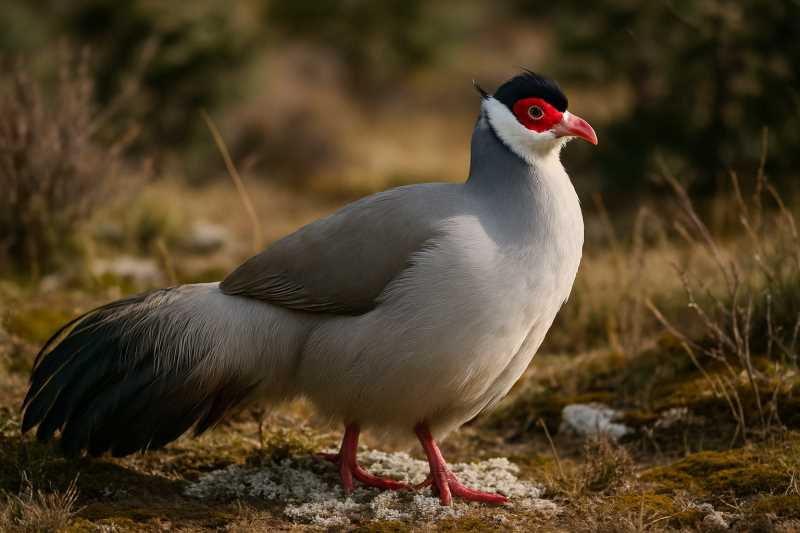
The Tibetan Eared Pheasant has a robust body, a long, drooping tail and short, backward-pointing ear tufts. Its plumage is mainly blue-grey to slate-grey, with a contrasting white band beneath the chin and across parts of the sides of the head. The face is largely bare and reddish, while the bill is pale horn-coloured and the legs are reddish.
The sexes are broadly similar in appearance, although males are generally larger and have a short spur on the leg. Published estimates place adult mass at roughly 1.5 to 2.5 kilograms, although measurements vary between sources and populations. The long tail, short ear tufts, red facial skin and white chin marking are more reliable identification features than overall body colour.
Range and Habitat
The species occurs in south-eastern Tibet, China, with a limited range extending into adjacent northern India, including a locality in Arunachal Pradesh. It is a resident species rather than a long-distance migrant, although seasonal movements to lower elevations may occur in winter.
It is usually found between about 3,000 and 5,000 metres above sea level, with occasional winter records at lower elevations. Preferred habitats include alpine and subalpine scrub, rhododendron thickets, bushy and grassy clearings, tall riverine vegetation, and open areas within or near mixed and coniferous forest.
Research in the Lhasa region found that non-breeding flocks regularly used stream belts for foraging. Dense vegetation near cliffs, hollows and other sheltered sites was important for night roosting. The availability of suitable scrub and cliff habitats also appears to influence nesting-site selection.
Behaviour and Diet
Tibetan Eared Pheasants are mainly terrestrial. They forage by walking and scratching through soil, leaf litter and low vegetation, and generally rely on their strong legs rather than sustained flight. When disturbed, they may run rapidly into cover before making a short, low flight.
Outside the breeding season, they may gather in flocks. Flock size varies with season and local conditions, and published studies have recorded groups using shared feeding areas and regular roosting sites. Their diet consists mainly of plant material, including roots, tubers, seeds, shoots and other available vegetation. Invertebrates may provide additional food, particularly when birds are feeding chicks or when seasonal plant food is limited.
Breeding takes place in spring and early summer. Nesting records from near Lhasa show laying from mid-April to early June, with a peak in late April and early May. The female produces one clutch per year and incubates the eggs. A study recorded clutch sizes of four to eleven eggs, with an average of 7.4, and an incubation period of 24 to 25 days. Nests were often placed in rock cavities or dense high scrub, particularly near streams. The chicks are precocial and leave the nest soon after hatching, but remain dependent on the adults for protection and guidance.
Identification Tips
Look for the following combination of features:
- A large, heavy-bodied pheasant with a long, drooping tail.
- Blue-grey or slate-grey plumage rather than predominantly white body plumage.
- Short ear tufts pointing backwards from the sides of the head.
- Bare red facial skin and a pale, horn-coloured bill.
- A conspicuous white band beneath the chin and along the upper throat.
- A preference for walking through dense alpine scrub, streamside vegetation and forest-edge clearings.
The White Eared Pheasant, Crossoptilon crossoptilon, is the most relevant comparison in areas where their ranges meet. It is generally much whiter overall, whereas the Tibetan Eared Pheasant is predominantly blue-grey or slate-grey. The two forms are closely related and have been reported to hybridise in parts of eastern Tibet, so identification may be difficult in contact zones.
Conservation Status
The Tibetan Eared Pheasant is currently assessed as Least Concern on the IUCN Red List. This global category does not mean that the species is free from local threats or that its population is well known. Reliable population estimates and detailed trend information remain limited.
The main concerns are degradation and loss of high-altitude scrub and forest-edge habitat, together with disturbance, hunting and local pressure associated with agriculture, grazing and infrastructure development. Climate change may also alter alpine vegetation, snow conditions and the availability of food and nesting cover, although the scale of its effect is not yet certain.
Important conservation measures include protecting mountain scrub and forest habitats, maintaining streamside vegetation, reducing illegal hunting, monitoring populations and improving knowledge of breeding ecology and seasonal movements. Conservation planning should also account for the species’ use of both feeding areas and sheltered roosting and nesting sites.
Frequently Asked Questions
Where does the Tibetan Eared Pheasant live?
It occurs mainly in south-eastern Tibet, China, with a limited range extending into adjacent northern India. It inhabits high-altitude alpine and subalpine scrub, forest margins, clearings and riverine thickets.
How high does the Tibetan Eared Pheasant live?
It is usually recorded between about 3,000 and 5,000 metres above sea level. Some individuals may move to lower elevations during winter.
What does the Tibetan Eared Pheasant eat?
Its diet is based mainly on plant material such as roots, tubers, seeds, shoots and other vegetation. Invertebrates may supplement the diet, particularly during the breeding season.
How many eggs does it lay?
A recorded clutch contains four to eleven eggs, with an average of 7.4 eggs in one study. The female incubates the clutch for approximately 24 to 25 days.
Is the Tibetan Eared Pheasant endangered?
The species is currently listed as Least Concern by the IUCN. Nevertheless, habitat degradation, hunting and disturbance remain conservation concerns, and further monitoring is needed because population data are limited.
How can it be identified in the field?
The most useful features are its blue-grey plumage, long drooping tail, short ear tufts, bare red face and white chin band. It is usually encountered walking through dense mountain scrub rather than flying for long distances.
References
- BirdLife International. n.d. “Tibetan Eared-pheasant Crossoptilon harmani Species Factsheet.” BirdLife DataZone. Available at: https://datazone.birdlife.org/species/factsheet/tibetan-eared-pheasant-crossoptilon-harmani (accessed 8 September 2026).
- IUCN. 2024. “Table 7: Species changing IUCN Red List Status, 2023–2024.” IUCN Red List version 2024-2. Available at: https://nc.iucnredlist.org/redlist/content/attachment_files/2024-2_RL_Table_7.pdf (accessed 8 September 2026).
- Gill, F., Donsker, D. and Rasmussen, P., eds. 2026. “IOC World Bird List, version 15.2.” International Ornithologists’ Union. Available at: https://www.worldbirdnames.org/new/ (accessed 8 September 2026).
- Lu, X. and Zheng, G.-M. 2002. “Habitat use of Tibetan Eared Pheasant Crossoptilon harmani flocks in the non-breeding season.” Ibis 144(1): 17–22. https://doi.org/10.1046/j.0019-1019.2001.00006.x
- Lu, X. and Zheng, G.-M. 2003. “Reproductive ecology of Tibetan Eared Pheasant Crossoptilon harmani in scrub environment, with special reference to the effect of food.” Ibis 145(4): 657–666. https://doi.org/10.1046/j.1474-919X.2003.00204.x
- Lu, X. and Zheng, G.-M. 2000. “Why do eared-pheasants of the eastern Qinghai-Tibet plateau show so much morphological variation?” Bird Conservation International 10(4): 305–309. https://doi.org/10.1017/S0959270900000253
- Li, X., et al. 2015. “Comparative mitochondrial genomics and phylogenetic relationships of the Crossoptilon species (Phasianidae, Galliformes).” Mitochondrial DNA 26(4): 536–543. Available at: https://pmc.ncbi.nlm.nih.gov/articles/PMC4326528/ (accessed 8 September 2026).
- Integrated Taxonomic Information System. n.d. “Crossoptilon harmani Elwes, 1881.” ITIS Report, Taxonomic Serial No. 553886. Available at: https://www.itis.gov/servlet/SingleRpt/SingleRpt?search_topic=TSN&search_value=553886 (accessed 8 September 2026).
Related posts