Introduction
The Purple-backed Sunbeam (Aglaeactis aliciae) is a range-restricted hummingbird endemic to northern Peru. It belongs to the hummingbird family Trochilidae and is associated with high-elevation shrubland, remnant alder woodland and flowering plants in the upper Marañón drainage. Its restricted distribution and continuing habitat loss make it a significant conservation species.
Physical Description
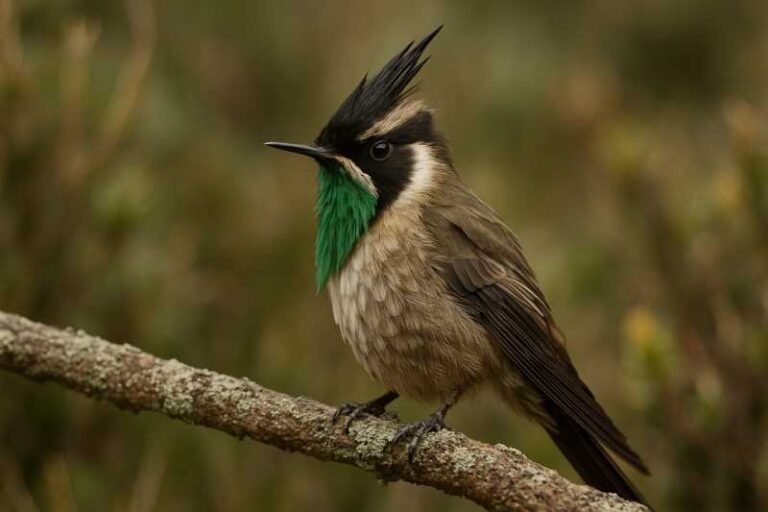
The Purple-backed Sunbeam is a medium-sized hummingbird measuring approximately 12–13 centimetres in length. Its general plumage is dusky brown, with white lores, chin, throat and an irregular white patch across the central breast. The tail is mostly dusky, slightly notched and paler at the base.
Adult males have an iridescent purple lower back and rump, sometimes showing golden or greenish reflections in bright light. The uppertail-coverts may also show green or golden tones. Females are generally duller, with the purple iridescence reduced or absent, although some colour may remain on the uppertail-coverts. Juveniles resemble females and may show buffy markings on the lores, chin, throat and central underparts.
The straight bill is black and moderately long, suited to feeding from tubular and deep flowers. As with other hummingbirds, the wings beat rapidly during hovering flight, making the bird easy to recognise by its agile feeding movements as well as its plumage.
Range and Habitat
The Purple-backed Sunbeam is endemic to Peru. Its principal known range lies in the upper Marañón drainage of La Libertad, with additional records from nearby areas, including northern Ancash. The species has a very restricted distribution, centred on a small group of valleys and slopes east of the main Andean divide.
It occurs at approximately 2,900–3,700 metres above sea level, although many earlier records came from elevations between about 3,000 and 3,500 metres. Suitable habitat includes semi-open Andean slopes, montane shrubland and remaining patches of Andean alder (Alnus acuminata) woodland. Flowering shrubs and trees, including Oreocallis and other native plants, are important components of the habitat.
The species is resident within its restricted range, although local movements may follow the availability of flowers. Much of its habitat has been reduced or altered by burning, grazing, agricultural expansion and the replacement of native vegetation with eucalyptus plantations.
Where to See This Species
El Molino, La Libertad, Peru
El Molino and the surrounding high-elevation roads and scrub-covered slopes are the most reliable publicly accessible area for looking for the Purple-backed Sunbeam. The species has been recorded repeatedly around the settlement, where remnant alder woodland, flowering shrubs and semi-open roadside vegetation provide suitable habitat. It may be present throughout the year, but access can be difficult during the wetter months, particularly on rough mountain roads. Visitors should use local guidance, avoid disturbing birds and respect privately managed land.
Nearby accommodation: Huamachuco is the nearest practical base, with hotels, guest houses and other basic accommodation. Very simple rooms may also be available locally in El Molino, but services are limited.
Behaviour and Diet
The Purple-backed Sunbeam feeds mainly on nectar from flowering plants. Documented or suspected food plants include mistletoes growing on alder, Oreocallis shrubs and Siphocampylus flowers. It may also take small insects and spiders, which provide protein and other nutrients, particularly during the breeding season.
Individuals commonly defend productive flower patches from other hummingbirds. Territorial encounters can include rapid chases and prolonged aerial fights. The species often perches quietly in shrubs between feeding bouts, then makes short, fast flights to flowers or nearby perches.
Breeding is poorly known, but observations near El Molino indicate nesting during the middle and later part of the rainy season, approximately from March to May. The female builds and attends the nest. Recorded nests are small cups made from moss, lichens and dried plant material, apparently secured with spider webs. Males have not been observed helping with nest construction or parental care.
Identification Tips
- Look for a small, dusky hummingbird with conspicuous white lores, chin, throat and central breast.
- In good light, an adult male shows a bright purple sheen across the lower back and rump, often with golden or greenish reflections.
- The tail is mostly dark, slightly notched and paler at the base.
- Search flowering shrubs, mistletoe-bearing alder trees and semi-open high-Andean slopes rather than dense closed forest.
- The species may occur alongside the more widespread Shining Sunbeam (Aglaeactis cupripennis). The Purple-backed Sunbeam is distinguished by its restricted range, white facial and breast markings, and the male’s concentrated purple colour on the lower back and rump. Careful attention is needed because the two species can overlap in elevation and habitat.
Conservation Status
The Purple-backed Sunbeam is currently assessed as Vulnerable on the IUCN Red List. Its restricted range, small population and continuing loss of suitable habitat are the main concerns. The population is considered to be declining, although precise population estimates remain uncertain.
Major threats include the clearance and burning of native vegetation for pasture and agriculture, overgrazing, mining and infrastructure development. The replacement of native alder woodland and shrubland with eucalyptus and other non-native vegetation can further reduce the availability of nesting cover and natural food plants.
Conservation priorities include protecting remaining alder woodland and native shrubland, restoring degraded slopes with appropriate native vegetation, maintaining flowering plants and improving surveys in the upper Marañón and adjacent valleys. Regional authorities in La Libertad have also recognised the species and its ecosystem as conservation priorities. Further research is needed on population size, movements, breeding success and the effectiveness of local habitat protection.
Frequently Asked Questions
Where is the Purple-backed Sunbeam found?
It is endemic to northern Peru, with its main known distribution in the upper Marañón drainage of La Libertad and additional records from nearby parts of Ancash.
What habitat does the Purple-backed Sunbeam use?
It uses high-elevation semi-open slopes, montane shrubland and remnant alder woodland, usually between about 2,900 and 3,700 metres above sea level.
What does the Purple-backed Sunbeam eat?
Its main food is nectar from native flowering plants, including mistletoes, Oreocallis shrubs and Siphocampylus. It also takes small insects and spiders.
When is the best time to look for this hummingbird?
The species can be present throughout the year around El Molino. March to May is particularly significant for breeding activity, but wet-season road conditions may make travel more difficult.
How can the Purple-backed Sunbeam be identified?
Look for a dusky hummingbird with white facial and breast markings, a slightly notched dark tail and, in adult males, an iridescent purple lower back and rump.
Is the Purple-backed Sunbeam endangered?
It is currently classified as Vulnerable globally. Habitat loss, burning, grazing, agricultural expansion and the replacement of native vegetation are the principal documented threats.
References
- BirdLife International
- Cotinga
- Ornithología Neotropical
Related posts