Introduction
The Nubian Nightjar, Caprimulgus nubicus, is a small nocturnal bird of arid Africa and the Arabian Peninsula. It is adapted to open desert-edge habitats, salt marshes, wadis and sparsely vegetated areas, where its mottled plumage provides effective camouflage during the day. The species is generally elusive, but its calls and moth-like flight can reveal its presence around dusk, dawn and during the night.
Physical Description
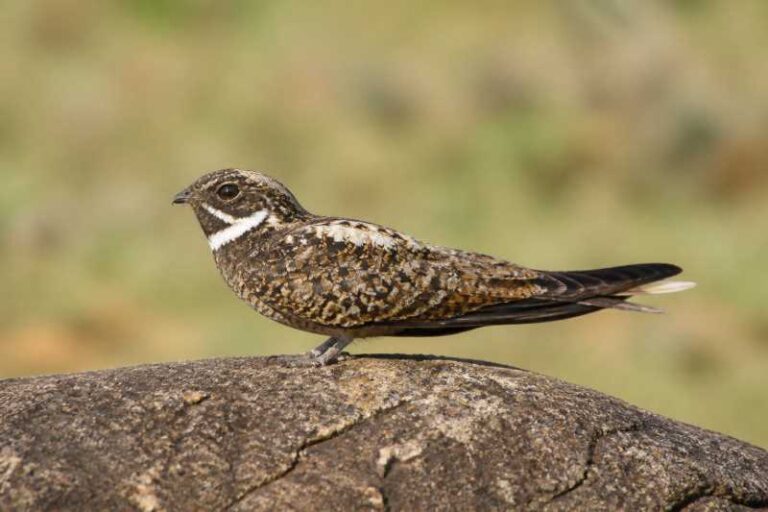
The Nubian Nightjar is a compact nightjar measuring approximately 21–22 cm in length and weighing about 45–55 g. It has broad, rounded wings, a relatively short tail and cryptic plumage in shades of sandy brown, grey, buff and cream. These colours help it blend with gravel, dry soil, stones and sparse vegetation.
A warm reddish-brown or chestnut band across the upper breast and neck can be noticeable at close range. White markings on the wings and tail are visible when the bird is flying or displaying, but are less conspicuous when it is resting on the ground. The large eyes and wide, bristled mouth are characteristic adaptations of nightjars, allowing the bird to locate and capture insects in low light.
Reliable field studies have not established strong, consistent external differences between the sexes. In an Israeli study, males and females showed similar measurements and wing markings, although their calls differed in pitch and quality. Juveniles are less well documented, so age-related plumage differences should be treated cautiously.
Range and Habitat
The species occurs in arid and semi-arid regions of eastern Africa and the south-western Arabian Peninsula. Its range extends from eastern Africa, including areas from Kenya northwards to Sudan, through parts of Arabia and northwards towards the Jordan Rift Valley and the Dead Sea region. Local distribution can be highly patchy, and the species is absent from many apparently suitable desert areas.
Nubian Nightjars use a variety of open, dry habitats, including sandy and stony deserts, gravel plains, wadis, salt marshes, sparse scrub and open areas near springs, canals or other water sources. In Israel, breeding and roosting sites have been associated with relatively dense salt-marsh vegetation, often dominated by Tamarix and salt-tolerant shrubs, beside open ground used for feeding.
The species is resident in much of eastern Africa. Some northern Arabian and Levantine populations are migratory or partially migratory, although local studies have also recorded resident birds. Geographic variation and the treatment of some proposed subspecies have been debated, so regional forms should be interpreted with taxonomic caution.
Behaviour and Diet
Nubian Nightjars are mainly crepuscular and nocturnal. Activity usually begins around dusk and may continue through the night, with additional activity before dawn. They spend daylight hours roosting on the ground, where their plumage makes them difficult to detect. Individuals may return repeatedly to the same roosting places.
The species feeds by hawking, taking flying insects from the air during short sallies from the ground or from a low perch. Moths are an important part of the diet, supplemented by beetles, grasshoppers, mantids, true bugs, flies, ants and earwigs. In Israel, moths accounted for most of the prey biomass identified from faecal pellets.
Nubian Nightjars are generally solitary outside the breeding season and occur in pairs or as territorial individuals during breeding. Courtship can include calls from the ground, wing and tail displays, and a slow, buoyant flight by the male close behind the female. In Israel, courtship activity was concentrated in March and was particularly noticeable around periods of full moon.
The species does not build a conventional nest. Eggs are laid directly on the ground, usually in a concealed position among vegetation, stones or bare substrate. Available observations indicate clutches of one or two eggs. Both adults may contribute to parental care, and fledged young remain dependent on their parents for a period after leaving the egg-laying site.
Identification Tips
- Look for a small, compact nightjar with a short tail and broad, rounded wings.
- The overall colour is sandy, grey-brown and buff, with fine mottling that closely matches desert ground and dry vegetation.
- A reddish-brown neck or upper-breast band may be visible in good light.
- White wing patches and white tail corners are more obvious during flight, courtship or alarm displays.
- Listen around dusk and dawn for a repeated, low double or triple call often rendered as ‘koww-koww’ or ‘ow-wow’.
- Search slowly along gravel tracks, wadis, salt marsh edges and open ground near scrub or water. A stationary bird may remain almost invisible until it flies.
In parts of the Middle East, identification should take account of other desert nightjars, particularly the Egyptian Nightjar and European Nightjar where their ranges overlap. Size, tail length, wing shape, plumage pattern and especially vocalisations should be assessed together rather than relying on a single feature.
Conservation Status
The Nubian Nightjar is classified globally as Least Concern on the IUCN Red List. This global category does not mean that all populations are secure. The species is locally scarce, and some northern populations have declined where suitable habitat has been converted or degraded.
Important local threats include agricultural expansion, water extraction, loss of salt marshes and oasis vegetation, habitat fragmentation, disturbance and artificial lighting near breeding and foraging areas. In Israel, the remaining population has been closely associated with a small number of suitable salt-marsh sites, and habitat loss caused by agricultural development has been a major concern.
Conservation measures should focus on protecting remaining wetlands, salt marshes, wadis and desert-edge feeding areas; maintaining natural water sources; limiting development in known breeding habitat; reducing artificial light near nightjar territories; and improving surveys of poorly known populations. Local monitoring is particularly important because the species is difficult to detect and population changes may be missed by conventional daytime bird surveys.
Frequently Asked Questions
Where does the Nubian Nightjar live?
The Nubian Nightjar occurs in arid and semi-arid parts of eastern Africa and the south-western Arabian Peninsula, with northern populations extending towards the Jordan Rift Valley and the Dead Sea region.
Is the Nubian Nightjar migratory?
Migration varies across its range. Many African populations are resident, while some northern Arabian and Levantine populations are migratory or partially migratory. Local studies have also recorded resident birds in areas where migration had previously been suspected.
What does the Nubian Nightjar eat?
It is an insectivore that catches flying prey in the air. Moths are especially important, but its diet also includes beetles, grasshoppers, mantids, true bugs, flies, ants and earwigs.
Where does the Nubian Nightjar nest?
It lays its eggs directly on the ground rather than building a nest. Suitable sites may be concealed among salt-marsh vegetation, stones, sparse scrub or other ground cover close to open feeding areas.
How can the Nubian Nightjar be identified at night?
Listen for its repeated low call around dusk, dawn or during the night, then search open ground and desert-edge vegetation for a small, cryptically coloured nightjar. White wing and tail markings may become visible when it flies.
Is the Nubian Nightjar endangered?
The species is globally classified as Least Concern, but some local populations are vulnerable to habitat loss, agricultural expansion, water depletion, disturbance and artificial lighting. Regional conservation assessments may therefore be more serious than the global category suggests.
References
- BirdLife International. 2016. Caprimulgus nubicus. The IUCN Red List of Threatened Species 2016. Species account no. 22689912. Available at: https://www.iucnredlist.org/species/22689912. Accessed 8 September 2026.
- Gill, F., Donsker, D. and Rasmussen, P. (eds.). 2026. IOC World Bird List, version 15.2. International Ornithologists’ Union. Available at: https://www.worldbirdnames.org/. Accessed 8 September 2026.
- Perlman, Y. 2008. The natural history of the Nubian Nightjar Caprimulgus nubicus in Israel. Sandgrouse 30(2): 117–124. Ornithological Society of the Middle East, the Caucasus and Central Asia. Available at: https://osme.org/wp-content/uploads/2019/10/Sandgrouse_302_Perlman_pp117-124.pdf.
- Kirwan, G. M. 2004. Some remarks on the taxonomy of Nubian Nightjar Caprimulgus nubicus, with particular reference to C. n. jonesi Ogilvie-Grant & Forbes, 1899. Bulletin of the African Bird Club 11(2): 117–125.
- Royal Commission for AlUla. n.d. Birds of AlUla. Royal Commission for AlUla, Saudi Arabia. Available at: https://www.rcu.gov.sa/getmedia/b34fa5d3-8355-4af7-9056-bf64ecb97d07/Birds_of_Alula_EN_web.pdf. Accessed 8 September 2026.
- Porter, R. F. and Suleiman, A. S. 2013. The breeding birds of the Socotra archipelago, Yemen. Sandgrouse 35. Ornithological Society of the Middle East, the Caucasus and Central Asia.
Related posts