Introduction
Bernier’s Teal (Anas bernieri), also known as Madagascar Teal, is a small duck endemic to Madagascar. It belongs to the family Anatidae and is one of the island’s specialised wetland birds. The species is closely associated with shallow coastal wetlands, mangroves, estuaries and brackish lakes, and is considered Endangered because of its restricted distribution, habitat loss and other human pressures.
Physical Description
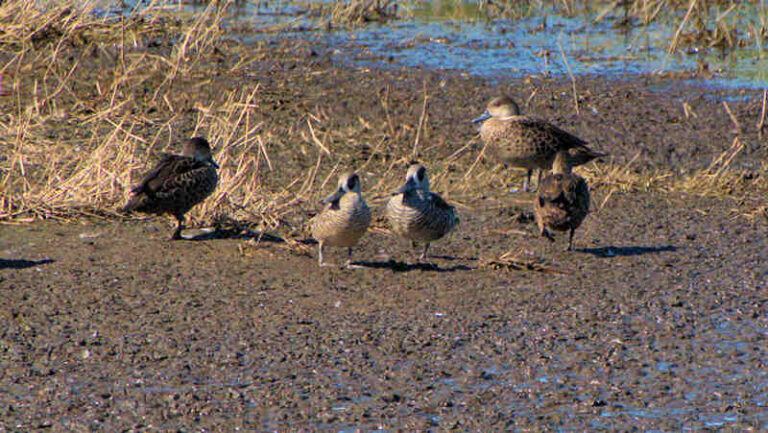
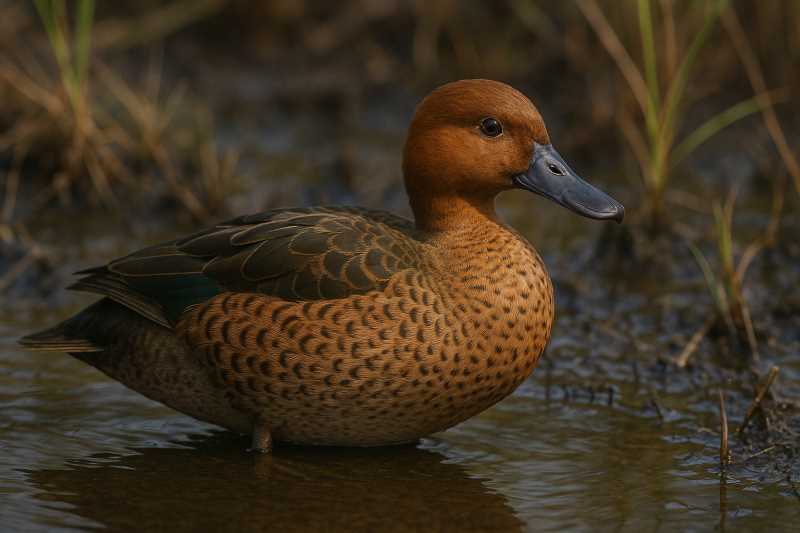
Bernier’s Teal is a small dabbling duck, approximately 40 cm long. Adults have predominantly warm brown plumage with fine, darker mottling that gives the body a subtly scaled appearance. The bill is reddish, while the legs and feet are dull reddish-orange. The wing shows a dark blue-black speculum, with contrasting pale areas visible in flight.
The sexes are similar in colour and pattern, so they can be difficult to distinguish in the field. Males are generally slightly larger than females. Immature birds resemble adults, although their plumage may appear less sharply marked. Unlike many other ducks, Bernier’s Teal does not show a strongly contrasting male breeding plumage.
Range and Habitat
Bernier’s Teal is endemic to Madagascar. It is recorded mainly from wetlands along the western and north-western parts of the island, with additional records from the extreme north-east. Its distribution is localised and fragmented rather than continuous.
The species uses shallow freshwater and brackish wetlands, including coastal lagoons, estuaries, mangrove channels, marshes, ponds and shallow lakes. It is particularly associated with mangrove habitats and open, lightly vegetated water near mangrove forests. The species usually occurs in lowland wetlands and is generally regarded as resident rather than a long-distance migrant.
Suitable wetlands may include both permanent and seasonal water bodies. Maintaining connections between mangroves, mudflats, shallow pools and adjacent marshes is important because the teal uses more than one wetland habitat during feeding and breeding.
Behaviour and Diet
Bernier’s Teal is usually seen alone, in pairs or in small groups. It feeds by dabbling at the surface, wading in shallow water and sifting through soft mud with its bill. Its diet includes aquatic invertebrates, insects, seeds and other plant material. Feeding activity may be concentrated around dawn and dusk, although the species can forage during the day and at other times.
Breeding is associated with the wet season. Wild nests have been found in cavities in mangrove trees, including holes above or close to the water. Captive birds can also use nest boxes. The female lays the eggs in the cavity and is responsible for incubation, while the male remains associated with the pair and territory. Available observations indicate that nesting biology is still incompletely known in the wild.
Identification Tips
- Look for a small, compact duck with an overall warm brown, finely mottled appearance.
- The reddish bill and dull reddish-orange legs help separate it from many uniformly dark-billed ducks.
- Both sexes look broadly alike, so plumage alone is not a reliable way to determine sex.
- The dark blue-black wing speculum and pale areas in the wing can be noticeable when the bird flies.
- Check shallow brackish pools, mangrove edges, estuaries and quiet coastal wetlands in western Madagascar.
- Do not rely on the common name alone when identifying the species. Bernier’s Teal is not simply any small teal found in Madagascar, and careful attention to its warm brown plumage, bill colour and habitat is important.
Conservation Status
Bernier’s Teal is classified as Endangered on the IUCN Red List. It has a restricted range, a small and fragmented population, and continuing pressure on the wetlands on which it depends.
The main threats include the loss and degradation of mangroves and other wetlands through fuelwood collection, timber extraction, agricultural expansion, settlement, altered water regimes and other forms of wetland conversion. Hunting may also affect the species, particularly where birds gather at breeding or moulting sites. Reduced water quality and changes in rainfall and water levels may add further pressure, although the relative importance of these factors varies between sites.
Conservation measures include protecting important wetland complexes, maintaining mangrove habitat, monitoring populations, reducing unsustainable resource use and involving local communities in wetland management. Sites such as the Mahavavy-Kinkony and Mangoky-Ihotry wetland complexes are important for the species. Captive-breeding work has also contributed to knowledge of the species and provides an additional safeguard, but protection and restoration of wild habitat remain essential.
Frequently Asked Questions
Where does Bernier’s Teal live?
Bernier’s Teal lives only in Madagascar, mainly in shallow coastal wetlands, mangroves, estuaries, brackish lakes, marshes and ponds in the west and north-west of the island.
Is Bernier’s Teal migratory?
It is generally considered a resident species. Local movements between nearby wetlands may occur, but it is not known for long-distance seasonal migration.
What does Bernier’s Teal eat?
Its diet includes aquatic invertebrates, insects, seeds and other plant material. It feeds by dabbling, wading and sifting through shallow water and soft mud.
How can Bernier’s Teal be identified?
Look for a small duck with warm brown, finely mottled plumage, a reddish bill, dull reddish-orange legs and a dark blue-black wing speculum. Males and females are very similar.
Where does Bernier’s Teal nest?
Known wild nests have been found in cavities in mangrove trees, usually above or close to water. Captive birds may also use nest boxes.
Why is Bernier’s Teal Endangered?
The species has a restricted and fragmented range, while mangrove and wetland habitats are being degraded or converted. Hunting and other pressures at important wetland sites may also contribute to its decline.
References
- BirdLife International. 2024–2026. Madagascar Teal Anas bernieri Species Factsheet. BirdLife DataZone. Available at: https://datazone.birdlife.org/species/factsheet/madagascar-teal-anas-bernieri (accessed 8 September 2026).
- BirdLife International. 2022. Madagascar Teal (Anas bernieri): Revise global status? Globally Threatened Bird Forums. Available at: https://forums.birdlife.org/2022-2-madagascar-teal-anas-bernieri-revise-global-status/ (accessed 8 September 2026).
- BirdLife International and Asity Madagascar. 2021. The State of Madagascar’s Birds. BirdLife International. Available at: https://www.birdlife.org/wp-content/uploads/2021/10/State_of_Madagascars_Birds_English.pdf (accessed 8 September 2026).
- Gill, F., Donsker, D. and Rasmussen, P., eds. 2026. IOC World Bird List, version 15.2. International Ornithologists’ Union. Available at: https://www.worldbirdnames.org/ (accessed 8 September 2026).
- Young, H. G., Sorenson, M. D. and Johnson, K. P. 1997. A description of the Madagascar Teal Anas bernieri and an examination of its relationships with the Grey Teal A. gracilis. Wildfowl, 48, pp. 174–180. Available at: https://tidsskrift.dk/Wildfowl/article/view/154113 (accessed 8 September 2026).
- International Ornithological Congress. 2026. IOC World Bird List, Master Lists and Taxonomic Resources. Available at: https://www.worldbirdnames.org/new/ioc-lists/master-list-2/ (accessed 8 September 2026).
- Integrated Taxonomic Information System. n.d. Anas bernieri (Hartlaub, 1860), Bernier’s Teal. ITIS Report, Taxonomic Serial No. 175098. Available at: https://www.itis.gov/servlet/SingleRpt/SingleRpt%3Bjsessionid%3DD232C8586D835E964F7DB7BF54DD71B2?search_topic=TSN&search_value=175098 (accessed 8 September 2026).
- Bunting, P., Rosenqvist, A., Lucas, R., Rebelo, L.-M., Hilarides, L., Thomas, N., Hardy, A., Itoh, T., Shimada, M. and Finlayson, C. M. 2018. The Global Mangrove Watch, a new 2010 global baseline of mangrove extent. Remote Sensing, 10, 1669. https://doi.org/10.3390/rs10101669.
Related posts