Introduction
The Scintillant Hummingbird (Selasphorus scintilla) is a tiny hummingbird endemic to the highlands of Costa Rica and western Panama. It is especially notable for the male’s brilliant orange-red throat, rapid flight and preference for flowering habitats in the tropical mountains.
Physical Description
The Scintillant Hummingbird is one of the smallest hummingbirds, measuring approximately 6.5–7.5 cm in length. Males weigh about 2 g, while females are slightly heavier. As with other hummingbirds, it has a slender bill, compact body and rapidly beating wings.
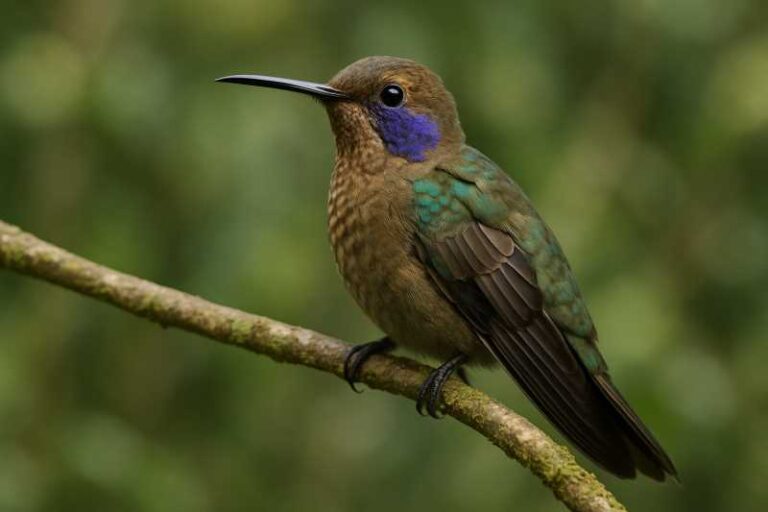
Adult males have bronze-green upperparts and a vivid orange-red to fiery red gorget, which can appear darker or brighter depending on the light. The underparts are generally pale to buffy, with rufous tones on the flanks and lower body. Females are less brightly coloured, with green upperparts, pale underparts and a more subdued throat marked with dusky or buffy spotting.
The tail is an important identification feature. The species has a slightly notched tail, with rufous tones and darker markings near the tips. Females and immature birds may show pale or whitish markings on the outer tail feathers. Young males gradually develop the adult gorget as they mature, so individuals in transitional plumage can be difficult to identify confidently.
Range and Habitat
The Scintillant Hummingbird is resident in Costa Rica and western Panama. It occurs mainly along montane slopes and in the highlands of the Cordillera de Tilarán, the Central Volcanic Cordillera and the Talamanca range.
It is associated with humid montane forest, forest edges, brushy clearings, regenerating vegetation, highland gardens and some coffee-growing areas. It is commonly recorded from about 900 to 2,100 metres above sea level, although individuals may occur at higher elevations outside the main breeding range. At the upper limits of its distribution, it can overlap with the closely related Volcano Hummingbird (Selasphorus flammula), making identification of females especially challenging.
The species is not considered a long-distance migrant. Local movements may occur in response to flowering conditions, elevation and seasonal food availability.
Where to See This Species
Cloudbridge Nature Reserve, San Gerardo de Rivas, Costa Rica
Cloudbridge Nature Reserve is a publicly accessible cloud-forest reserve in the Talamanca Mountains, beside Chirripó National Park. The reserve’s bird inventories document the Scintillant Hummingbird, and its forest trails, clearings and flowering gardens provide suitable viewing habitat.
Nearby accommodation: San Gerardo de Rivas and the wider San Isidro area offer guest houses, small lodges, cabins and self-catering accommodation.
Los Quetzales National Park, San José Province, Costa Rica
Los Quetzales National Park protects high-elevation montane forest in the Dota region, within the species’ documented Costa Rican range. Bird records from the surrounding highlands include Scintillant Hummingbirds, particularly in forest edges, open areas and flowering habitats along accessible mountain routes.
Nearby accommodation: Copey, San Gerardo de Dota and Providencia de Dota provide lodges, guest houses, cabins and small rural accommodation.
Mount Totumas Ecolodge and Wildlife Sanctuary, Chiriquí, Panama
Mount Totumas is a publicly accessible highland wildlife-viewing venue in western Panama. Species lists and birding records document the Scintillant Hummingbird there, including sightings around the lodge’s hummingbird gardens and feeders. The surrounding montane forest and cultivated areas also offer suitable habitat.
Nearby accommodation: The lodge itself provides a practical base, while the nearby town of Volcán has hotels, guest houses, cabins and self-catering accommodation.
Behaviour and Diet
Scintillant Hummingbirds are active during daylight hours and usually forage alone. Males can be strongly territorial around productive flowers or feeders, chasing other hummingbirds and making rapid aerial manoeuvres. They may also use short display flights during courtship and territorial encounters.
Nectar forms the main part of the diet. The birds visit small tubular flowers, including salvias, fuchsias and other highland plants, using a slender bill and extensible tongue to obtain nectar. They also capture small insects and spiders, often by taking prey from foliage or catching it in short flights. Animal prey is particularly important for supplying protein during breeding and chick-rearing.
The female builds the nest and raises the young without assistance from the male. The nest is a small cup made from plant fibres, soft material and spider silk, usually placed in sheltered vegetation. Clutches generally contain two white eggs. The female alone incubates the eggs and feeds the nestlings until they are sufficiently developed to leave the nest.
As a flower visitor, the Scintillant Hummingbird also contributes to pollination in montane ecosystems. Its ecological importance is linked to the movement of pollen between flowers as it feeds.
Identification Tips
- Look for a very small, fast-moving hummingbird in mountain forest edges, gardens, clearings and flowering shrubs.
- Adult males are distinguished by the brilliant orange-red or fiery red gorget, bronze-green crown and upperparts, and rufous tones in the body and tail.
- Females and immature birds are mainly green above and pale or buffy below, with rufous colouring on the flanks and characteristic tail markings.
- Pay close attention to the tail when separating females from the similar Volcano Hummingbird. The pattern and extent of pale or white markings on the outer tail feathers can be useful, but poor views may not allow a confident identification.
- At high elevations in Costa Rica and western Panama, avoid identifying a female solely by size or overall colour. A clear view of the tail, elevation and habitat is often necessary.
Conservation Status
The Scintillant Hummingbird is currently classified as Least Concern on the IUCN Red List. No reliable population estimate is given in the sources consulted, and the species is not regarded as globally threatened.
Nevertheless, its restricted distribution makes the conservation of highland habitats important. Deforestation, agricultural expansion, forest fragmentation and changes in flowering cycles associated with climate change could reduce the quality or availability of suitable habitat. Protecting montane forest, forest edges and connected areas of regenerating vegetation will help maintain the food resources and nesting sites on which the species depends.
Frequently Asked Questions
Where does the Scintillant Hummingbird live?
It is endemic to Costa Rica and western Panama, where it lives mainly in humid montane forest, forest edges, brushy clearings, gardens and other flowering habitats at middle and high elevations.
How small is the Scintillant Hummingbird?
It is approximately 6.5–7.5 cm long. Adult males weigh about 2 g, making this one of the smallest hummingbirds.
What does a male Scintillant Hummingbird look like?
The male has bronze-green upperparts and a brilliant orange-red to fiery red throat. Rufous tones on the body and tail can also be visible, especially when the bird is perched or seen in good light.
What does the Scintillant Hummingbird eat?
It mainly feeds on nectar from small flowers, including tubular highland plants. It also eats small insects and spiders, which provide important protein and other nutrients.
Is the Scintillant Hummingbird migratory?
It is generally considered resident within its range rather than a long-distance migrant. Local movements may occur as birds follow flowering plants or move between elevations.
How can it be distinguished from the Volcano Hummingbird?
The two species can look very similar, particularly females and immature birds. Elevation, habitat and the pattern of the outer tail feathers are important clues, but a clear view of the tail is often needed for a reliable identification.
References
- BirdLife International
- IOC World Bird List
- Cloudbridge Nature Reserve
Related posts