Introduction
The Swallow-tailed Nightjar (Uropsalis segmentata) is a poorly known nightjar of the northern and central Andes. It occurs in Bolivia, Colombia, Ecuador and Peru, mainly in humid montane environments at high elevation. The species is named for the male’s greatly elongated outer tail feathers, which form a deeply forked silhouette in flight and during display.
Physical Description
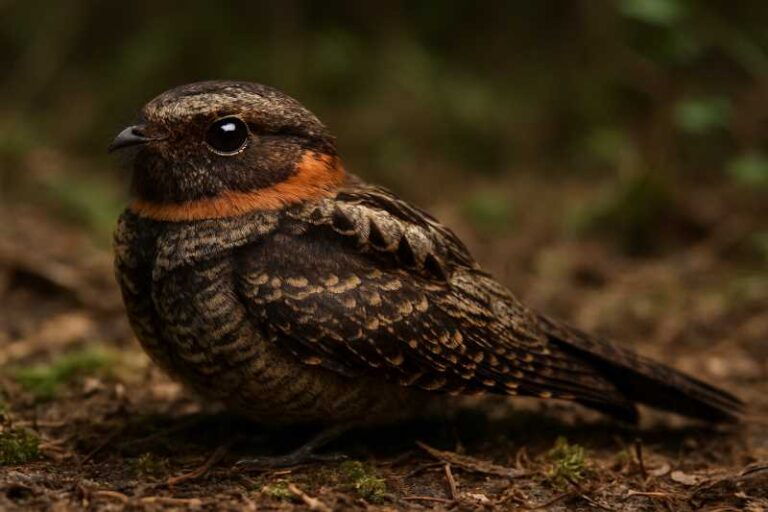
The Swallow-tailed Nightjar is a compact, dark-plumaged nightjar, with a body length of approximately 20–22 cm. Its upperparts are dark brown to blackish, finely mottled and spotted with buff, rufous and grey-brown tones. The underparts are similarly dark and patterned, with barring and mottling on the flanks and belly. A subdued buff or rufous throat and collar may be visible, although these markings are not always prominent.
The sexes differ markedly in tail structure. Adult males have greatly elongated outer tail feathers, which may extend the total length to roughly 40–57 cm. The outer feathers have contrasting pale or whitish edging and create the species’ characteristic swallow-like, forked tail. Females have much shorter tails, with a more conventionally graduated and barred appearance. The wings are generally dusky and lack conspicuous white wing bands.
Reliable information on juvenile plumage and age-related variation remains limited. Young birds are expected to show less-developed tail elongation than adult males, but detailed descriptions are not well documented in the available literature.
Range and Habitat
The species is distributed along the Andes of Colombia, Ecuador, Peru and Bolivia. The nominate subspecies, U. s. segmentata, occurs mainly in Colombia and Ecuador, while U. s. kalinowskii is associated with the Andes of Peru and Bolivia. Subspecies limits and geographic variation follow the taxonomic authority being used and may require further study.
It is generally recorded between about 2,000 and 3,600 metres above sea level, although local records may fall outside this range. Its habitats include humid montane forest, cloud forest, elfin forest, forest edges, shrubby clearings, dense grass or bamboo-like vegetation, rocky walls and landslide margins. These open or semi-open features within otherwise forested mountain landscapes may provide important roosting and foraging habitat.
The Swallow-tailed Nightjar is considered resident or non-migratory in the broad sense. No regular long-distance migration is established for the species.
Behaviour and Diet
The Swallow-tailed Nightjar is primarily nocturnal and is most likely to be detected at dusk, during the night or shortly before dawn. Like other nightjars, it feeds mainly on flying insects captured in the air. Its broad gape and bristles around the mouth are adaptations associated with aerial insect feeding, although detailed dietary studies of this species are limited.
During daylight, it typically rests quietly on the ground, a low perch, rocky surfaces or other sheltered locations. Its dark, mottled plumage provides effective camouflage among leaf litter, shadowed vegetation and rough rock. The long tail of the male is especially conspicuous when displayed or seen against the sky, but may be less obvious when the bird is perched in dense cover.
The species is generally encountered alone or in pairs. Vocal, territorial and courtship behaviour is incompletely documented, although elongated outer tail feathers in male Uropsalis nightjars are associated with display behaviour.
Breeding information is scarce. A documented nest of the nominate subspecies in south-eastern Ecuador consisted of a simple ground scrape or cleared area rather than a constructed nest. The record involved a single egg, illustrating the limited clutch information currently available for the species. Claims about fixed breeding seasons, regular male incubation or elaborate aerial displays should therefore be treated cautiously until supported by additional observations.
Identification Tips
- Look for a dark, heavily mottled nightjar in humid Andean forest, forest edges or high-elevation clearings.
- An adult male in flight may show extremely long outer tail feathers and a deeply forked tail.
- Females and immature birds lack the male’s dramatic tail extension and are more likely to be recognised by their dark, barred and mottled plumage.
- The wings appear fairly uniform and dusky, without prominent white wing bands.
- The species is usually associated with higher elevations than the closely related Lyre-tailed Nightjar (Uropsalis lyra), although their ranges can overlap.
- Compared with the Lyre-tailed Nightjar, the Swallow-tailed Nightjar is generally smaller and more uniformly dark, with a less elaborate tail shape and less extensive pale or rufous patterning.
Conservation Status
The Swallow-tailed Nightjar is currently assessed as Least Concern on the IUCN Red List. It is locally uncommon or rare, and its specialised montane distribution means that habitat loss and fragmentation remain potential concerns. Forest clearance, agricultural expansion, road development, disturbance and the degradation of high-elevation forest edges may reduce suitable habitat in parts of its range.
A reliable global population estimate and a well-supported population trend are not available. Important conservation measures include protecting Andean cloud forests and adjacent high-elevation habitats, maintaining connectivity between forest blocks, and conserving natural forest edges, rocky slopes and landslide margins used by the species.
Frequently Asked Questions
Where does the Swallow-tailed Nightjar live?
It occurs in the Andes of Bolivia, Colombia, Ecuador and Peru, mainly in humid montane forest, cloud forest and nearby high-elevation clearings.
How high does the Swallow-tailed Nightjar occur?
Most records are from approximately 2,000–3,600 metres above sea level, although the documented elevational range varies between countries and localities.
Why is it called the Swallow-tailed Nightjar?
The name refers to the adult male’s very long outer tail feathers, which produce a strongly forked, swallow-like tail profile.
What does the Swallow-tailed Nightjar eat?
It feeds mainly on flying insects caught during aerial foraging at night or around dusk and dawn.
Does the female have the same long tail as the male?
No. The female has a much shorter, more normally graduated and barred tail. The extreme tail elongation is principally a feature of adult males.
Is the Swallow-tailed Nightjar endangered?
It is currently classified as Least Concern, but habitat loss and fragmentation in the Andes may affect local populations. Its global population size and trend have not been quantified reliably.
References
- BirdLife International. n.d. BirdLife’s Taxonomic Checklist. BirdLife DataZone. Available at: https://datazone.birdlife.org/about-our-science/taxonomy (accessed 8 September 2026).
- Gill, F., Donsker, D. & Rasmussen, P. (eds). 2026. IOC World Bird List, version 15.2. International Ornithologists’ Union. Available at: https://www.worldbirdnames.org/ (accessed 8 September 2026).
- World Bird Names. n.d. Swallow-tailed Nightjar, Uropsalis segmentata. World Bird Names species database. Available at: https://www.worldbirdnames.com/bird/swallow-tailed-nightjar/3519.html (accessed 8 September 2026).
- Harms, I., Lynch, R. L., Greeney, H. F. & Lohnes, R. 2006. Observations on the nest and egg of the Swallow-tailed Nightjar (Uropsalis segmentata segmentata) in southeastern Ecuador. Ornitología Neotropical 17(4), article 14. Available at: https://digitalcommons.usf.edu/ornitologia_neotropical/vol17/iss4/14.
- Vuilleumier, F. 1969. Field notes on some birds from the Bolivian Andes. Ibis 111(4), 599–608. https://doi.org/10.1111/j.1474-919X.1969.tb02569.x.
- Begazo, A. (ed.). n.d. Swallow-tailed Nightjar, Uropsalis segmentata. Aves de Perú, CORBIDI. Available at: https://avesdeperu.org/caprimulgidae/chotacabras-de-cola-ahorquillada-uropsalis-segmentata/ (accessed 8 September 2026).
- INABIO. n.d. Uropsalis segmentata collection records. Instituto Nacional de Biodiversidad, Ecuador. Available at: https://bndb.sisbioecuador.bio/bndb/collections/list.php?db=33&reset=1&taxa=Caprimulgidae&taxontype=3 (accessed 8 September 2026).
Related posts