Introduction
The Long-tailed Woodnymph (Thalurania watertonii) is a small hummingbird endemic to north-eastern Brazil. It is associated with humid Atlantic Forest, including lowland forest, foothill forest and isolated montane forest patches. The species is locally uncommon and difficult to find, partly because its remaining habitat is highly fragmented.
Physical Description
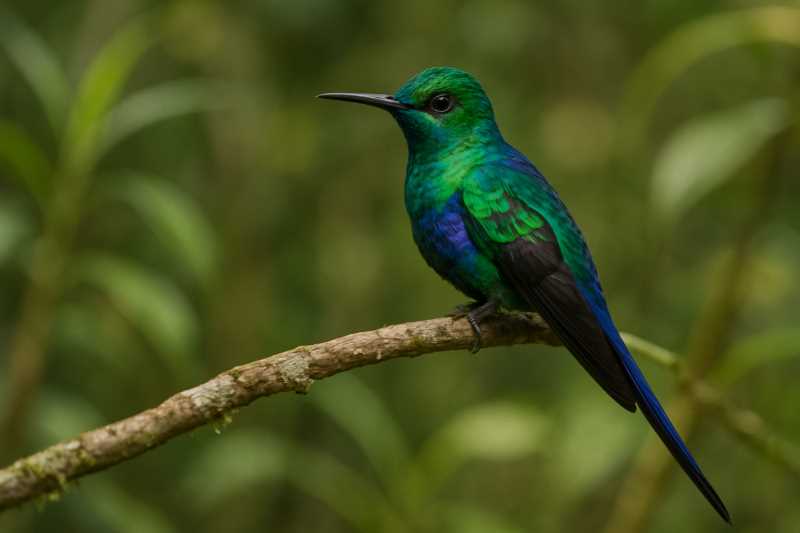
The Long-tailed Woodnymph is a small, slender hummingbird with a long, deeply forked tail.
Adult males are brightly coloured. They have a green crown, iridescent violet-blue upperparts and metallic green underparts, with darker wings and a blue-violet tail. The colours can appear duller or greener in poor light, so the tail shape and overall combination of blue, violet and green are useful field characters.
Females are less conspicuous. They are mainly green above and greyish or pale below, with a shorter-looking tail that is typically dark with pale or whitish tips. Juvenile males may resemble females at first, retaining duller plumage before developing the brighter adult colours.
The species is closely related to other woodnymphs, and identification can be difficult where ranges or older records are uncertain. Plumage, tail length and locality should be considered together rather than relying on colour alone.
Range and Habitat
The Long-tailed Woodnymph is endemic to Brazil. The best-supported records are concentrated in the states of Pernambuco and Alagoas, in the Pernambuco Centre of Endemism. Reports from Sergipe and Bahia have been treated as unconfirmed or requiring further evidence by recent reviews.
It inhabits humid Atlantic Forest, including lowland rainforest, foothill forest, montane forest and so-called brejos de altitude. It may also use forest edges, clearings, gardens and lightly modified habitats where flowering plants remain available, but the species is most strongly associated with forest remnants and is not considered a bird of open Caatinga or Cerrado.
The remaining habitat is divided into many small fragments. This restricted and fragmented distribution makes the protection of individual forest patches, connecting vegetation and clean forest streams particularly important. The species is resident rather than migratory, although local movements may occur in response to food availability and breeding conditions.
Where to See This Species
Sightings are localised and the Long-tailed Woodnymph should not be expected at every site within its broad range. Visits should be arranged in advance where access is controlled, and recent local bird records should be checked before travelling.
Serra do Urubu, Pernambuco, Brazil
Serra do Urubu includes the private reserves Frei Caneca and Pedra D’Antas in and around Jaqueira and Lagoa dos Gatos. The area protects premontane Atlantic Forest and is a recognised site for the Long-tailed Woodnymph. Forest trails and the reserve’s hummingbird garden provide suitable places to search, although sightings are not guaranteed.
Nearby accommodation: Lagoa dos Gatos is the practical gateway, with local guest houses, small hotels and other simple accommodation options. The reserve may also provide limited short-stay accommodation by prior arrangement.
Reserva Natural Pedra D’Antas, Pernambuco, Brazil
Pedra D’Antas forms part of the Serra do Urubu conservation landscape and has documented records of the species. Access is generally arranged for organised birdwatching visits, making it a more realistic option than searching unprotected forest fragments independently. Look for the bird in flowering vegetation, forest edges and shaded forest trails.
Nearby accommodation: Lagoa dos Gatos is the nearest established settlement for guest houses, small hotels and self-catering accommodation.
Parque Estadual Dois Irmãos, Recife, Pernambuco, Brazil
The Long-tailed Woodnymph has been recorded at Parque Estadual Dois Irmãos, a publicly visited Atlantic Forest park in Recife. The record is historical and recent detection rates have been low, so the site is better treated as a supplementary opportunity rather than a dependable destination for this species. Search quiet forested areas and flowering plants, while also checking with local guides for current records.
Nearby accommodation: Recife offers the widest choice of hotels, guest houses, serviced apartments and other accommodation, with the park accessible from the city.
Behaviour and Diet
The Long-tailed Woodnymph is an active, agile hummingbird that feeds mainly on flower nectar. It has been recorded visiting a variety of native plants, especially bromeliads and other tubular or nectar-rich flowers. It may also visit cultivated or ornamental flowers where these occur near forest.
Small insects and other arthropods provide additional protein, particularly during breeding and while young birds are developing. The bird may take these prey items in short sallies or glean them from vegetation.
Males can defend feeding areas and may be territorial around productive flowers. The species is also reported to bathe in or use shallow, clear forest streams, which may make clean watercourses an important part of suitable habitat.
Breeding information remains limited. Reproductive activity has been recorded mainly from October to March, although the timing may vary between years and localities. The nest is a small cup attached to vegetation, and the female is responsible for nest construction and incubation. Details of clutch size, incubation and nestling development are not well documented.
Identification Tips
- Look for a small hummingbird with a noticeably long, deeply forked tail.
- Adult males show a green crown, violet-blue back and metallic green underparts.
- Females are duller, with green upperparts, paler greyish underparts and pale tail tips.
- Watch flowering plants, forest edges, shaded trails and vegetation near clean streams.
- Poor light can make the male appear greener and can conceal the violet-blue tones.
- The Violet-capped Woodnymph (Thalurania glaucopis) is a potentially confusing relative in parts of eastern Brazil. Its range and plumage differ, but historical records of the two species have sometimes been confused. Confirm the crown colour, tail proportions, locality and, where possible, photographs or recordings.
Conservation Status
The Long-tailed Woodnymph is currently assessed as Endangered on the IUCN Red List. The main threats are the continuing loss, degradation and fragmentation of Atlantic Forest, especially through agricultural expansion, urbanisation and the conversion of forest remnants.
A recent review concluded that the species is known from fewer confirmed localities than some older range maps suggested. That study also argued that the available evidence may support a reassessment as Vulnerable rather than Endangered, but it did not replace the current IUCN assessment. Population size and trend remain poorly known, and published population estimates should therefore be treated cautiously.
Important conservation measures include protecting remaining forest fragments, maintaining native vegetation between isolated patches, safeguarding clear streams and improving surveys in poorly studied areas. Private reserves and protected areas such as Serra do Urubu, Reserva Biológica de Pedra Talhada and Reserva Biológica de Saltinho are important because they preserve habitat within the species’ restricted range.
Frequently Asked Questions
Where is the Long-tailed Woodnymph found?
It is endemic to north-eastern Brazil, with the strongest evidence coming from Atlantic Forest sites in Pernambuco and Alagoas. Records from other states require careful verification.
What does a male Long-tailed Woodnymph look like?
The male has a green crown, iridescent violet-blue upperparts, metallic green underparts and a long, deeply forked tail.
How does the female differ from the male?
The female is less brightly coloured, with green upperparts, greyish or pale underparts and a shorter-looking dark tail with pale tips.
What does the Long-tailed Woodnymph eat?
It feeds mainly on nectar from flowering plants and supplements this diet with small insects and other arthropods.
Is the Long-tailed Woodnymph migratory?
No. It is regarded as a resident species, although individuals may make local movements between forest patches and feeding areas.
Is the Long-tailed Woodnymph endangered?
Yes. The IUCN Red List currently classifies it as Endangered because of its restricted, fragmented range and continuing habitat loss. A recent scientific review suggested that the status may warrant reassessment, so further field surveys are important.
References
- IUCN Red List of Threatened Species
- Ornithology Research
- Instituto Chico Mendes de Conservação da Biodiversidade
Related posts