Introduction
The Ocellated Poorwill (Nyctiphrynus ocellatus) is a small, nocturnal nightjar in the family Caprimulgidae. It occurs in southern Central America and across much of tropical and subtropical South America east of the Andes. Its forest-dwelling habits, cryptic plumage and quiet daytime behaviour make it difficult to locate except when it calls, flies from the ground or is flushed from the leaf litter.
Physical Description
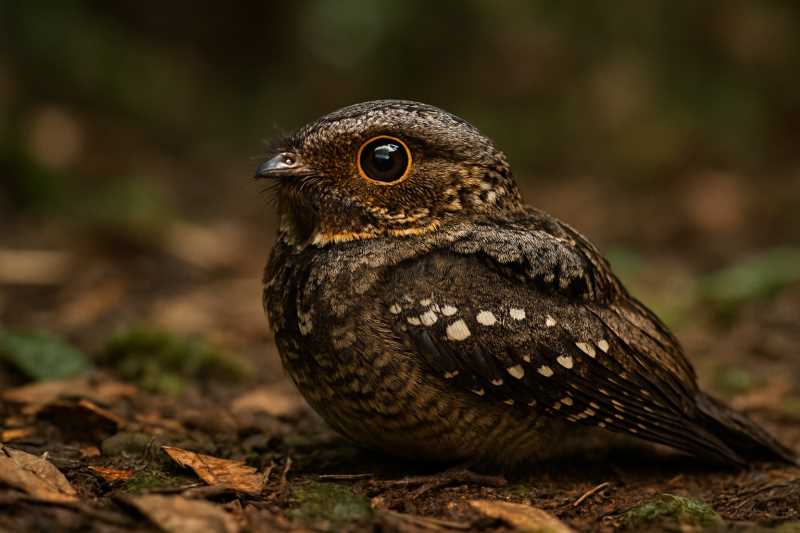
The Ocellated Poorwill is approximately 20–21 centimetres long. It has cryptic brown, grey and rufous plumage that blends with dead leaves, shaded soil and low forest vegetation. A broad pale or white band crosses the upper breast and throat, while conspicuous pale spots on the belly resemble small eyes and give the species its common name.
The sexes are similar, but males are generally greyer and darker on the upperparts and underparts. Females are usually paler and more rufous, with darker markings on the scapulars and some wing-coverts. The outer tail feathers have narrow white tips, although the central tail feathers lack these tips. Juveniles have a distinct immature plumage and can differ from adults in the colour and pattern of the underparts and wing-coverts.
Range and Habitat
The species has a broad but discontinuous range from Honduras and Nicaragua south through Costa Rica, Colombia and Ecuador, and east of the Andes through Peru, Bolivia, Brazil, Paraguay and northern Argentina. It is generally regarded as resident rather than migratory, although local movements and seasonal changes in detectability may occur.
The Ocellated Poorwill is associated mainly with humid lowland and foothill forest. Records come from mature tropical forest, terra firme forest, Atlantic Forest and some secondary forest or selectively disturbed woodland. It is often found where the forest floor has abundant leaf litter, a relatively open lower layer and low perches suitable for nocturnal foraging. The species is not restricted to the Amazon Basin, and its distribution also includes important forest regions in Central America, eastern Brazil and the southern Atlantic Forest.
Behaviour and Diet
The Ocellated Poorwill is primarily nocturnal and is most active around dusk, during the night and before dawn. It often rests motionless on the ground or on a low perch during daylight, relying on its cryptic plumage for concealment. When disturbed, it may flush only a short distance before settling again in dense vegetation or leaf litter.
It feeds on flying insects, including moths, beetles, grasshoppers and other nocturnal insects. The usual hunting method is to wait quietly on a low perch or near the ground, then make short aerial sallies to seize passing prey.
Its vocalisation has been described as a distinctive rising-and-falling trill or emphatic whistled phrase. Calls may be given from low or medium-height perches and are often the best indication that the species is present.
Breeding information remains limited. The eggs are laid directly on the forest floor, usually in a shallow depression among leaf litter rather than in a constructed nest. Documented clutches contain one or two eggs, which may be pinkish, salmon or pale buff with darker spotting. Observations from Argentina indicate an incubation period of approximately 17–18 days in one nest. Adults may use distraction displays when a nest or young are approached, and chicks are mobile soon after hatching. The lifespan of the species in the wild is not well documented.
Identification Tips
- Look for a small, compact nightjar in humid forest, especially on or close to the ground.
- The combination of a broad pale throat and upper-breast band, dark mottled plumage and pale eye-like spots on the belly is distinctive.
- In flight, narrow white tips on the outer tail feathers may be visible, together with the pale throat and belly markings.
- Females tend to appear warmer rufous than males, while males are generally greyer and darker.
- Do not rely on the supposed presence of eye-like markings on the tail. The most conspicuous ocellated markings are on the belly, while the tail mainly shows narrow white tips on the outer feathers.
- Identification by sound is often more practical than visual detection. The species is usually encountered by its characteristic trill or by flushing it from the forest floor.
Conservation Status
The Ocellated Poorwill is currently assessed as Least Concern on the IUCN Red List. This global category does not mean that every population is secure. The species depends largely on forest habitats, and deforestation, forest degradation and fragmentation may reduce suitable habitat in parts of its range.
Detailed information on population size and long-term population trends is limited. Conservation measures should therefore focus on retaining large areas of humid forest, maintaining connectivity between forest remnants and protecting well-preserved sites in the Amazonian, Central American and Atlantic Forest regions. Further field research is also needed on distribution, abundance, breeding success, vocal variation and the effects of forest alteration.
Frequently Asked Questions
Where does the Ocellated Poorwill live?
It occurs from southern Central America through much of tropical and subtropical South America east of the Andes, including Brazil, Peru, Bolivia, Paraguay and northern Argentina. It is mainly associated with humid forest.
Is the Ocellated Poorwill a nightjar?
Yes. It belongs to the nightjar family, Caprimulgidae, a group of mostly nocturnal insect-eating birds adapted for aerial hunting and camouflage.
What does the Ocellated Poorwill eat?
It eats flying insects, particularly moths, beetles, grasshoppers and other nocturnal insects. It usually captures prey during short flights from a low perch.
Does the Ocellated Poorwill build a nest?
No conventional nest is normally built. The eggs are laid directly on the ground, often in a shallow depression among leaf litter.
How many eggs does it lay?
Documented nests have contained one or two eggs. The eggs are generally pale pinkish, salmon or buff and may have darker spots.
Is the Ocellated Poorwill endangered?
The species is currently classified as Least Concern globally. Nevertheless, habitat loss and forest fragmentation remain potential local threats, and its population status is not well documented in all parts of its range.
References
- BirdLife International. n.d. Ocellated Poorwill Nyctiphrynus ocellatus Species Factsheet. BirdLife DataZone. https://datazone.birdlife.org/species/factsheet/ocellated-poorwill-nyctiphrynus-ocellatus. Accessed 8 September 2026.
- Gill, F., Donsker, D. and Rasmussen, P. (eds.). 2026. IOC World Bird List, version 15.2. International Ornithologists’ Union. https://www.worldbirdnames.org/. Accessed 8 September 2026.
- Anderson, D. L. 2000. Notes on the Breeding, Distribution, and Taxonomy of the Ocellated Poorwill (Nyctiphrynus ocellatus) in Honduras. Ornitología Neotropical 11(3): 233–238. https://digitalcommons.usf.edu/ornitologia_neotropical/vol11/iss3/10/.
- Bodrati, A. and Baigorria, J. 2013. El Atajacaminos Ocelado (Nyctiphrynus ocellatus) en Argentina: Distribución, abundancia y reproducción. Nuestras Aves 58: 75–84. https://doi.org/10.56178/na.vi58.338.
- Costa, T. V. V. and Ingels, J. 2020. The immature plumage of Ocellated Poorwill Nyctiphrynus ocellatus (Caprimulgidae). Bulletin of the British Ornithologists’ Club 140(3): 364–366. https://doi.org/10.25226/bboc.v140i3.2020.a10.
- Instituto Chico Mendes de Conservação da Biodiversidade. 2010. Guia de Aves do Parque Nacional de Brasília. ICMBio, Brasília. https://www.gov.br/icmbio/pt-br/centrais-de-conteudo/publicacoes/guias-de-aves/guia-aves-pnb-completo.pdf.
- Área de Conservación Guanacaste. 2024. Nyctiphrynus ocellatus (Caprimulgidae). Sistema Nacional de Áreas de Conservación, Costa Rica. https://www.acguanacaste.ac.cr/paginas-de-especies/insectos-2/738-caprimulgidae/6084-i-nyctiphrynus-ocellatus-i-caprimulgidae. Accessed 8 September 2026.
Related posts