The Enigmatic Austral Pygmy Owl: A Closer Look at Glaucidium nana
The Austral Pygmy Owl (Glaucidium nana) is a fascinating species that captivates ornithologists and bird enthusiasts alike. Despite its diminutive size, this owl boasts a remarkable presence throughout its native range in South America. Known for its distinct physical characteristics, vocalizations, and ecological role, the Austral Pygmy Owl provides unique insights into the diverse avian life of the Southern Hemisphere.
Physical Characteristics
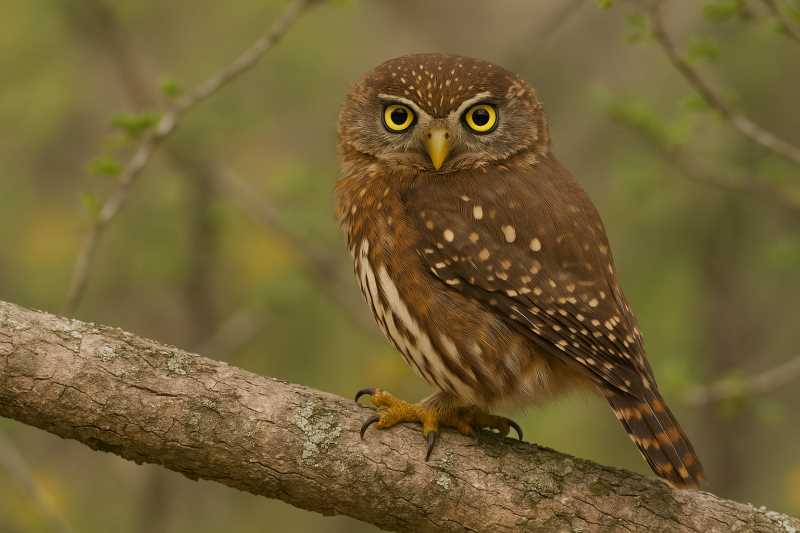
The Austral Pygmy Owl is one of the smallest owl species in the world, measuring around 15 to 20 centimeters in length. Its wingspan typically ranges from 30 to 35 centimeters, yet despite these modest dimensions, it exhibits a bold demeanor. The owl’s plumage is predominately brown with white spotting, providing effective camouflage among the trees and foliage of its habitat. Its underparts are lighter, often streaked with brown, allowing it to blend seamlessly into its environment.
One of the most distinguishing features of the Austral Pygmy Owl is its large, yellow eyes. These striking eyes, along with its rounded facial disk, give the owl an alert and inquisitive expression. This visual acuity is crucial for its hunting activities, allowing it to detect prey with remarkable precision.
Habitat and Distribution
The Austral Pygmy Owl is native to the southern regions of South America, with its range extending across Argentina, Chile, and parts of the Andean forests. It primarily inhabits temperate forests and woodlands, often preferring areas with dense vegetation that offer ample cover and hunting grounds. This owl is also adaptable to various altitudes, thriving from sea level up to 2,000 meters in the Andes.
Due to its adaptability, the Austral Pygmy Owl can also be found in secondary forests and occasionally in urban parks and gardens, where it exploits the presence of small mammals and insects. However, habitat degradation poses a significant threat to its population, as deforestation and land conversion reduce the availability of suitable living conditions.
Behavior and Diet
Despite its size, the Austral Pygmy Owl is a formidable hunter. It primarily feeds on small mammals, birds, and insects, employing a combination of stealth and agility to catch its prey. Its hunting strategy typically involves perching silently on a branch and scanning the surroundings for movement before swooping down swiftly and silently.
This owl is known for its diurnal hunting habits, which is relatively uncommon among owl species. Its vocalizations are another distinctive aspect, consisting of a series of high-pitched whistles that serve as communication signals, especially during the breeding season. These calls are often used to mark territory and attract mates, echoing through the forest and adding to the bird’s enigmatic allure.
Breeding and Lifespan
The breeding season for the Austral Pygmy Owl generally occurs during the Southern Hemisphere’s spring and summer months, from September to December. During this period, males engage in elaborate courtship displays to attract females, often involving vocalizations and presenting food.
Nesting typically takes place in tree cavities, where the female lays a clutch of three to five eggs. She incubates the eggs while the male provides food and protection. Once hatched, the young owlets remain in the nest for several weeks, relying on their parents for sustenance and learning essential survival skills. The lifespan of the Austral Pygmy Owl in the wild is not extensively documented, but it is estimated to be around 10 years.
Conservation Status
Currently, the Austral Pygmy Owl is classified as a species of Least Concern by the International Union for Conservation of Nature (IUCN). However, continued monitoring is essential to ensure this status remains stable, particularly in light of ongoing habitat loss and environmental changes.
Conservation efforts aimed at preserving its habitat are crucial to maintaining healthy populations. Protecting temperate forests and promoting sustainable land use practices can help mitigate the impact of human activities on this and other native species.
Conclusion
The Austral Pygmy Owl is a remarkable example of nature’s ingenuity, embodying both the beauty and complexity of avian life in the Southern Hemisphere. Its adaptability, hunting prowess, and distinctive vocalizations make it a subject of interest and admiration among bird watchers and researchers.
As we continue to uncover the mysteries of the Austral Pygmy Owl, it serves as a reminder of the importance of conserving our planet’s diverse ecosystems. By protecting the habitats of such enigmatic creatures, we ensure their survival and contribute to the rich tapestry of life on Earth.
Related posts