Introduction
The Madagascar Partridge (Margaroperdix madagarensis) is a small, ground-dwelling galliform endemic to Madagascar. It is the only species in the genus Margaroperdix and is also known in some sources as the Madagascan Partridge. The species is resident rather than migratory and occurs in a range of open and semi-open habitats, including scrub, grassland, secondary vegetation and cultivated areas.
Physical Description
The Madagascar Partridge is a compact, sturdy bird measuring approximately 26–30 cm in length. It has strong legs, a short bill and rounded wings suited to quick, low flights rather than sustained aerial movement.
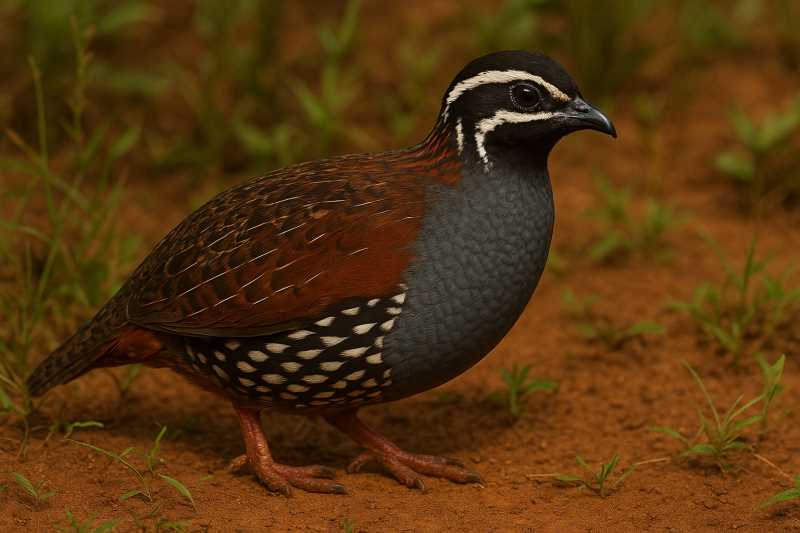
The sexes are markedly different in appearance. The adult male has a striking pattern of chestnut, rufous, black and white. Its head shows contrasting pale and dark markings, while the breast and belly are strongly patterned with dark markings and pale spots. The wings, flanks and tail are barred in buff, chestnut and black.
The female is less colourful and mainly brown, with a scalloped or scaled pattern on the underparts. This subdued plumage provides camouflage while the bird is moving through vegetation or nesting on the ground. Immature birds are reported to resemble females more closely than adult males.
Range and Habitat
The species is endemic to Madagascar, where it is widely distributed apart from the driest parts of the far south. It is mainly associated with brushland, grassland, forest edges, secondary woodland and weedy farmland. It can tolerate modified habitats and has been recorded from cultivated areas and other human-altered landscapes.
Although often described broadly as a forest bird, the Madagascar Partridge is not restricted to closed-canopy rainforest. It is more frequently associated with habitats that provide dense ground cover and a mixture of shrubs, grasses and scattered woodland. Its recorded elevational range extends from near sea level to approximately 2,700 m, although older conservation assessments give lower upper limits for some regions.
Introduced populations have also been reported on Réunion and Mauritius. These populations are separate from the species’ native Malagasy range and should not be confused with its status as a Madagascar endemic.
Behaviour and Diet
The Madagascar Partridge is primarily terrestrial and generally active by day. It usually moves through cover on foot, searching the ground and leaf litter for food. When disturbed, it may run rapidly before making a short, explosive flight into nearby vegetation.
It may occur singly, in pairs or in small family groups. The species is considered sedentary, with no regular long-distance migration documented. Its diet includes seeds and other plant material, such as berries and roots, together with insects and other small invertebrates. The relative importance of these foods probably varies with habitat and season.
Breeding information is limited and may vary geographically. Nests are placed on the ground, usually concealed in grass or other dense vegetation. Nesting has been recorded on the Malagasy high plateau from March to June, and clutch reports of approximately 15–20 eggs are available from published species accounts. The original assumption that both parents routinely share incubation and cooperative care is not sufficiently well documented, so breeding behaviour should be described cautiously.
Identification Tips
- Look for a dark, chunky partridge-sized bird walking through grassland, scrub or open woodland.
- Adult males are distinctive, with a complex black, white, chestnut and rufous pattern on the head and body.
- Females are much plainer and browner, but show conspicuous scalloping or scaling on the underparts.
- The species is more likely to be detected running through cover or making a short flight than remaining in the open for long periods.
- Its combination of terrestrial habits, compact shape and strongly patterned male plumage helps separate it from other Malagasy ground birds. There is no need to rely on comparisons with introduced or unrelated partridges for field identification.
Conservation Status
The Madagascar Partridge is currently assessed as Least Concern at global level. A precise global population estimate is not available, and the population trend is not sufficiently quantified for a reliable numerical assessment.
The main concerns are habitat degradation, conversion of scrub and grassland, repeated burning, agricultural expansion and local hunting. Habitat loss is particularly important where fires convert brushland to poorer-quality grassland or remove the dense cover needed for feeding and nesting. Hunting may also reduce numbers locally, even though the species remains widespread overall.
Conservation measures should include protection of remaining native habitats, improved fire management, sustainable land-use practices and monitoring of hunting pressure. Maintaining a mosaic of scrub, grassland, secondary vegetation and woodland is likely to benefit the species across much of its range.
Frequently Asked Questions
Where is the Madagascar Partridge found?
It is native to Madagascar and occurs widely across the island, except in the driest parts of the extreme south. Introduced populations have also been reported on Réunion and Mauritius.
Is the Madagascar Partridge endemic to Madagascar?
Yes. The species is endemic to Madagascar in its native range, although it has been introduced elsewhere in the western Indian Ocean.
What does the Madagascar Partridge eat?
Its diet includes seeds, berries, roots and other plant material, supplemented by insects and other small invertebrates.
How can the Madagascar Partridge be identified?
The male is recognised by its bold chestnut, rufous, black and white plumage. The female is browner and more cryptic, with scalloped or scaled markings on the underparts.
Does the Madagascar Partridge migrate?
No regular long-distance migration is known. It is generally regarded as a sedentary resident.
Is the Madagascar Partridge endangered?
The species is currently classified as Least Concern globally. Nevertheless, habitat degradation, fires, agricultural expansion and hunting can create serious local pressures.
References
- BirdLife International. 2021. The State of Madagascar’s Birds. BirdLife International, Cambridge, UK. https://www.birdlife.org/wp-content/uploads/2021/10/State_of_Madagascars_Birds_English.pdf (accessed 8 September 2026).
- Conservation Planning Specialist Group. 1993. Galliform CAMP: Madagascar Partridge Margaroperdix madagascariensis. IUCN Species Survival Commission and Conservation Planning Specialist Group. https://www.cpsg.org/sites/default/files/2024-05/Galliform%2520CAMP%25201993.pdf (accessed 8 September 2026).
- International Union for Conservation of Nature. 2024. The IUCN Red List of Threatened Species, Version 2024-2. IUCN, Gland, Switzerland and Cambridge, UK. https://www.iucnredlist.org (accessed 8 September 2026).
- McGowan, P. J. K. and Kirwan, G. M. 2020. Madagascar Partridge (Margaroperdix madagarensis), version 1.0. In J. del Hoyo, A. Elliott, J. Sargatal, D. A. Christie and E. de Juana, eds, Birds of the World. Cornell Lab of Ornithology, Ithaca, New York, USA. https://doi.org/10.2173/bow.madpar2.01.
- IOC World Bird List. 2026. IOC World Bird List, version 15.2. International Ornithologists’ Committee. https://www.worldbirdnames.org/new/ioc-lists/ (accessed 8 September 2026).
- Oiseaux.net. 2026. Madagascar Partridge, Margaroperdix madagarensis. Oiseaux.net. https://www.oiseaux.net/en/oiseaux/madagascar.partridge.html (accessed 8 September 2026).
Related posts