The Royal Penguin: A Regal Resident of the Subantarctic Isles
The Royal Penguin (Eudyptes schlegeli) is a captivating and distinctive member of the penguin family, recognized for its striking appearance and unique habitat. This extraordinary bird is primarily found on the subantarctic Macquarie Island, a UNESCO World Heritage site located halfway between New Zealand and Antarctica. The Royal Penguin, with its vibrant plumage and fascinating behaviors, has captured the interest of ornithologists and nature enthusiasts alike.
A Regal Appearance
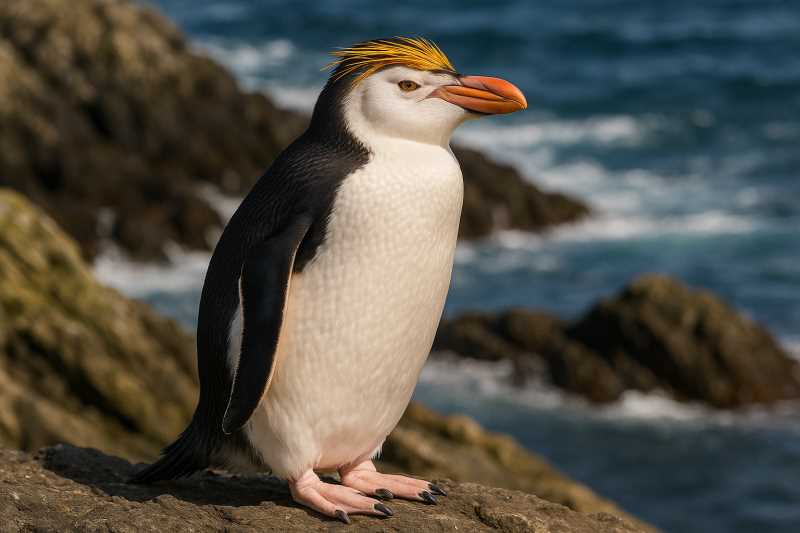
The Royal Penguin is easily distinguishable from other penguin species due to its vivid yellow crest feathers that extend from its forehead, contrasting sharply with its stark white face. Unlike its close relatives, the Macaroni Penguins, which have a black face, the Royal Penguin’s lighter facial coloration sets it apart. Adult Royal Penguins typically stand about 70 cm tall and weigh between 4 to 6 kilograms, with males slightly larger than females.
Despite the similarities in appearance to the Macaroni Penguin, genetic studies have shown that the Royal Penguin is a distinct species. The debate over its classification persisted for years, but the unique characteristics of the Royal Penguin have cemented its status as a separate species within the crested penguin group.
Habitat and Distribution
The Royal Penguin’s primary breeding ground is Macquarie Island, a remote and ecologically significant territory that provides the ideal environment for these birds. The island’s rugged terrain and sparse vegetation create a unique biosphere that supports a diverse range of wildlife. Royal Penguins are also occasionally found on nearby Bishop and Clerk Islets, further emphasizing their preference for isolated and undisturbed habitats.
During the breeding season, which runs from September to February, Royal Penguins form large colonies on the beaches and slopes of Macquarie Island. These colonies can number in the hundreds of thousands, creating a bustling, lively environment. Outside of the breeding season, Royal Penguins are pelagic, spending months at sea foraging and exploring the Southern Ocean.
Diet and Foraging Behavior
Royal Penguins primarily feed on krill, small fish, and squid, which they hunt during their extensive foraging trips. Their diet largely depends on the availability of prey, which can fluctuate with oceanic conditions. Royal Penguins are adept divers, capable of reaching depths of up to 50 meters in pursuit of food, although they typically hunt at shallower depths.
Their foraging expeditions can last several days, with parents taking turns caring for their chicks and embarking on feeding trips. This cooperative behavior ensures a steady supply of food for their young during the breeding season.
Breeding and Life Cycle
The breeding cycle of the Royal Penguin is a well-coordinated process. Males arrive on Macquarie Island in early September to establish nesting sites and await the arrival of females. The nests, often simple scrapes in the ground lined with stones and vegetation, are fiercely defended.
Once paired, the female lays two eggs, although only the second, larger egg usually survives. Incubation duties are shared between both parents and last approximately 35 days. After hatching, the chicks are cared for by both parents, who alternate between guarding the nest and foraging.
Chick rearing is a demanding time, with parents providing continuous care and feeding until the chicks are ready to fledge at about 70 days old. The fledging period is crucial as the young penguins learn to forage and survive independently.
Conservation Status and Challenges
The Royal Penguin is currently classified as Near Threatened by the International Union for Conservation of Nature (IUCN). Although their population is relatively stable, there are several threats looming. Climate change poses a significant risk, potentially altering the availability and distribution of their prey. Additionally, human activities such as fishing and pollution could impact their food sources and habitat.
Conservation efforts are in place to monitor the population and protect the unique ecosystem of Macquarie Island. The island’s designation as a World Heritage site and its status as a marine reserve are crucial steps in safeguarding the Royal Penguin and its environment.
Conclusion
The Royal Penguin remains one of the most fascinating inhabitants of the subantarctic region. Its striking appearance, complex behaviors, and the remote beauty of its habitat continue to enchant and inspire those who study and observe it. As our understanding of this remarkable species grows, so too does the importance of ensuring its survival in the face of environmental challenges. Protecting the Royal Penguin is not only about preserving a species but also about maintaining the delicate balance of the ecosystems they inhabit.
This is one of the species covered in our book Penguins Of The World which is part of our Kings Birds of the world series, and one of the Kings Guides.

Related posts