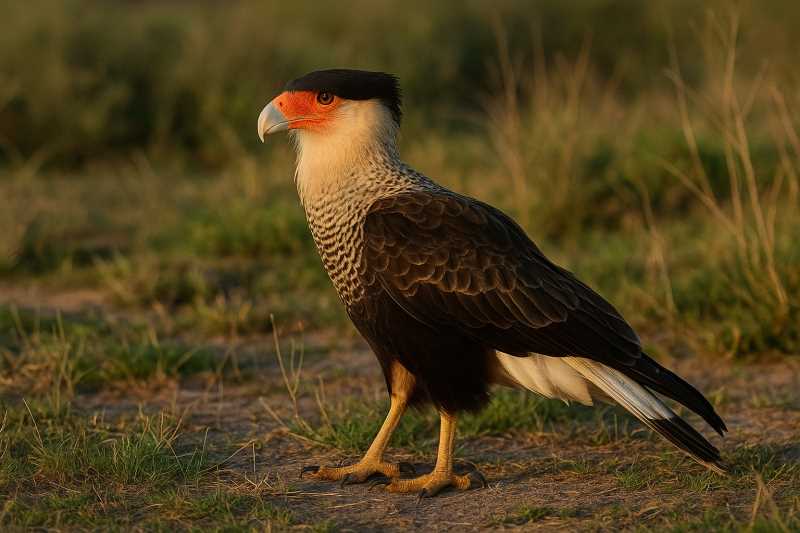
Crested Caracara: The Unique Falcon of the Americas
The Crested Caracara (Caracara plancus) is a distinctive bird of prey that stands out in the avian world due to its remarkable appearance and intriguing behavior. Though often grouped with falcons, the Crested Caracara is unlike its swift and agile relatives and offers a fascinating glimpse into the diversity of raptors across the Americas.
Physical Characteristics
The Crested Caracara is a large raptor, measuring between 20 to 26 inches in length with a wingspan that can reach up to 49 inches. Its striking appearance includes a bold black cap, a bare face with a bright orange or yellow cere, and a predominantly dark body contrasted with white neck and underparts. The bird’s legs are long and yellow, a feature that assists it in its terrestrial activities. Unlike many falcons, which are adapted for speed and aerial hunting, the Crested Caracara has a more leisurely flight pattern and is often seen gliding on thermals.
Habitat and Distribution
This bird is primarily found across parts of the southern United States, Central America, and throughout much of South America. It favors open landscapes such as savannas, grasslands, pastures, and even marshes, where it can be seen walking or flying low as it searches for food. The Crested Caracara’s adaptability to various habitats has aided its survival in regions where human activity is prevalent.
Diet and Feeding Behavior
The Crested Caracara is an opportunistic feeder with a varied diet that includes carrion, insects, small mammals, reptiles, and even other birds. Unlike many raptors that prefer to hunt live prey, the Crested Caracara is just as likely to scavenge, taking advantage of roadkill or carcasses left by other predators. This behavior has earned it the nickname "Mexican Eagle" in some regions, although it is not a true eagle.
The bird’s hunting strategy is as unique as its diet. While capable of capturing live prey, the Crested Caracara often relies on its keen eyesight to spot carcasses from afar. It may also follow other birds, such as vultures, to locate food sources. On the ground, it uses its strong legs to run and chase prey, showcasing a level of terrestrial agility uncommon among falcons.
Reproduction and Lifespan
Breeding season for the Crested Caracara varies depending on its geographical location but generally occurs in the spring and early summer. The birds build large nests made of sticks, typically in tall trees or on cliffs, although they have been known to nest on the ground in areas with limited tree cover. Females lay two to three eggs, which both parents incubate for about a month. After hatching, the young are cared for by both parents until they are ready to fledge, approximately two months later.
Crested Caracaras have a relatively long lifespan, often living over a decade in the wild. Their longevity is supported by their adaptability in diet and habitat, making them resilient to environmental changes.
Conservation Status
Currently, the Crested Caracara is listed as a species of Least Concern by the International Union for Conservation of Nature (IUCN). Despite this status, regional populations, particularly in the United States, face threats from habitat destruction and fragmentation. Conservation efforts focus on preserving open habitats and reducing human-wildlife conflict.
Cultural Significance
The Crested Caracara holds cultural significance in several regions, notably in Mexico, where it is associated with national symbolism. It features prominently in indigenous folklore and is often depicted in art and literature, representing strength and adaptability.
Conclusion
The Crested Caracara is a testament to the diversity and adaptability of raptors. Its unique blend of terrestrial and aerial prowess, coupled with an opportunistic feeding strategy, sets it apart from other birds of prey. As it continues to navigate changing landscapes, the Crested Caracara remains an emblem of resilience and adaptability in the natural world.
Related posts