Introduction
The Greater Scaup (Aythya marila) is a medium-sized diving duck of the northern hemisphere. It breeds mainly in Arctic and subarctic wetlands and migrates to sheltered coastal waters, estuaries, large lakes and reservoirs during the non-breeding season. The species is also known as Scaup in parts of Europe and Bluebill in North America.
Physical Description
The Greater Scaup is a stocky duck measuring approximately 39–56 cm in length, with a wingspan of about 72–79 cm. It has a rounded head, broad bill, compact body and strong legs adapted for diving.
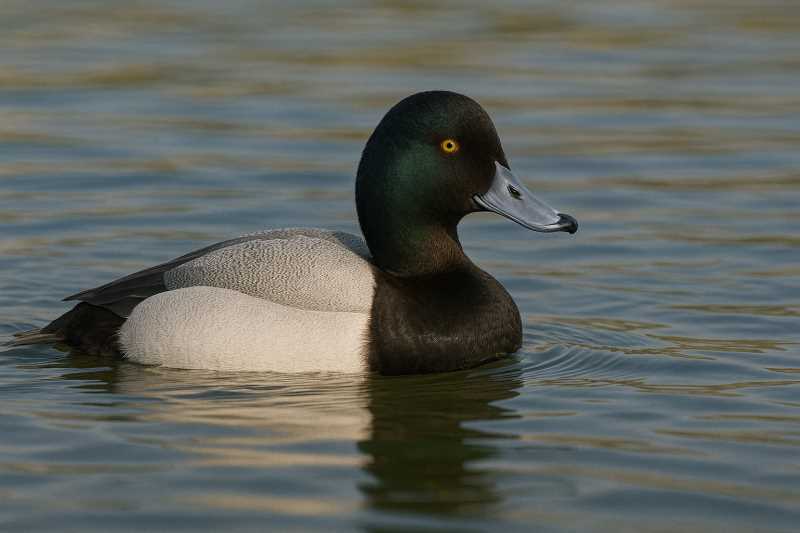
Adult males have a glossy black head, often showing a green sheen in good light, a black breast and rear, finely barred grey back, white flanks and a bluish-grey bill with a dark nail. The eyes are bright yellow. Females are predominantly warm brown, with a darker head, a pale or white patch around the base of the bill and yellow eyes. The extent of the facial patch varies among individuals and can be less conspicuous in some plumages.
Non-breeding males and immature birds are duller and more mottled, combining brown, grey and black tones. Both sexes show a prominent white wing stripe in flight. Males are generally slightly larger than females.
Range and Habitat
The Greater Scaup has a circumpolar breeding distribution across northern North America, Iceland, northern Europe and northern Asia. It breeds mainly in shallow freshwater lakes, ponds and marshes in tundra, wooded tundra and the northern margins of the boreal zone. Breeding sites usually contain emergent or submerged vegetation and are close to open water.
The species is strongly migratory. North American birds winter along the Atlantic and Pacific coasts, around the Great Lakes and on other large, ice-free inland waters. In Europe and Asia, wintering birds occur along sheltered sea coasts, estuaries, lagoons, inland seas and large freshwater lakes. Important wintering areas include the Baltic and North seas, the Atlantic and Pacific coasts, the Black and Caspian seas, and coastal waters of eastern Asia.
Geographic variation is recognised within the species, although the treatment of some eastern populations and subspecies has varied between taxonomic authorities. The IOC World Bird List currently recognises Aythya marila as the accepted species name.
Behaviour and Diet
Greater Scaups are social ducks and often form dense flocks, or rafts, during migration and winter. They frequently associate with other diving ducks, particularly Lesser Scaups (Aythya affinis) and Tufted Ducks (Aythya fuligula). They dive from the surface and use their feet to propel themselves underwater, usually foraging in shallow water but capable of diving to greater depths when necessary.
The diet varies with season and location. It includes molluscs, crustaceans, aquatic insects, other invertebrates, seeds and vegetative parts of aquatic plants. Molluscs such as mussels, clams and snails can be particularly important in coastal wintering areas. Greater Scaups generally feed during the day, although nocturnal feeding may occur where daylight disturbance from boats or other human activity is high.
Breeding pairs usually form during late winter or spring migration. The female selects and builds a shallow nest close to water, often among grasses and sedges, on solid ground, floating vegetation or an island. She lines the nest with plant material and down. A clutch commonly contains 5–13 eggs, and incubation lasts about 23–28 days. The female provides the main parental care. Ducklings are covered in down, have open eyes when they hatch and leave the nest within roughly a day, feeding themselves while remaining under the female’s protection.
Identification Tips
- Look for a medium-sized, round-headed diving duck with a broad bill and compact shape.
- Adult males appear black and white at a distance, with a black head and breast, pale grey back, white sides and a yellow eye.
- In good light, the male’s head may show a green sheen rather than the purple sheen often associated with Lesser Scaup.
- Females are brown overall and usually show a conspicuous pale or white patch at the base of the bill.
- In flight, the white wing stripe is generally broad and prominent.
- Greater Scaups are larger and heavier-looking than Lesser Scaups, with a broader bill and a smoothly rounded head. The head profile of a Lesser Scaup more often rises to a noticeable peak towards the rear, although lighting, posture, age and individual variation can make identification difficult.
- Greater Scaups can resemble female or immature Tufted Ducks, but they usually have a smoother, rounder head and lack the Tufted Duck’s obvious crest.
Conservation Status
The Greater Scaup is currently assessed as Least Concern on the IUCN Red List. However, population declines have been documented in several regions, and the species remains a conservation concern in parts of Europe and North America. In North America, monitoring is complicated because Greater and Lesser Scaups are often counted together, making species-specific trends difficult to determine.
Potential and documented pressures include degradation of breeding and wintering wetlands, disturbance, contaminants, changes in food availability, hunting and climate-related changes to northern habitats. Conservation priorities include protecting Arctic and subarctic breeding wetlands, safeguarding important coastal and inland wintering sites, maintaining food-rich shallow waters, reducing pollution and disturbance, and improving monitoring that separates the two scaup species.
Frequently Asked Questions
Where does the Greater Scaup live?
It breeds mainly in Arctic and subarctic lakes, ponds and marshes across northern North America, Europe and Asia. It winters on sheltered coasts, estuaries, inland seas, the Great Lakes and other large ice-free waters.
What does a Greater Scaup look like?
The male has a dark glossy head, black breast, grey back, white flanks and a yellow eye. The female is brown with a pale or white patch around the base of the bill. Both sexes have a rounded head and broad bill.
What does the Greater Scaup eat?
Its diet includes molluscs, crustaceans, aquatic insects, other aquatic invertebrates, seeds and aquatic plant material. Molluscs are especially important for many wintering birds in coastal habitats.
Is the Greater Scaup a migratory bird?
Yes. It is strongly migratory, breeding at high northern latitudes and moving south to coastal waters and large inland lakes during autumn and winter.
How can a Greater Scaup be distinguished from a Lesser Scaup?
Greater Scaups are usually larger, broader-billed and more smoothly round-headed. Males often show a greenish head sheen, while Lesser Scaup males more often show a purplish sheen. Identification can be difficult, particularly for females and immature birds.
Is the Greater Scaup endangered?
The species is currently listed globally as Least Concern, but some regional populations are declining. Protection of wetlands, wintering waters and important food resources remains important for its long-term conservation.
References
- BirdLife International. 2024–2026. Greater Scaup Aythya marila species factsheet. BirdLife Data Zone. Accessed 8 September 2026. https://datazone.birdlife.org/species/factsheet/greater-scaup-aythya-marila
- Cornell Lab of Ornithology. n.d. Greater Scaup identification. All About Birds. Accessed 8 September 2026. https://www.allaboutbirds.org/guide/Greater_Scaup/id
- Cornell Lab of Ornithology. n.d. Greater Scaup life history. All About Birds. Accessed 8 September 2026. https://www.allaboutbirds.org/guide/Greater_Scaup/lifehistory
- Fink, D., Auer, T., Johnston, A., Strimas-Mackey, M., Ligocki, S., Robinson, O., Hochachka, W., Jaromczyk, L., Crowley, C., Dunham, K., Stillman, A., Stokowski, M., Sharma, P., Pantoja, V., Burgin, M., Crowe, P., Ray, S., Davies, I., Ruiz-Gutierrez, V., Wood, C. and Rodewald, P. 2024. eBird Status and Trends, Data Version: 2023, released 2025. Cornell Lab of Ornithology. https://doi.org/10.2173/WZTW8903
- Gill, F., Donsker, D. and Rasmussen, P., eds. 2026. IOC World Bird List, version 15.2. International Ornithologists’ Union. Accessed 8 September 2026. https://www.worldbirdnames.org/
- Marchowski, D., Jankowiak, Ł., Ławicki, Ł., Wysocki, D. and Chylarecki, P. 2019. Conservation implications of extraordinary Greater Scaup (Aythya marila) concentrations in the Odra Estuary, Poland. Ornithological Applications 121(2): duz013. https://doi.org/10.1093/condor/duz013
- National Audubon Society. n.d. Greater Scaup. Audubon Field Guide. Accessed 8 September 2026. https://www.audubon.org/field-guide/bird/greater-scaup
- U.S. Fish and Wildlife Service. 2024. Waterfowl Population Status, 2024. U.S. Department of the Interior. Accessed 8 September 2026. https://www.fws.gov/sites/default/files/documents/2024-08/waterfowl-population-status-report-2024.pdf
Related posts