The Lewis’s Woodpecker (Melanerpes lewis) is an exceptional member of the woodpecker family, distinct not only in its striking coloration but also in its remarkable foraging behavior. Named in honor of Meriwether Lewis of the Lewis and Clark Expedition, this bird has fascinated ornithologists and birdwatchers alike for centuries. From its iridescent feathers to its aerial acrobatics, the Lewis’s Woodpecker is truly a standout species among North America’s avifauna.
Physical Description
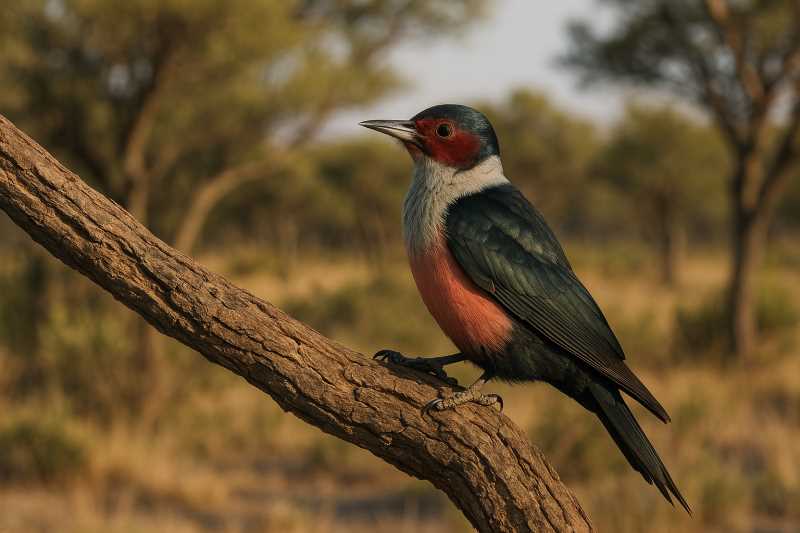
Unlike the typical black-and-white plumage associated with many woodpecker species, Lewis’s Woodpecker boasts a remarkable combination of colors. Its dark greenish-black upperparts and wings shimmer with a metallic gloss in sunlight. The breast is a rosy-pink, while the face features a deep red mask set against a pale gray collar that wraps around the back of the head and neck. The bird’s wings are broad and its flight style more closely resembles a jay’s than that of a typical woodpecker.
Adult Lewis’s Woodpeckers are approximately 10–11 inches (25–28 cm) in length with a wingspan of around 19–20 inches (48–51 cm). Males and females look similar, though males may have slightly brighter facial coloring during the breeding season.
Range and Habitat
Lewis’s Woodpecker primarily inhabits the western United States and parts of southern Canada, especially British Columbia. Its range extends across dry open forests, ponderosa pine woodlands, oak savannas, and burned or recently logged areas. During the breeding season, it favors open woodlands with scattered trees, especially those offering dead snags for nesting.
Come winter, Lewis’s Woodpecker migrates to lower elevations or southern latitudes, with populations found in California, Arizona, and New Mexico. However, its winter range is less predictable than many other species, likely due to variability in food availability.
Behavior and Feeding
Lewis’s Woodpecker is renowned for its uncharacteristic feeding style. While many woodpeckers drill into wood to extract insects, this species often catches prey in mid-air, employing a graceful, buoyant flight more reminiscent of a flycatcher. It spends a significant amount of time perched and scanning for flying insects, launching into the air to snatch them with impressive agility.
In addition to aerial insects, Lewis’s Woodpecker consumes a varied diet including ants, beetles, and spiders. It also relies heavily on plant-based foods, especially in fall and winter. Acorns, berries, and other fruits are commonly eaten, and the species has been observed storing food in crevices for later use—a behavior known as caching.
Breeding and Nesting
The breeding season typically begins in late spring. Lewis’s Woodpeckers are cavity nesters, usually excavating their own nesting holes in dead or decaying trees. They may also use existing cavities left by other woodpeckers. Both sexes participate in nest excavation, incubation, and feeding of the young.
Clutch size ranges from 5 to 9 eggs, with both parents sharing incubation duties for about 12 to 14 days. After hatching, chicks are fed by both parents and fledge approximately four weeks later. The success of breeding often depends on the availability of suitable dead trees and an ample insect supply.
Conservation Status
The Lewis’s Woodpecker is currently listed as “Near Threatened” by the IUCN due to habitat loss and fragmentation. Its dependence on open forest structures and dead trees for nesting makes it vulnerable to changes in land use, such as logging, fire suppression, and agricultural expansion.
Conservation efforts focus on preserving suitable habitats, especially maintaining snags and large trees in both breeding and wintering areas. Controlled burns and sustainable forestry practices can also benefit the species by maintaining the open woodland structures it favors.
Cultural Significance
This bird holds a special place in American natural history. Meriwether Lewis first described it during the famed Lewis and Clark Expedition in the early 1800s, making it one of the earliest documented bird species from that journey. Its name honors Lewis’s role in expanding scientific knowledge of North American fauna.
Birdwatching Tips
For birders, spotting a Lewis’s Woodpecker is a memorable experience. Look for them in the summer around open pine forests in the Rocky Mountain West or in oak savannas. In winter, check for them in orchards, riparian woodlands, and oak groves, particularly in California’s Central Valley or parts of the Southwest.
Their flight is slow and crow-like, and they often perch motionlessly for long periods, scanning for insects. Listen for their harsh “churrr” calls and watch for them hawking insects with remarkable precision.
Related posts