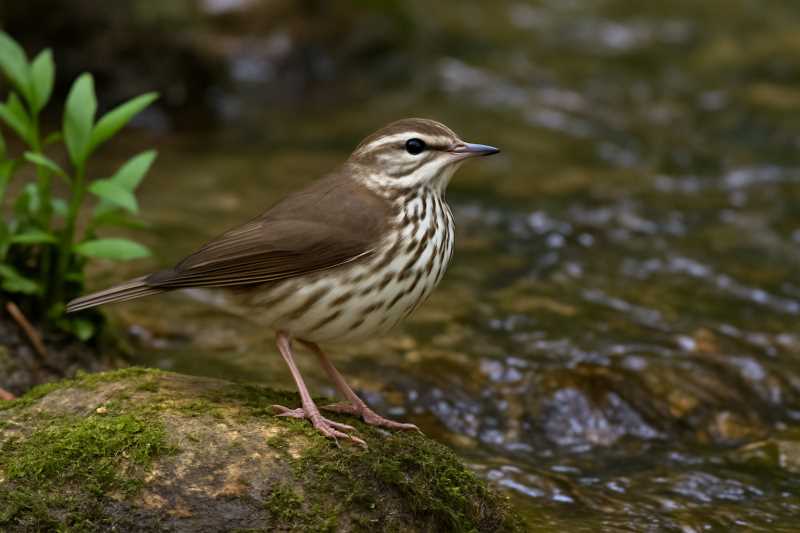
The Louisiana Waterthrush (Parkesia motacilla) is a distinctive and energetic warbler that thrives along shaded forest streams in eastern North America. Despite its name, it is not a true thrush, but rather a member of the wood warbler family (Parulidae), and one of only two species in the genus Parkesia. It is a bird of fast-flowing water, recognized as much for its incessant tail bobbing and streaked appearance as for its sweet, ringing song that echoes through the dense hardwood forests it calls home during the breeding season.
Identification and Description
The Louisiana Waterthrush is a large-bodied warbler, measuring about 15–17 cm in length, with a wingspan of 23–25 cm. It is often mistaken for a thrush due to its size, upright stance, and heavily streaked underparts.
Key identification features include:
- Brownish-olive upperparts
- Bright white underparts with bold dark streaking on the breast and flanks
- A broad, often buff-tinged white eyebrow stripe (supercilium) that flares behind the eye
- Pinkish legs, which it uses to bob constantly as it walks along the water’s edge
- A long, straight bill and relatively long tail for a warbler
This species is often confused with the closely related Northern Waterthrush, but can be distinguished by its cleaner white underparts, bolder supercilium, and preference for higher-quality stream habitats.
Habitat and Distribution
The Louisiana Waterthrush breeds throughout eastern North America, from the southeastern United States northward into southern parts of Ontario, Quebec, and New England. It is strongly tied to mature deciduous or mixed forests with clean, fast-flowing streams, often in hilly or mountainous terrain.
In winter, it migrates to Central America, the Caribbean, and parts of northern South America, where it inhabits shaded streams and swampy lowlands. Despite its migratory nature, it shows strong site fidelity to breeding and wintering territories.
Its dependence on intact riparian forest makes it a valuable indicator species for water quality and forest health.
Behaviour and Diet
The Louisiana Waterthrush is primarily terrestrial, often seen walking along stream banks in a deliberate, bobbing gait while flipping over leaves or probing mud and rocks for prey. Unlike many warblers, it forages almost exclusively on the ground and rarely flies unless disturbed.
Its diet includes:
- Aquatic and terrestrial insects
- Spiders
- Crustaceans
- Small mollusks
During the breeding season, males establish territories and sing from exposed perches along the stream. The song—a series of clear, whistled phrases followed by a jumble of notes—is distinctive and one of the best ways to locate the bird in dense foliage.
Breeding and Nesting
Breeding occurs from April to July, depending on latitude. The female builds a well-camouflaged nest on the ground, often hidden among roots, mossy banks, or beneath fallen logs, always near running water. The nest is made of leaves, mud, and moss, forming a domed structure with a side entrance.
She lays 4–6 eggs, which she incubates for about 12–14 days. Once hatched, the chicks are cared for by both parents and fledge after roughly 10–12 days.
The Louisiana Waterthrush is also a known host of the Brown-headed Cowbird, a brood parasite, though its concealed nest placement helps minimize this risk.
Conservation Status
The Louisiana Waterthrush is currently listed as a species of Least Concern by the IUCN, but its populations are considered declining in parts of its range, especially where streamside forests are degraded or fragmented.
Major threats include:
- Logging and deforestation
- Stream pollution and sedimentation
- Hydrological changes from development or agriculture
- Climate change, which may alter stream flow and forest composition
Because of its strong habitat fidelity and sensitivity to water quality, the species is increasingly used in riparian conservation planning as a bioindicator of healthy forested stream systems.
Birdwatching Tips
To observe the Louisiana Waterthrush, visit mature forests with clean, moving water in spring or early summer. Some of the best areas include:
- The Appalachian Mountains
- Ozark Plateau
- Protected river corridors in the Midwest and Southeast
Arrive early in the morning, listen for the clear, melodic song, and scan shaded stream banks for movement. The bird’s tail-bobbing behaviour is a helpful visual clue even when the song is absent.
Conclusion
The Louisiana Waterthrush is more than a charming forest warbler—it is a sentinel of streamside ecosystems. Its presence speaks to the health of riparian forests, and its decline is a warning of ecological imbalance. With continued habitat protection and restoration, this elegant warbler will continue to ring its cheerful song through forested valleys each spring, enriching the soundscape of North America’s wild rivers.
Related posts