Introduction
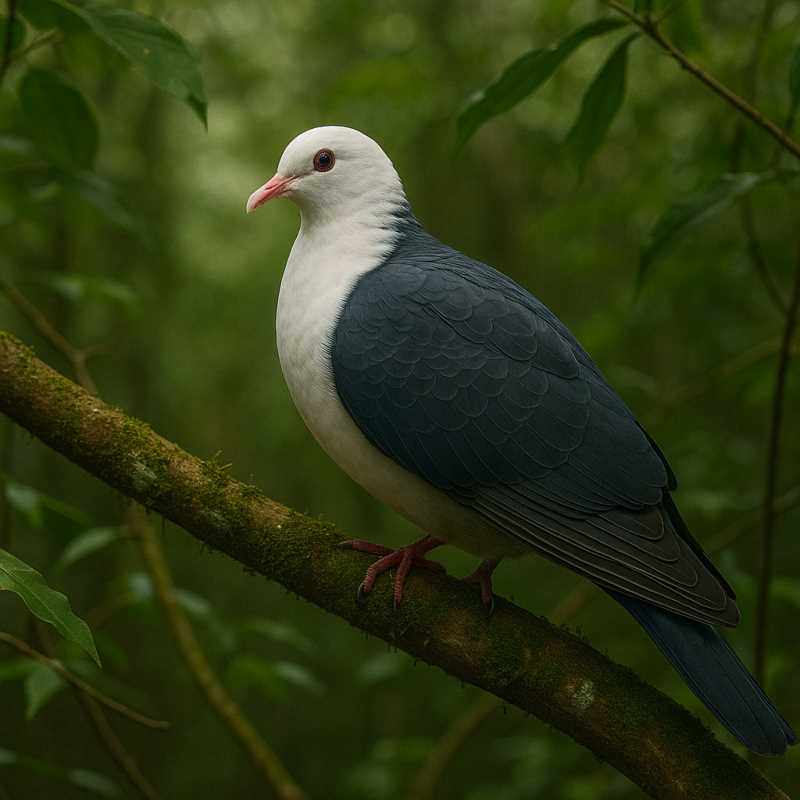
The White-headed Pigeon (Columba leucomela), also known as the Baldy, is a large pigeon native to eastern Australia. It is recognised by its contrasting white head and breast, dark wings and back, and pink to red facial skin and legs. The species occurs mainly in rainforest, wet forest remnants and other areas where fruiting trees are available.
Physical Description
The White-headed Pigeon measures approximately 38–42 centimetres in length. Adults have a white head, neck and breast, sometimes showing a faint orange or greyish wash. The back, wings and tail are dark grey to black, while the lower underparts are generally grey.
Males often show a metallic green, purple or grey sheen in the dark plumage. Females are usually duller and greyer, with a darker or faintly grey cap and more mottling on the head and underparts. Young birds are browner and darker overall, resembling immature females before developing adult plumage.
The eye is orange-yellow to yellow, surrounded by a pink or red orbital ring. The bill is pinkish-red to reddish-brown with a paler tip, and the legs and feet are usually pink to reddish-pink.
Range and Habitat
The White-headed Pigeon is found along the eastern side of Australia, from far northern Queensland southwards to southern New South Wales, generally east of the Great Dividing Range. It is a resident species, although individuals may travel several kilometres between forest, feeding and roosting sites.
Its preferred habitats include tropical and subtropical rainforest, wet sclerophyll forest, forest remnants, rainforest edges and other areas with abundant fruiting trees. It also occurs in modified landscapes, including farmland, roadsides, suburban gardens and areas containing introduced Camphor Laurel and privet. These introduced trees can provide important food, particularly where native forest has been cleared.
Where to See This Species
Fitzroy Island National Park, Queensland, Australia
White-headed Pigeons have been recorded on Fitzroy Island, where rainforest, woodland and forest edges provide suitable habitat. The island is publicly accessible by ferry or private boat from Cairns, and birdwatching is possible along the walking tracks. Records do not indicate that the species is guaranteed on every visit, so careful searching around fruiting trees is advisable.
Nearby accommodation: Cairns provides the most practical base, with hotels, guest houses, hostels, campsites and self-catering accommodation. Limited resort accommodation is also available on Fitzroy Island.
Tyagarah Nature Reserve, New South Wales, Australia
The Tyagarah Nature Reserve plan of management lists the White-headed Pigeon among the birds recorded in the reserve. Its mixture of rainforest, wetland, woodland and coastal vegetation provides suitable habitat, although public access is concentrated around the day-use area and adjacent tracks.
Nearby accommodation: Byron Bay and Brunswick Heads are the nearest established accommodation centres, offering hotels, guest houses, holiday rentals, cabins and campsites.
Royal National Park, New South Wales, Australia
White-headed Pigeons have been recorded in the Royal National Park, which contains rainforest gullies, wet forest, woodland and other habitats used by fruit-eating birds. Look for pigeons moving between forested areas and fruiting trees, particularly in sheltered gullies and around suitable edges. The species may be local or inconspicuous, so sightings are not guaranteed.
Nearby accommodation: Sutherland, Cronulla, Bundeena, Otford and Helensburgh provide practical bases with hotels, guest houses, cabins, cottages, campsites and other self-catering accommodation.
Behaviour and Diet
White-headed Pigeons are often encountered alone or in pairs, although small groups may gather where food is plentiful. They can be shy and may remain high in the canopy, but they also visit forest edges, gardens, roadsides and agricultural areas. Their flight is strong and direct, with birds often travelling quickly between feeding and roosting sites.
The diet consists mainly of rainforest fruits and seeds. Camphor Laurel is an important food source in many modified landscapes, and the birds also eat fruit from other native and introduced trees, including privet. Published observations have recorded flowers, buds, bark and grit in the diet as well. By consuming and moving seeds, White-headed Pigeons may contribute to seed dispersal, although their use of introduced fruiting trees can also assist the spread of some environmental weeds.
The call is described as a strong, repeated “whook” or a slow, mournful series of “oom-coo” notes.
Breeding information from wild birds indicates considerable regional and seasonal variation. Near Lismore in northern New South Wales, nests were recorded in most months except October and November. The nest is a simple platform of sticks placed in dense foliage, tangled vines or a tree or shrub. A clutch normally consists of a single white egg. Both members of the pair incubate and care for the young, and nests may be reused in the same season or in later years. Predation was the principal known cause of nesting failure in one long-term study.
Identification Tips
- Look for a large, heavy-bodied pigeon measuring about 38–42 centimetres.
- The clean white head, neck and breast contrast strongly with the dark grey to black back, wings and tail.
- Adult males may show a metallic green or purple sheen in the dark plumage.
- Pink to red bare skin around the eye, a reddish bill and pinkish legs are useful supporting features.
- Immature birds are browner and less sharply patterned, with a darker, mottled head.
- Do not confuse it with the common Rock Dove, which has a smaller white facial area, a different wing pattern and usually a more urban appearance. The White-headed Pigeon is more closely associated with forest, fruiting trees and eastern Australian habitats.
Conservation Status
The White-headed Pigeon is classified as Least Concern by the International Union for Conservation of Nature. It is not currently considered globally threatened, but local populations can be affected by clearing, fragmentation and degradation of rainforest and wet forest habitat.
The species has adapted to some modified landscapes, particularly where Camphor Laurel and other fruiting plants are available. However, removal of these introduced food trees during habitat restoration can reduce food availability in some areas, especially where native fruiting vegetation has not yet recovered. Conservation priorities include protecting remaining rainforest and wet forest, maintaining habitat connections and restoring diverse native vegetation. Sightings submitted through recognised citizen-science programmes can also help document distribution and local changes.
Frequently Asked Questions
Where is the White-headed Pigeon found?
It is found in eastern Australia, from far northern Queensland to southern New South Wales, mainly east of the Great Dividing Range.
What does a White-headed Pigeon look like?
It is a large pigeon with a white head, neck and breast, dark grey to black wings and back, and pink or red skin around the eye. Females and young birds are generally duller and more mottled.
What does the White-headed Pigeon eat?
It mainly eats fruits and seeds, including rainforest fruits, Camphor Laurel fruit and privet. Flowers, buds, bark and grit have also been recorded in its diet.
Is the White-headed Pigeon migratory?
It is generally considered resident, although individuals may make local movements between forest patches, feeding sites and roosts. It is not known for regular long-distance migration.
When does the White-headed Pigeon breed?
Breeding can occur across much of the year, with timing varying by region. A study near Lismore recorded nests in every month except October and November. The species usually lays one white egg in a simple stick platform nest.
Is the White-headed Pigeon endangered?
No. The species is currently classified as Least Concern, although habitat clearing, fragmentation and changes in the availability of fruiting trees may affect local populations.
References
- The Australian Museum
- Australian Field Ornithology
- IOC World Bird List
Related posts