Introduction
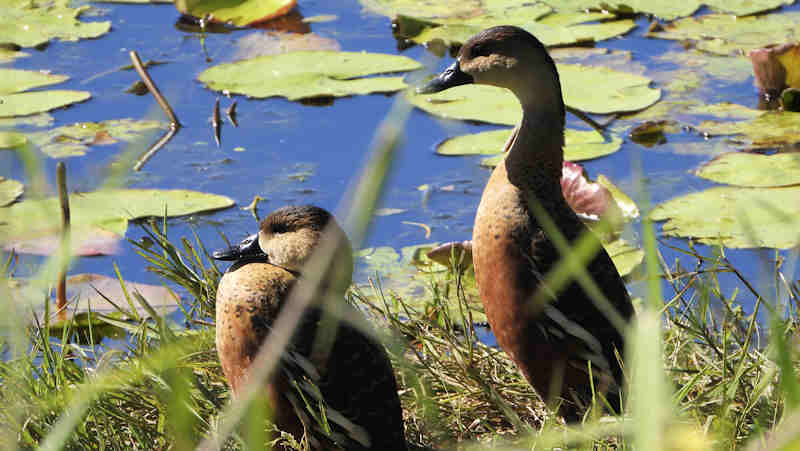
The Wandering Whistling Duck, Dendrocygna arcuata, is a medium-sized whistling duck of the family Anatidae. It is recognised by its rich red-brown plumage, elongated neck, distinctive flank plumes and clear whistling calls. The species is widely distributed across parts of Indonesia, the Philippines, Papua New Guinea, northern and eastern Australia and some Pacific islands.
Physical Description
The Wandering Whistling Duck measures approximately 55–60 centimetres in length. Adults have predominantly rich red-brown plumage, with a paler face, front of the neck and upper breast. A dark stripe extends over the crown, nape and back of the neck. The bill and legs are dark, while the elongated flank feathers are mostly off-white with chestnut edges.
In flight, the species shows dark underwings, cinnamon and chestnut underbody plumage, a white undertail and legs projecting beyond the tail. Males and females are broadly similar in appearance, and reliable field separation by sex is generally difficult. Age-related plumage differences are not sufficiently distinctive for routine field identification.
Range and Habitat
The species occurs from Indonesia and the Philippines eastwards through Papua New Guinea and the Pacific, and southwards into Australia. In Australia, it is mainly found across the northern and eastern parts of the country, from the Kimberley region across the Top End and into south-eastern New South Wales. It may occur farther south as a vagrant.
Wandering Whistling Ducks favour deep, vegetated lagoons and swamps, flooded grasslands, floodplain wetlands and other shallow to moderately deep freshwater habitats. They also use ricefields, irrigated land, pastures, grain stubbles and artificial waterbodies where suitable food is available.
The species is not a strict long-distance migrant. Its movements are often nomadic or dispersive, responding to rainfall, changing water levels and food availability. In northern Australia, flocks may leave dry-season refuges beside permanent water and disperse to temporary inland swamps and coastal wetlands after rain.
Behaviour and Diet
Wandering Whistling Ducks are highly social. Outside the breeding period, they may gather in flocks numbering hundreds or, under favourable conditions, thousands of birds. They may also associate with Plumed Whistling Ducks (Dendrocygna eytoni).
The species is mainly active during the day, although activity patterns may vary with temperature and local conditions. During hot periods, birds may rest in shaded vegetation or on the water. Their calls include shrill, twittering whistles, and airborne flocks can be particularly noisy.
The diet consists mainly of aquatic vegetation and seeds. Birds also take young grass, the bulbs of rushes, other wetland herbage, insects and small aquatic animals. Flocks may forage closely together, with birds at the front diving or disturbing vegetation while others follow. Cooperative surface-foraging behaviour has also been recorded, although the details of this behaviour remain comparatively poorly documented.
Breeding is generally associated with the wet season, when water and food are more readily available. In northern Australia, breeding has been recorded from approximately January to April. The nest is a shallow scrape placed above the expected level of rising floodwater and concealed in tall grass or shrubbery, with grass used as lining material. Clutch sizes of about 8–12 eggs have been reported, but detailed information on incubation and brooding remains limited. The species is considered monogamous, and pair bonds may persist for long periods. Ducklings are precocial and can move and feed soon after hatching under parental supervision.
Identification Tips
Look for a large, long-necked duck with an overall red-brown appearance, a noticeably paler face and upper breast, and dark markings along the crown and back of the neck. The pale, chestnut-edged flank plumes are especially useful at close range. In flight, dark underwings, a white undertail and trailing dark legs are helpful features.
The most likely confusion species in Australia is the Plumed Whistling Duck. Both species can occur in large mixed flocks, but the Wandering Whistling Duck is generally richer red-brown overall and has a paler face and upper breast with a prominent dark crown and nape stripe. Care should be taken when identifying distant birds, particularly in strong sunlight or among dense wetland vegetation.
The species is also readily detected by its repeated whistling calls, especially when a flock is flying or regrouping.
Conservation Status
The Wandering Whistling Duck is currently assessed as Least Concern on the IUCN Red List. This global category does not mean that every population is secure. Local populations may be affected by the loss, drainage or degradation of wetlands, changes to floodplain water regimes, agricultural and urban development, pollution and disturbance.
The species’ use of ricefields, irrigated land and artificial waterbodies can provide additional habitat, but these areas may also expose birds to altered water management, contaminants and conflict with agricultural activities. Important conservation measures include protecting permanent and seasonal wetlands, maintaining natural flooding patterns where possible, reducing pollution and ensuring that wetland development is carefully assessed. Continued monitoring is important because movements and population trends are not equally well documented across the entire range.
Frequently Asked Questions
Where can the Wandering Whistling Duck be found?
It occurs across parts of Indonesia, the Philippines, Papua New Guinea, northern and eastern Australia and some Pacific islands. In Australia, it is most common in the north and east, with occasional records farther south.
What habitat does the Wandering Whistling Duck prefer?
It prefers vegetated lagoons, swamps, flooded grasslands, floodplain wetlands and ricefields. It also uses irrigated land, pastures, grain stubbles and permanent artificial waterbodies when suitable food and shelter are available.
What does the Wandering Whistling Duck eat?
Its diet is dominated by aquatic plants and seeds. It also eats young grass, rush bulbs, other wetland vegetation, insects and small aquatic animals.
Is the Wandering Whistling Duck migratory?
It is better described as nomadic or dispersive than as a strict long-distance migrant. Flocks move in response to rainfall, changing water levels and the availability of food and suitable wetlands.
How can the Wandering Whistling Duck be identified?
Look for its rich red-brown body, paler face and upper breast, dark crown and nape stripe, dark bill and legs, and pale flank plumes edged with chestnut. Its repeated whistling calls are also distinctive.
Is the Wandering Whistling Duck endangered?
No. The species is currently listed as Least Concern globally. Nevertheless, wetland drainage, habitat degradation, altered water regimes, pollution and development can create local conservation pressures.
References
- BirdLife International. 2026. “Wandering Whistling-duck Dendrocygna arcuata Species Factsheet.” BirdLife DataZone. Accessed 8 September 2026. https://datazone.birdlife.org/species/factsheet/wandering-whistling-duck-dendrocygna-arcuata
- Gill, F., D. Donsker and P. Rasmussen, eds. 2026. IOC World Bird List, version 15.2. International Ornithologists’ Union. Accessed 8 September 2026. https://www.worldbirdnames.org/
- The Australian Museum. 2024. “Wandering Whistling-Duck.” Australian Museum, updated 25 July 2024. Accessed 8 September 2026. https://australian.museum/learn/animals/birds/wandering-whistling-duck/
- Parks Australia. n.d. “Wandering Whistling Duck.” Kakadu National Park. Accessed 8 September 2026. https://kakadu.gov.au/discover/nature/birds/wandering-whistling-duck/
- Wetlands International. n.d. “Waterbird Population Estimates.” Waterbird Population Portal. Accessed 8 September 2026. https://wpp.wetlands.org/data/SP
- Australian Bird Study Association. 2024. “Communal Cooperative Foraging from the Surface of Water by Wandering Whistling-Duck Dendrocygna arcuata.” Australian Field Ornithology 41: 4–5. Accessed 8 September 2026. https://afo.birdlife.org.au/afo/index.php/afo/article/download/2316/2344
Related posts