The Barred Forest Falcon: A Stealthy Predator of the Neotropics
The Barred Forest Falcon (Micrastur ruficollis) is a fascinating bird of prey found predominantly in the dense forests of Central and South America. Despite its elusive nature, this raptor plays a critical role in its ecosystem as a stealthy and efficient predator. This article delves into the intriguing characteristics, behavior, and conservation status of the Barred Forest Falcon.
Taxonomy and Description
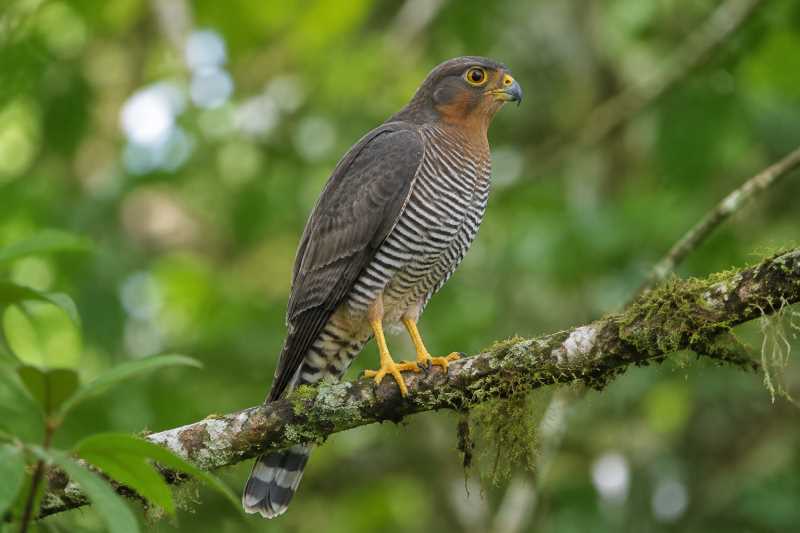
The Barred Forest Falcon belongs to the family Falconidae, which includes other falcons and caracaras. It falls within the genus Micrastur, which is known for forest-dwelling raptors that exhibit unique adaptations for life in densely wooded habitats. The species name ‘ruficollis’ translates to ‘red-necked’, reflecting the distinctive rufous coloring around its neck.
Physically, the Barred Forest Falcon is a medium-sized bird, measuring between 30 to 38 centimeters in length. Its plumage is predominantly dark, with a slate-gray or brownish back and wings, contrasted by a lighter, barred pattern on its underparts. This cryptic coloration provides excellent camouflage within the forest understory. The bird’s sharp, hooked beak and strong talons are well-adapted for capturing and subduing prey.
Distribution and Habitat
The Barred Forest Falcon’s range extends from southern Mexico through Central America and into northern Argentina and southeastern Brazil. It is primarily associated with humid lowland forests, but can also be found in montane and secondary forests, as well as some woodland edges.
Its preference for dense, mixed forests is closely linked to its hunting strategy. The bird relies heavily on cover provided by the thick canopy and underbrush to ambush prey. This habitat preference makes it susceptible to deforestation and habitat fragmentation, which pose significant threats to its populations.
Behavior and Diet
Barred Forest Falcons are known for their secretive and solitary nature, which makes them challenging to observe in the wild. They are primarily crepuscular, being most active during the early morning and late afternoon. Despite their elusive behavior, they are vocal birds, often communicating through a series of high-pitched whistles and calls.
The diet of the Barred Forest Falcon is diverse, comprising small mammals, birds, reptiles, and insects. It is an opportunistic hunter, often taking advantage of the element of surprise to capture prey. Its hunting technique involves perching silently on a low branch or tree trunk, scanning the forest floor and understory for movement. Upon spotting potential prey, the falcon swiftly descends with precision and speed.
Reproduction and Lifespan
The breeding season for Barred Forest Falcons varies with geographic location but generally occurs during the dry season when prey is more abundant. The species is known for nesting in tree cavities, where the female lays a clutch of 2 to 3 eggs. Both parents participate in incubating the eggs and feeding the chicks.
Chicks fledge approximately five weeks after hatching but remain dependent on their parents for several weeks post-fledging. The average lifespan of Barred Forest Falcons in the wild is not well-documented but is estimated to be around 10 to 15 years, given the typical lifespan of similar-sized raptors.
Conservation Status
The International Union for Conservation of Nature (IUCN) currently classifies the Barred Forest Falcon as a species of Least Concern. However, ongoing threats such as habitat destruction due to logging, agriculture, and urban expansion could impact its populations in the future.
Conservation efforts aimed at preserving large tracts of forest and maintaining ecological corridors are essential to ensure the long-term survival of the Barred Forest Falcon. Research initiatives focused on understanding the species’ ecology, population dynamics, and responses to environmental changes are crucial for informing effective conservation strategies.
Conclusion
The Barred Forest Falcon remains an enigmatic yet vital component of neotropical ecosystems. Its role as a predator helps maintain ecological balance by regulating prey populations. As human activities continue to alter natural landscapes, understanding and preserving the habitats of such species become increasingly important. By fostering awareness and supporting conservation efforts, we can help ensure that the Barred Forest Falcon and its forest home continue to thrive for generations to come.
Related posts